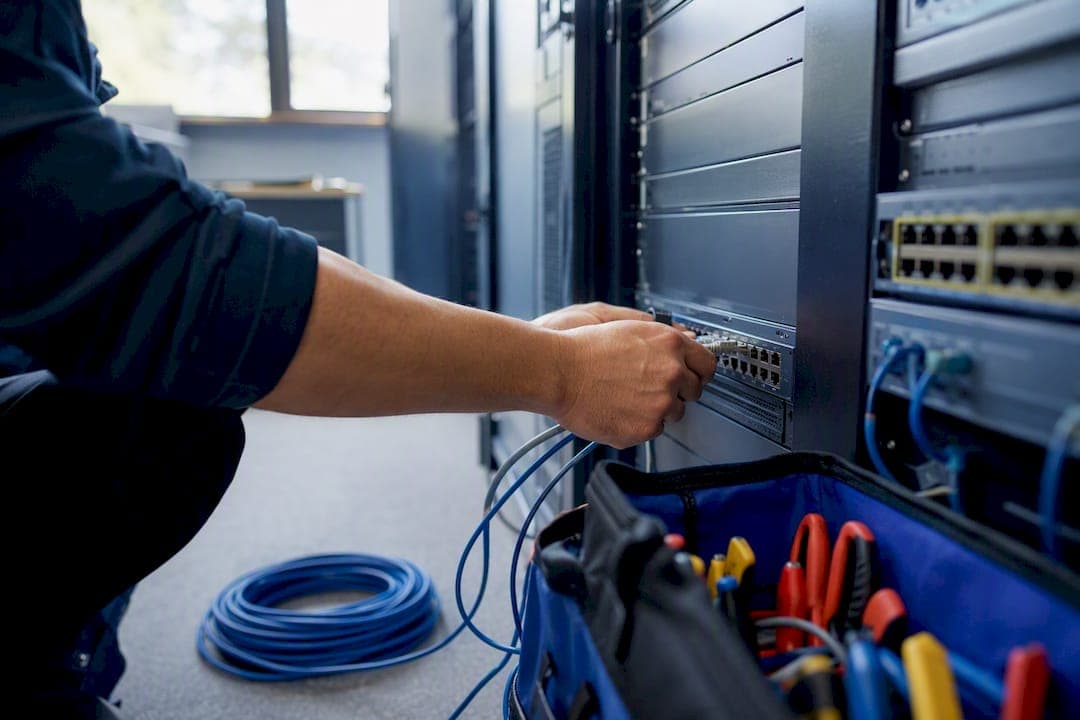
Deploy an AI-powered, telemetry-first troubleshooting stack that pairs streaming router telemetry, anomaly detection, and an isolated out-of-band management plane, then stage automation from advisory to autonomous. This is the fastest, safest path to cutting mean time to repair (MTTR) and building self-healing networks across distributed sites. It requires NetFlow/sFlow/IPFIX telemetry, a platform like Netverge, and governance aligned to standards from bodies such as the IETF.
Your first three moves:
- Enable streaming telemetry and syslog forwarding across every managed router.
- Confirm out-of-band console access works independently of the production path.
- Pick one pilot KPI (usually MTTR) and baseline it before turning anything on.
Pro Tip: Don't automate remediation before you've validated your out-of-band path. If the management plane depends on the same router that's failing, you've built a system that can't reach itself when it matters most.
Key Takeaways
Reliable AI-powered router troubleshooting depends on rich telemetry, gated automation, an independent out-of-band management plane, and KPIs tracked from a pilot before any fleet-wide rollout.
| Point | Details |
|---|---|
| Telemetry comes first | Enable NetFlow, sFlow, streaming telemetry, and syslogs before enabling any AI workflow. |
| Stage automation | Move from monitoring to RCA to advisory automation before allowing autonomous remediation. |
| Out-of-band access is mandatory | Validate an independent management path before enabling any automated remediation action. |
| MTTR is the core pilot KPI | Baseline mean time to repair before the pilot and measure reduction throughout. |
| Netverge maps directly to this stack | Netverge combines streaming telemetry, knowledge graphs, and gated autonomous agents for MSPs and multi-site enterprises. |
Table of Contents
- What Does Troubleshooting Routers with AI Actually Mean?
- What Telemetry Do You Need to Make Automation Reliable?
- Which Capabilities Should You Require from an AI Platform?
- How Should You Architect the Deployment?
- How Do You Run a Pilot and Prove It Worked?
- What Changes for Your Team and Your Runbooks?
- What Security and Governance Controls Does Autonomous Remediation Need?
- What Drives Cost and Timeline for a Rollout?
- How Netverge Maps to These Requirements
- Ready to Pilot AI-Powered Router Troubleshooting?
- Frequently Asked Questions
- Sources
What Does Troubleshooting Routers with AI Actually Mean?
For MSPs and multi-site enterprises, AI-powered router troubleshooting means automated diagnostics, anomaly detection, root cause analysis (RCA), and optional autonomous remediation applied to enterprise router fleets, not a reboot-your-modem checklist for a home network.
The operational payoff shows up fast:
- Lower MTTR because correlation happens in seconds instead of during a call escalation.
- Fewer truck rolls when issues get fixed or scoped remotely before a technician is dispatched.
- Automated ticket triage that routes the right incident to the right engineer with context attached.
This is not consumer Wi-Fi troubleshooting. It's a fleet-scale operational discipline for teams managing hundreds or thousands of routers across sites.
What Telemetry Do You Need to Make Automation Reliable?
Automation is only as good as the data feeding it. AI models trained on thin or inconsistent telemetry produce generic, low-value insights instead of accurate root cause analysis, so the data layer deserves as much planning as the AI layer itself.
Prioritize these sources before you turn on any automated workflow:
- Streaming telemetry (gNMI/gRPC) for real-time state changes
- NetFlow/IPFIX and sFlow for traffic and flow-level visibility
- Syslogs and SNMP traps for event and fault signals
- Interface counters, CPU/memory metrics, and routing tables (BGP/OSPF updates)
- Configuration snapshots for drift detection
| Telemetry Source | Primary Troubleshooting Value |
|---|---|
| NetFlow/IPFIX | Flow-level congestion and traffic anomaly detection |
| sFlow | Sampled traffic visibility at high speed with low overhead |
| Syslogs/SNMP traps | Event correlation and fault signaling |
| Streaming telemetry (gNMI) | Sub-second state changes for real-time anomaly detection |
| Configuration snapshots | Drift detection against approved baselines |
Pro Tip: Start with 30 to 90 days of enriched, retained telemetry before you let any model set baselines. A model trained on a week of quiet traffic will flag your first busy Monday as an anomaly.
Which Capabilities Should You Require from an AI Platform?
Evaluation teams need a requirements checklist that separates genuine platform capability from a dashboard with an AI label bolted on. AI network monitoring correlates flows, logs, and tracing data in real time to detect network anomalies and predict failures, and that correlation depth is the differentiator worth testing in a proof of concept.
Require these capabilities at minimum:
- Real-time anomaly detection across multi-source telemetry
- Cross-source correlation and automated RCA
- Remediation with safety gates, not blind auto-execution
- Change-drift detection against approved configuration intent
- Knowledge graph and runbook integration for context-aware triage
- Multi-tenant, role-based access for MSP environments
- Southbound support for SSH, NETCONF, REST, and legacy CLI
| Capability | Impact on MTTR | Impact on Analyst Workload |
|---|---|---|
| Anomaly detection | High reduction | Fewer false escalations |
| Automated RCA | High reduction | Cuts manual log correlation |
| Gated remediation | Moderate reduction | Shifts work to approval, not execution |
| Drift detection | Prevents incidents | Reduces unplanned change tickets |
Confirm northbound API support for your ITSM platform before signing anything. Triage that can't create or update a ticket automatically just adds another screen to check.
How Should You Architect the Deployment?
The pattern that scales across many sites and mixed router vendors runs telemetry collectors into a stream processing and AI layer, then into a decision engine, with an independent out-of-band management plane sitting alongside it for recovery access. Skip the out-of-band leg and you inherit the same failure that breaks VPNs and jump hosts at scale: the moment production routing fails, so does your path to fix it.
Work through this integration checklist before go-live:
- Deploy southbound collectors on every router, including branch and edge devices.
- Provision mutual TLS certificates for collector-to-platform authentication.
- Normalize syslog formats across router vendors so correlation logic doesn't break on vendor-specific fields.
- Set up identity and role-based access control before any team gets platform access.
- Connect an ITSM connector for bidirectional ticket sync.
- Wire in zero-touch provisioning (ZTP) hooks for new site onboarding.
- Validate out-of-band console reachability, ideally over cellular or a secondary ISP, at every site.
Pro Tip: Test the out-of-band path by simulating a full production outage at one site before rollout, not after. If your engineer can't reach the router when the primary path is down, no amount of AI correlation upstream will matter.
How Do You Run a Pilot and Prove It Worked?
A disciplined pilot runs six to twelve weeks, starts with five to fifteen sites, and stages feature enablement in order: monitoring first, then RCA, then advisory automation, then gated remediation last. Autonomous network capabilities tend to deliver ROI faster than other AI use cases because they cut outages and manual effort directly, which is why MTTR is the metric most pilots should anchor to.
- Baseline current MTTR, incident volume, and mean time to detect (MTTD) before enabling anything.
- Enable monitoring and correlation only, and measure MTTD improvement for two to three weeks.
- Turn on advisory RCA and track analyst time saved per incident.
- Enable gated autonomous remediation on low-risk incident types only.
- Set go/no-go criteria: target a meaningful MTTR reduction, a low false-positive rate, and a high success rate on autonomous actions before expanding scope.
Build rollback steps into every stage, not just the last one. A pilot that can't unwind a bad automated action isn't a pilot, it's a liability.
What Changes for Your Team and Your Runbooks?
Runbooks need to show explicitly where AI suggests an action and where a human approves it, especially early on. AI-driven platforms now automate anomaly detection, event correlation, ticketing, and remediation workflows, which shifts NOC work from manual triage toward oversight and exception handling.
Map roles clearly:
- NOC engineer: monitors advisory recommendations and approves low-risk actions.
- Automation owner: maintains playbooks and tunes model thresholds.
- Change approver: signs off on any remediation touching production routing.
- Security reviewer: audits agent permissions and access scope quarterly.
Pro Tip: Run tabletop exercises where engineers watch the AI recommend a fix without executing it. Trust in autonomous action builds faster when your team sees the reasoning first, not just the result.
What Security and Governance Controls Does Autonomous Remediation Need?
Autonomous remediation without governance is how a small anomaly becomes a multi-site outage. Build these controls in before you expand automation scope:
- Role-based access control scoped tightly to each automation agent's function
- Immutable audit logs for every automated action taken
- Signed playbooks so remediation logic can't be altered without review
- Approval gates on any action touching production routing or firewall rules
- Least-privilege credentials for every agent, never shared admin access
- Encryption in transit and at rest for all collected telemetry
Out-of-band management isn't optional once remediation goes autonomous. It's the independent path that keeps your team in control when the automated system needs a human to step in, and losing it means losing the ability to intervene at the worst possible moment.
What Drives Cost and Timeline for a Rollout?
Budget conversations should separate licensing (per-device, per-site, or per-agent), telemetry storage and egress, edge hardware, and integration effort. Fragmented connectivity models tend to be the hidden cost driver in multi-vendor environments, since inconsistent provisioning multiplies support burden over time.
- Licensing model: confirm whether pricing scales per device, per site, or per deployed agent.
- Storage and egress: telemetry retention adds up fast at scale, so ask about compression and sampling.
- Edge hardware: confirm what's included versus billed separately.
- Integration effort: this is where most rollout budgets actually get spent, not in software licensing.
- Ask for SLAs specific to autonomous actions, not just uptime.
- Ask for evidence of safe remediation in production, not just lab demos.
- Confirm what pilot support is included before committing to a paid tier.
How Netverge Maps to These Requirements
Netverge was built around the exact stack this playbook describes: streaming telemetry ingest, anomaly detection, knowledge graphs, and autonomous agents, backed by Vergepoint edge hardware for on-site visibility where software alone can't see.
| Requirement | Netverge Capability |
|---|---|
| Streaming telemetry and flow data | Native ingest with intelligent sensors per Vergepoint |
| Cross-source correlation and RCA | Knowledge graph correlates telemetry, logs, and config state |
| Gated autonomous remediation | Autonomous agents with approval workflows built in |
| Multi-tenant, role-based access | Native multi-tenant management for MSP environments |
| ITSM and ticketing integration | AI-powered ticket triage with automated context |
Consider a multi-location retail chain running network anomaly detection across dozens of branch routers. Before automation, a routing anomaly at one site meant a support call, a manual log pull, and a truck roll to confirm the fix. With streaming telemetry and gated remediation in place, the same class of incident gets flagged, correlated, and resolved or escalated with full context, often before a store manager notices anything.
If your team is still triaging incidents by scrolling through disconnected logs, an AI network monitoring platform built for MSPs is the next logical step, not a leap.
Why the Shift to Autonomous Troubleshooting Actually Matters
The real change isn't that AI fixes routers faster. It's that engineers stop spending their day firefighting and start spending it on governance, playbook design, and deciding what "safe to automate" actually means for their environment. That's a better use of a skilled network engineer than chasing the same flapping interface for the third time this month. Autonomous network capabilities are already showing faster ROI than most other AI use cases in networking, and the teams getting there first are treating it as an operating model change, not a tool purchase.
Ready to Pilot AI-Powered Router Troubleshooting?
Netverge runs pilots scoped to your actual environment, typically five to fifteen sites, six to twelve weeks, with Vergepoint hardware, full platform access, and onboarding support included so your team isn't building the integration layer from scratch.
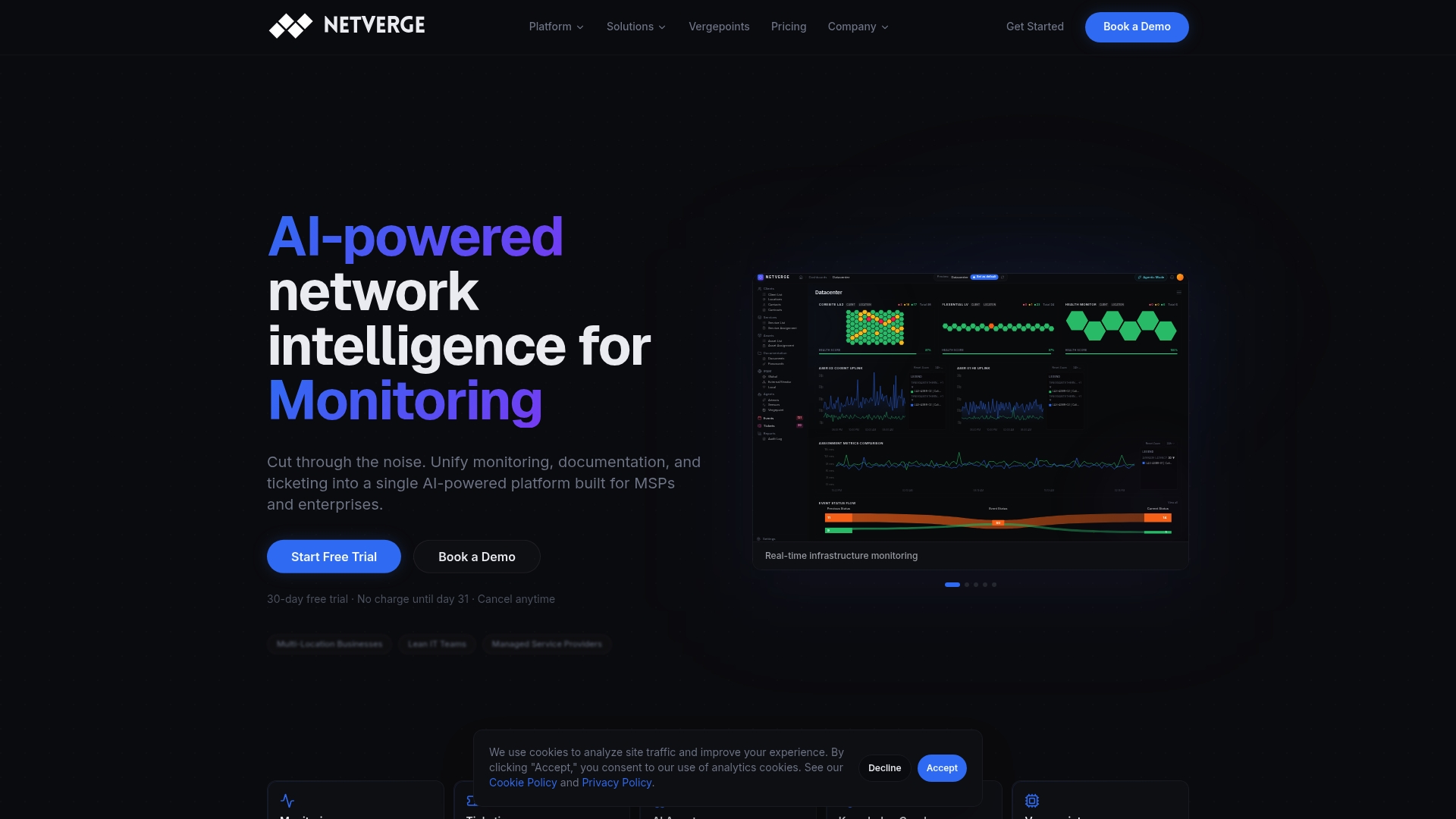
The KPI to watch during that window is MTTR. If your pilot doesn't move that number, nothing else about the platform matters. Netverge gives MSPs and multi-site enterprises a unified path from streaming telemetry to gated autonomous remediation, without stitching together five disconnected tools first. Visit the Netverge monitoring platform to scope a pilot for your fleet, or start with a broader look at the full platform if you're still comparing approaches.
Frequently Asked Questions
What is the fastest way to start troubleshooting routers with AI? Enable streaming telemetry and syslog forwarding first, confirm out-of-band access works, then run monitoring-only mode for two to three weeks before adding RCA or remediation.
Does AI-powered router troubleshooting replace NOC engineers? No. It shifts their focus from manual log correlation toward approving automated actions, tuning playbooks, and managing exceptions that the platform escalates.
How long should a pilot run before expanding to more sites? Six to twelve weeks is typical, staged from monitoring through advisory automation to gated remediation, with clear go/no-go criteria at each stage.
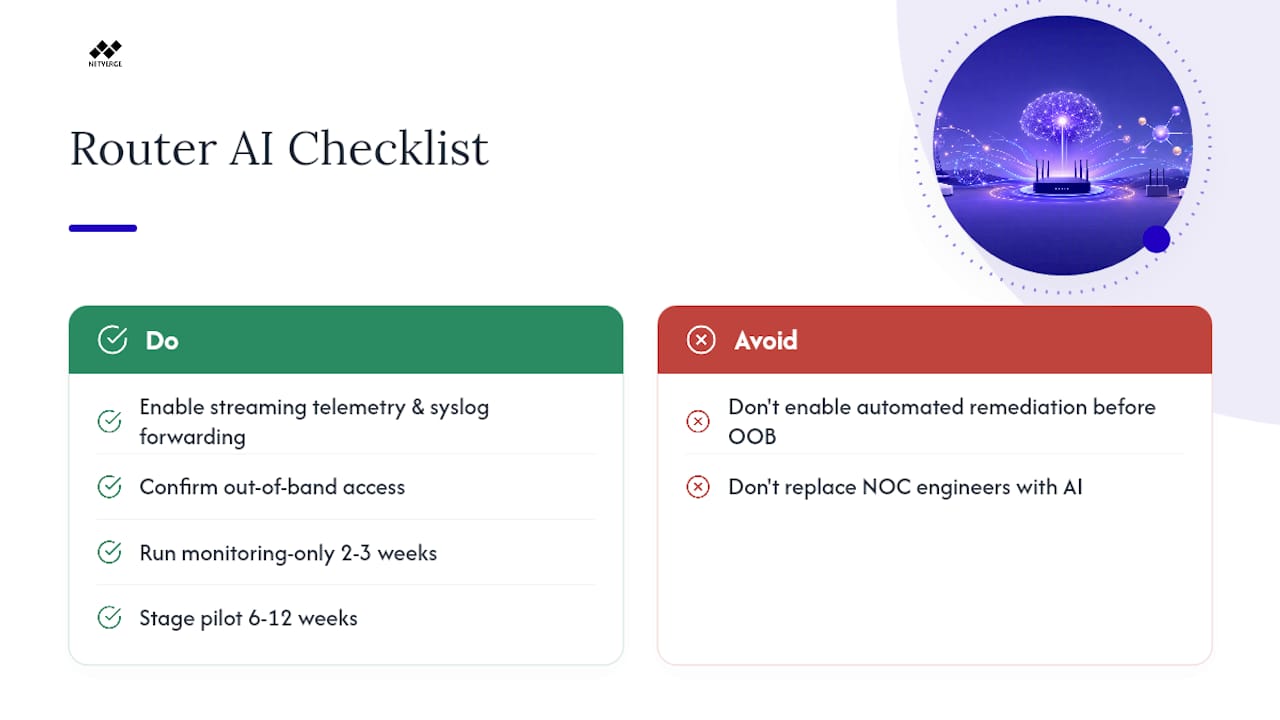
What's the biggest risk in deploying autonomous remediation? Enabling automated actions before validating out-of-band management access. If the primary network fails, your team needs an independent path to intervene.
Sources
- How AI is being used to manage networks | Computer Weekly
- Why VPNs and Jump Hosts Fail MSPs at Scale, And How To Fix It - ZPE Systems
- Why MSP Deployment Breaks with Fragmented Connectivity
This list is a reading resource, not a vendor comparison.