
AI ticket deduplication merges duplicate monitoring alerts into a single operational incident using topology, entity context, and policy-driven rules. The result: fewer redundant tickets, faster triage, and full auditability. NIST research backs the approach, and platforms like Netverge already apply it in production for MSP network operations.
TL;DR:
- Accurate deduplication requires carefully mapping your grouping keys and running in shadow mode for several weeks to ensure low false-merge and missed-merge rates.
- Preserving original alert data and creating an audit trail are essential for compliance, forensics, and undoing incorrect merges in the future.
- Using topology and knowledge graphs alongside traditional text matching reduces errors and improves the reliability of alert correlation at scale.
- Merging related alerts into one incident reduces clutter, but suppression should be used only for repeated identical alerts to prevent conflating distinct incidents.
- Netverge offers topology-aware AI deduplication tailored for MSPs, with features supporting safety testing, detailed auditing, and reversible merges.
Table of Contents
- How Does Ticket Deduplication AI Work for Network Monitoring?
- How Should You Roll Out AI Deduplication Safely?
- Why You Must Preserve Raw Alerts and Child Data
- What Metrics Prove Deduplication Is Working?
- Integration Checklist for Deduplication and Existing Tools
- What Practitioners Get Wrong About Deduplication
- Netverge: Topology-Aware Deduplication Built for MSP Operations
- Sources
- FAQ
How Does Ticket Deduplication AI Work for Network Monitoring?
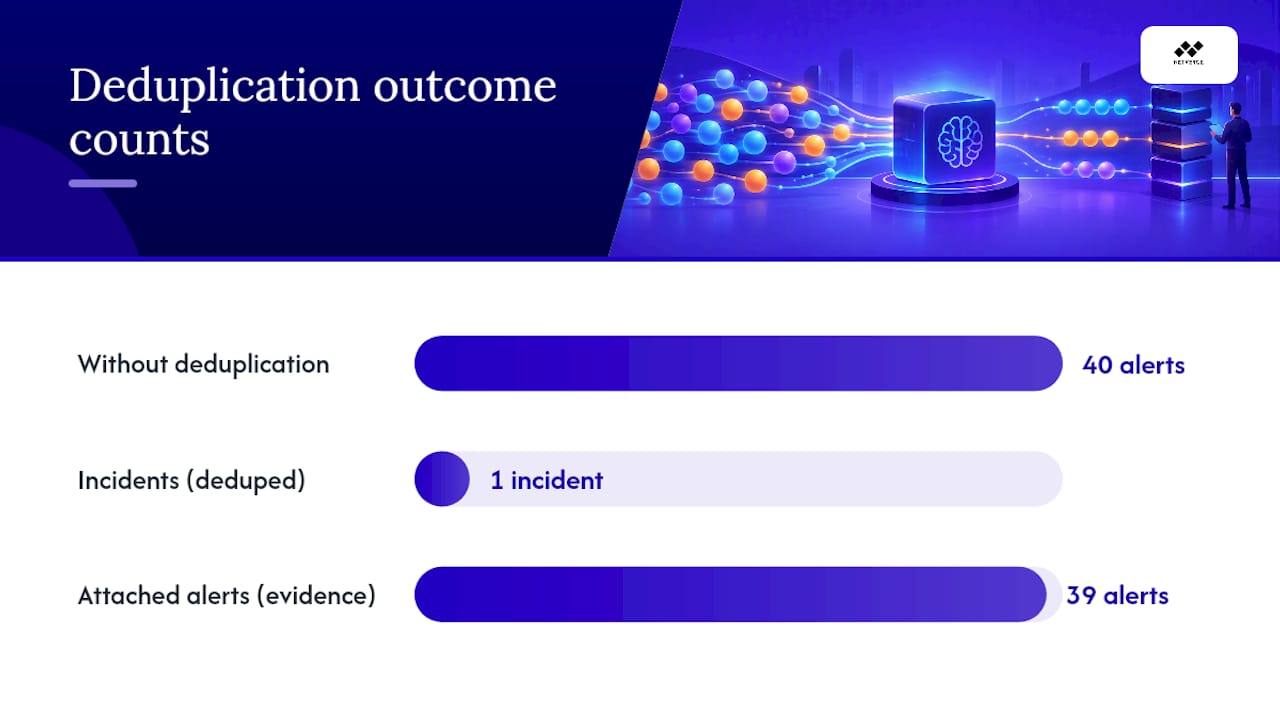
A router flaps, and your monitoring stack fires 40 alerts in three minutes: interface down, BGP session lost, latency spikes, dependent service warnings. Without deduplication, that becomes 40 tickets. With it, that becomes one incident, with the other 39 alerts attached to it as evidence.
The mechanism starts with dedup keys. Most systems build a composite key from fields like resource name, alert classification, and condition, then apply a time window. IBM's documentation gives a concrete example: alerts sharing the same resource within a short configurable time window get correlated into one record instead of spawning duplicates. That's the baseline layer, and it catches the obvious cases.
The harder cases need topology. Two alerts with completely different text (a switch port error and a downstream application timeout) can be the same incident if your knowledge graph knows the application depends on that switch. NIST's research on adaptable AI assistants for network management found that combining large language model retrieval with knowledge-graph context prevents the errors that plague text-similarity-only matching, since duplicate symptoms and genuinely separate incidents often read almost identically in plain text.
For scale, aggregation algorithms matter. Grouping thousands of alerts per minute with naive pairwise comparison is computationally expensive. NIST's hypergraph and Hamming-distance research shows aggregation methods that stay lossless (nothing gets discarded) while running far faster than brute-force comparison, which is what makes streaming deduplication viable at MSP scale.
The building blocks you should expect in any serious deduplication engine:
- Field-based dedup keys combining resource, classification, condition, and timestamps
- Topology and CMDB mapping to link alerts sharing a failing upstream dependency
- Grouping algorithms tuned for speed without losing original alert data
- LLM and knowledge-graph hybrids that reason across documentation, not just alert text
Grouping and suppression solve different problems, and conflating them causes real damage. Grouping consolidates related alerts into one incident so an analyst sees the full picture. Suppression (also called throttling) blocks repeated firing of the same alert for a defined window, per Google Security Operations documentation. Use grouping when multiple distinct signals share a root cause. Use suppression when one flapping sensor keeps re-triggering the identical condition.
How Should You Roll Out AI Deduplication Safely?
Every MSP that has automated deduplication in production started the same way: not automated. You build trust in the model's judgment before letting it touch ticket creation.
- Map your dedup keys first. Decide which fields (resource, classification, condition, tenant) compose the grouping key before you write a single rule.
- Run in shadow mode. Let the engine propose merges without executing them. Sample a stratified set across tenants and alert types, then measure how many proposed merges were correct versus false or missed.
- Set policy boundaries. Define the grouping window, tenant scoping (never merge across client boundaries), and a max-alerts-per-incident cap so one bad rule doesn't swallow unrelated tickets.
- Add human review gates. Route uncertain merges to an analyst queue rather than auto-approving everything above a confidence threshold.
- Promote to auto-create gradually. Once false-merge rates hold steady below your acceptance threshold across multiple sampling cycles, allow the highest-confidence rule categories to auto-create incidents.
Streaming aggregation (real time, alert by alert) suits high-volume MSP environments; batch aggregation (processed on intervals) works fine for smaller networks where a few minutes of latency costs nothing. Tune thresholds based on which mode you run.
Pro Tip: Start shadow mode with your noisiest client, not your calmest one. A quiet network won't generate enough duplicate volume to tell you anything about your dedup key's accuracy within a reasonable timeframe.
Why You Must Preserve Raw Alerts and Child Data
Deduplication should compress what an analyst sees, never what the system stores. Merge alerts into one incident view, but keep every original alert payload, timestamp, source monitor ID, and device identity intact underneath it. This isn't optional housekeeping. It's what makes vendor escalation, compliance audits, and forensic troubleshooting possible after the fact.
Practical requirements for any deduplication system you adopt:
- Parent incidents must reference child alerts, not replace them
- Original payloads stay queryable, even months later
- Merges need an audit trail showing what was combined, when, and by which rule
- Reversibility matters. If a rule misfires and merges two unrelated incidents, you need a clean way to undo it
Design the parent incident record with a reconstruction path back to every source alert. That single design choice separates a deduplication system you can trust from one you'll eventually stop believing.
What Metrics Prove Deduplication Is Working?
Two categories of KPIs matter, and MSPs that only track one miss half the picture.
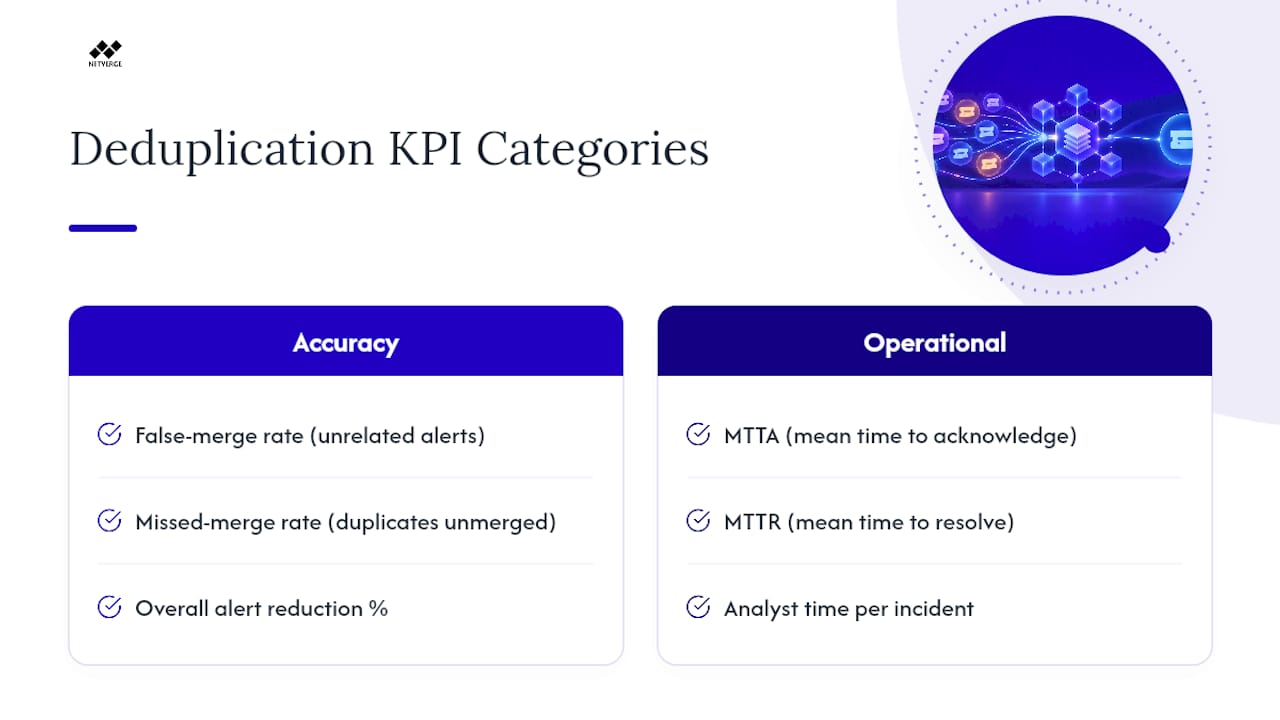
Accuracy KPIs tell you whether the model is making good decisions: false-merge rate (unrelated alerts combined), missed-merge rate (duplicates that should have merged but didn't), and overall alert reduction percentage.
Operational KPIs tell you whether accuracy translates into business value: mean time to acknowledge (MTTA), mean time to resolve (MTTR), and analyst time spent per incident.
During shadow mode, sample a fixed percentage of proposed merges each week (stratified across tenants and alert categories) and have a senior analyst manually verify them. Set your acceptance threshold before you start, not after you see the numbers, or you'll unconsciously grade on a curve.
Validate no data loss with reconstruction checks: pick a merged incident at random and confirm every child alert is still retrievable with its original metadata. If reconstruction fails even once, pause auto-promotion until the audit trail is fixed.
Integration Checklist for Deduplication and Existing Tools
Connecting AI deduplication to your existing monitoring and ticketing stack requires a few concrete pieces before it works reliably.
Inputs the engine needs:
- A normalized alert schema across all monitoring sources
- A
sourceGroupIdentifieror equivalent grouping entity field, as Google Security Operations documents - Topology or CMDB links tying devices to dependencies
- Consistent device identity fields across every data source
Outputs the engine must produce:
- Parent incident API support with child-alert references
- Detailed, timestamped audit logs for every merge decision
Policy artifacts to prepare in advance: dedup key mapping, suppression windows, tenant scoping rules, and rollback controls.
Pro Tip: Build your rollback control before your auto-promotion rule, not after. Teams that reverse the order almost always discover the rollback gap during an actual incident, which is the worst possible time to learn it.
Test with shadow-run sampling, manual verification against known incidents, and clearly defined autopromotion criteria before flipping any rule to live. Netverge's ticket triage process maps directly onto this sequence.
What Practitioners Get Wrong About Deduplication
Aggressive merging feels great in a demo and terrible in production. Merge too eagerly and you'll bury a genuinely separate incident inside a parent ticket, delaying detection of a second problem that just happens to look similar. Merge too conservatively and you're back to alert fatigue, the exact problem you set out to fix.
The biggest pitfall I see is text-only matching dressed up as intelligence. Two alerts with similar wording aren't necessarily the same incident, and NIST's own research on this makes that point directly. The second pitfall is deleting or archiving child alerts after a merge, which destroys the audit trail the first time you actually need it for a vendor escalation. The third is rushing straight to auto-create because shadow mode felt slow. It isn't slow. It's the only phase where mistakes cost nothing.
Review your false-merge and missed-merge samples every two weeks during rollout, then quarterly once stable. Networks change, and static thresholds go stale.
— Jim
Netverge: Topology-Aware Deduplication Built for MSP Operations
Netverge is the alternative to stitching together a monitoring tool, a separate ticketing system, and a manual escalation spreadsheet. It replaces that fragmented setup with one platform where AI triage, knowledge graphs, and topology mapping already talk to each other, so deduplication decisions are grounded in real dependency data instead of alert text alone.
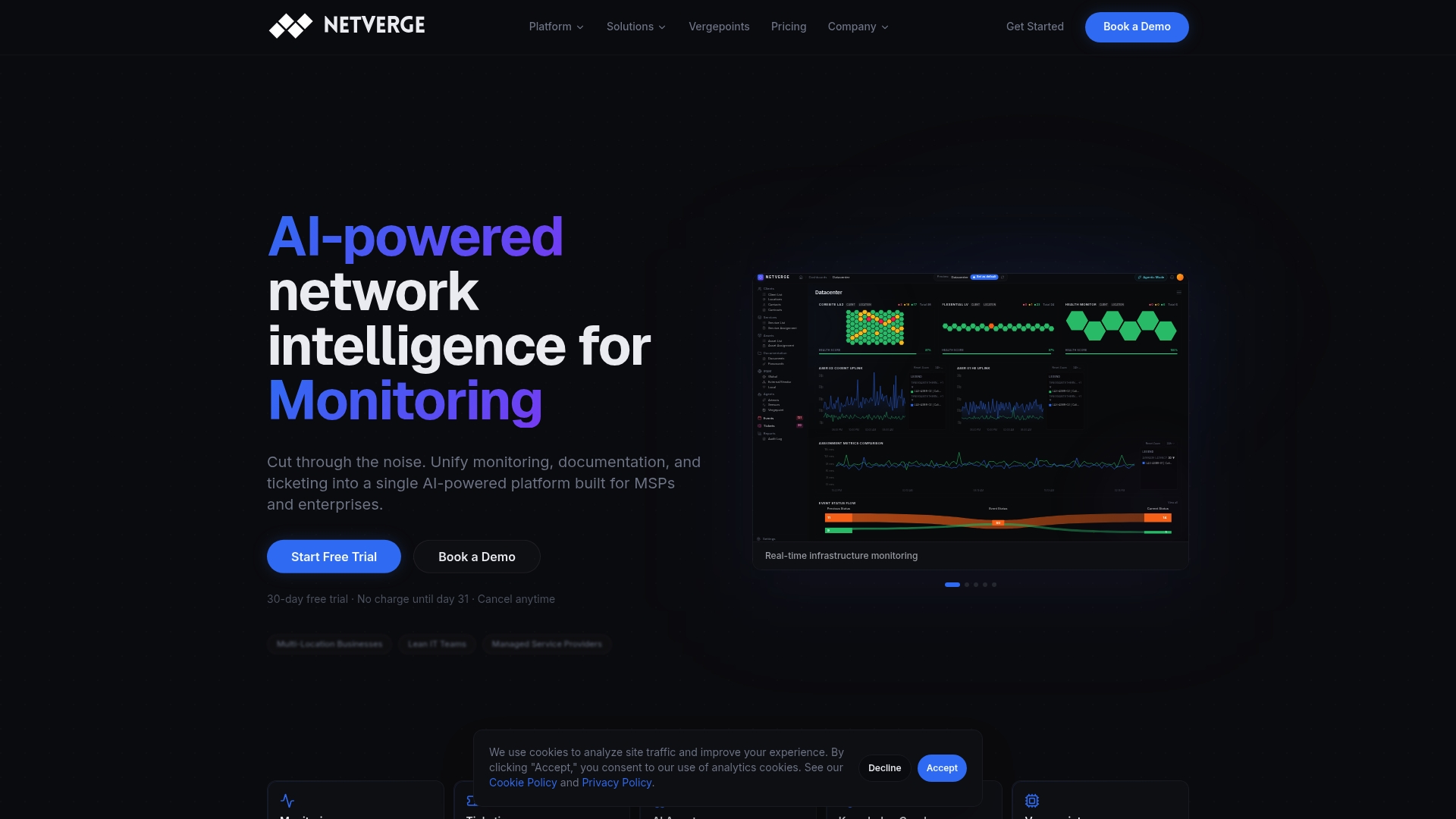
Vergepoint hardware feeds live topology context straight into the platform, giving the deduplication engine the same kind of dependency awareness NIST's research recommends. Every merge respects shadow mode by default: proposed groupings surface for review before anything auto-creates, and every child alert stays attached to its parent incident through Netverge's AI-powered ticketing module, fully auditable and reversible.
The Starter Package includes core monitoring, ticketing, and AI triage features as described throughout this guide. If you're managing multiple client networks and need topology-aware deduplication without building it from scratch, start a free trial or review the full pricing guide to size out sensors, sites, and AI agents for your environment.
Sources
- An Adaptable AI Assistant for Network Management | NIST
- NIST publication (alert aggregation / hypergraph algorithm)
- IBM documentation — deduplication and alert correlation
FAQ
What Is Ticket Deduplication AI?
Ticket deduplication AI is software that identifies monitoring alerts describing the same underlying network incident and merges them into one operational ticket instead of many. It relies on dedup keys, topology context, and grouping algorithms rather than simple text matching, as NIST's research recommends.
How Do You Merge Duplicate Tickets Without Losing Data?
Keep every original alert payload, timestamp, and device identity intact even after merging, and reference them from the parent incident rather than deleting them. This preserves the audit trail needed for vendor escalation and compliance review.
What's the Difference Between Grouping and Suppression?
Grouping combines multiple distinct alerts that share a root cause into one incident. Suppression, or throttling, blocks a single alert from re-firing repeatedly within a set window, per Google's documentation. They solve different problems and shouldn't be used interchangeably.
How Long Should Shadow Mode Run Before Automation?
Run shadow mode until your sampled false-merge and missed-merge rates hold steady across multiple sampling cycles and tenant types, not on a fixed calendar date. Most MSPs need several weeks of stratified sampling before promoting any rule category to auto-create.
Does Netverge Support Deduplication for Multi-Site MSP Networks?
Yes. Netverge combines AI triage, knowledge graphs, and Vergepoint hardware for topology context, and supports shadow-mode review before any auto-created incident. Pricing starts with the Starter Package at $299 per month, with additional sensors, sites, and AI agents available on the pricing guide.