
Autonomous IT agents are software systems that observe telemetry, reason about root cause, and take corrective action across your infrastructure without waiting on a human to click "approve" for every step. Deployed correctly, they cut manual L1 and L2 ticket volume by 30% to 40% and shrink time to resolution. The catch: none of that works without solid context engineering and governance, which we cover below.
TL;DR:
- Autonomous IT agents currently mainly operate in the execute stage, handling scoped remediation while humans oversee broader decisions.
- Key success depends on comprehensive context engineering, including telemetry, dependency maps, and a knowledge graph, to prevent confident incorrect actions.
- Proper governance involves least-privilege identities, audit trails, approval gates, blast-radius limits, and detailed decision metadata.
- Deployment should follow a phased approach: shadow mode, supervised execution, canary rollout, then controlled autonomous actions.
- Building a complete, accurate environment picture is crucial, with tools like Netverge's knowledge graph to minimize false positives and improve agent reasoning.
Table of Contents
- What Makes Autonomous IT Agents Different From Automation and Generative AI
- The Architecture Behind Reliable Agentic Operations
- What Ticket Reduction and ROI Actually Look Like
- Where Autonomous Agents Fail and How to Govern Around It
- A Phased Rollout Plan That Builds Trust Before Autonomy
- How Netverge Builds the Context Layer Agents Actually Need
- Three Priorities for IT Leaders Weighing Autonomous Agents
- Deploy Autonomous Agents on a Foundation That Already Knows Your Network
- Sources
What Makes Autonomous IT Agents Different From Automation and Generative AI
Traditional IT automation follows a script. If X happens, do Y. It's reliable and completely blind to anything outside its programmed condition. Generative AI, by contrast, is conversational. It drafts a response, summarizes a log file, or answers a question, but it doesn't act on your infrastructure on its own. Autonomous IT agents sit in a different category entirely: they perceive state, reason about what that state means, decide on a course of action, and execute it, then watch what happened next and adjust.
Most vendors and IT teams describe agent maturity as a ladder, and it's worth thinking in those terms when you're scoping a rollout:
- Observe — the agent ingests telemetry and flags anomalies but takes no action.
- Recommend — it proposes a fix or root cause to a human technician for approval.
- Execute — it carries out pre-approved, low-risk actions (restarting a service, clearing a queue) within defined guardrails.
- Ownership — it manages an entire workflow end to end, escalating only when confidence drops or the situation falls outside its policy.
Very few production environments operate agents at the ownership rung today. Most mature deployments live in the execute stage, running narrowly scoped remediation while humans retain oversight on anything with wider blast radius.
What separates a genuinely autonomous agent from a chatbot wrapped around a runbook is persistent memory. An agent needs to know that the switch it's investigating had a firmware update three days ago, that the same alert fired twice last month, and that a particular application depends on a database that isn't in its immediate view. That's context engineering: structuring and connecting telemetry, configuration data, and dependency maps so an agent can reason with the same situational awareness a ten-year senior engineer would bring to a ticket, a concept Neo4j has described as foundational to reliable agent decisions, not a nice add-on.
In practice, the action classes you'll see agents handle today cluster into four groups: alert enrichment (adding context to a raw alert before a human ever sees it), ticket triage (classifying, prioritizing, and routing), runbook execution (running a known, tested remediation sequence), and limited remediation (restarting services, adjusting thresholds, or rolling back a bad config within a tightly scoped permission set).
The Architecture Behind Reliable Agentic Operations
Every autonomous IT agent worth deploying in production is built on five layers, and skipping any one of them is where most pilots quietly fail.
- Telemetry layer. Logs, metrics, traces, and configuration data feed the agent a live picture of the environment. Gaps here are the single biggest cause of bad decisions.
- Reasoning layer. The model interprets telemetry against historical patterns and the knowledge graph to form a hypothesis about what's wrong.
- Action layer. A constrained set of executable operations, each mapped to a specific permission and blast-radius limit.
- Feedback/state layer. The system records what happened after an action, so the agent (and your team) can tell whether the fix worked.
- Identity layer. Every agent runs under its own credential, scoped to exactly what it needs and nothing more.
That identity layer deserves more attention than most teams give it. Agents should never run under shared human credentials, generic service accounts, or a blanket API token, according to security governance research on enterprise agentic networks. Give each agent a granular, business-function-scoped identity so an audit trail can tell you exactly which agent did what, when, and under what policy version.
The reasoning and action layers should also be architecturally separate. Agents propose plans; a deterministic orchestration control plane validates and executes them under policy, according to Itential's guide to agentic operations for infrastructure. This separation is what makes rollback possible. If an agent's plan turns out to be wrong, you need a control plane that can reverse the specific action taken, not a black box that already moved on to the next task.
Pro Tip: *Before an agent ever touches production, run it in dry-run mode against an action allowlist for at least two full weeks.
Integration with your existing stack matters as much as the agent itself. Agents need read access to your CMDB, write access (scoped) to your ticketing system, and an event bus connection to your monitoring platform. If those systems aren't already talking to each other, an agent layered on top will just automate the confusion that's already there.
What Ticket Reduction and ROI Actually Look Like
The numbers here are the reason IT leaders are paying attention. MSPs deploying autonomous agents for active triage are seeing manual L1 and L2 ticket volume drop by 30% to 40%, freeing technicians to focus on higher-value engineering work instead of password resets and disk-space alerts.
Gartner projections cited in industry analysis on managed services suggest agentic AI could autonomously resolve up to 80% of common service issues and cut operational costs by roughly 30% by 2029.
That's a five-year horizon, not a promise for next quarter, but it signals where the investment case is heading. If you're running a pilot today, track these KPIs from day one:
- Mean time to resolution (MTTR) before and after agent deployment on the same ticket category.
- Percentage of tickets resolved without human intervention, broken out by category, not as a blended average.
- Triage accuracy — how often the agent's classification and priority assignment match what a human technician would have assigned.
- False positive rate on alerts the agent escalates versus suppresses.
Structure your success plan around a narrow slice of ticket categories first. A well-designed triage workflow gives you a clean baseline to measure against, and measuring against a baseline, not a vendor's marketing claim, is what makes the ROI conversation with finance credible.
Where Autonomous Agents Fail and How to Govern Around It
The most common failure mode isn't a rogue agent taking a wild action. It's an agent that's confidently wrong. Incomplete telemetry, stale configuration data, or a missing dependency map leads an agent to attribute root cause with total confidence to the wrong component, according to analysis of agentic AI failure modes in IT operations. The agent isn't hallucinating in the sense people usually mean. It's reasoning correctly from an incomplete picture, which is arguably more dangerous because the output looks credible.

Prompt injection and tool misuse round out the other major risk categories. An agent that parses log content or ticket text as part of its reasoning can be manipulated if that content contains crafted instructions, and an agent with overly broad action permissions can take a legitimate-looking action that's wrong for the specific context.
Governance controls that actually mitigate these risks:
- Least-privilege by default. Every agent gets the minimum action set required for its function, reviewed quarterly.
- Per-action approval gates for anything touching production systems outside a pre-approved low-risk category.
- Blast-radius limits that cap how many devices, tickets, or users a single agent action can affect before it requires escalation.
- Endpoint correlation and audit logging that ties every agent action back to a specific telemetry input and policy version.
That last point matters more than most teams realize. Effective governance requires capturing decision-path metadata, meaning policy versions, confidence scores, approval chains, and the reasoning trace behind each action, according to survey research on agentic AI networking bottlenecks. Without that trail, you can't troubleshoot why an agent did something unexpected, and you definitely can't defend the decision to an auditor.
Pro Tip: Set your human-in-the-loop threshold based on blast radius, not action type. A config rollback on one switch and a config rollback on a core router shouldn't require the same approval level, even if the underlying action is technically identical.
A Phased Rollout Plan That Builds Trust Before Autonomy
Jumping straight to full autonomy is how pilots die. The crawl, walk, run model that shows up across trustworthy agentic AI research exists because agents earn autonomy through demonstrated accuracy, not through a vendor's confidence in the model.
- Shadow mode (crawl). The agent observes live telemetry and generates recommendations, but every action goes to a human queue for review. No autonomous execution happens at all. This phase typically runs two to four weeks and gives you a clean accuracy baseline.
- Supervised execution (walk). The agent executes low-risk, pre-approved actions (service restarts, cache clears, known runbook steps) automatically, but every action is logged and reviewable within minutes. Pick pilot use cases here based on two criteria: low blast radius and easy verification. A disk cleanup script is a good candidate. A firewall rule change is not.
- Canary rollout. Expand the agent's autonomous action set to a small subset of the environment, one site, one device class, or one customer if you're an MSP, and compare outcomes against the rest of the fleet still running supervised.
- Controlled autonomous change (run). Once the canary group shows accuracy and MTTR improvements that hold steady over a full reporting cycle, expand the action set and device scope incrementally, never all at once.
Set explicit decision gates before you start: what accuracy threshold, sustained over what time period, justifies moving to the next phase. Without a number written down in advance, "it seems to be working" becomes the standard, and that's how scope creeps past what your governance controls can actually support.
How Netverge Builds the Context Layer Agents Actually Need
Most agent deployments stall for a boring reason: the agent doesn't have a complete, accurate picture of the environment it's supposed to manage. Netverge was built around solving that problem first, before layering agentic action on top of it.
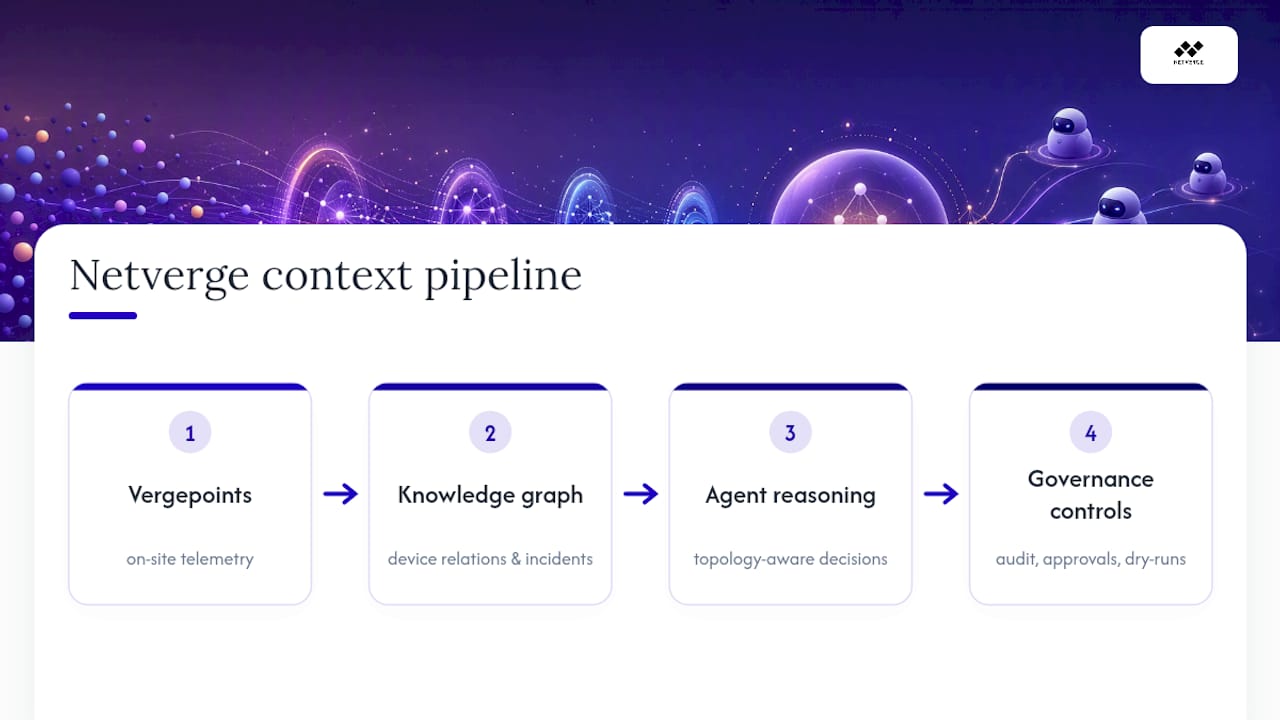
Vergepoints, Netverge's edge hardware, give you physical, on-site visibility into segments of the network that software-only monitoring tools routinely miss, port-level activity, local device behavior, and conditions that only show up close to the source. That telemetry feeds directly into Netverge's knowledge graph, which models device relationships, dependencies, and historical incident patterns so an agent reasoning about an outage isn't guessing at what's connected to what.
Operationally, that translates into fewer false positives, because an agent working from a connected topology map catches the difference between "this switch is down" and "this switch is down and three dependent services just failed as a result." Netverge pairs that context layer with the governance controls this article covers: audit trails on every agent action, approval workflows for anything outside a pre-approved scope, and dry-run modes for testing new automation before it touches live infrastructure. The AI triage capabilities built on top of this foundation are designed to reduce the confidently-wrong problem at its root: incomplete context, not model quality.
Three Priorities for IT Leaders Weighing Autonomous Agents
If you take one thing from this article, take this: the model is not the bottleneck. Context is. Teams that invest in clean telemetry, dependency mapping, and a real knowledge graph before turning on any autonomous execution consistently outperform teams that buy the flashiest agent and hope the data catches up later.
Second, measure in small increments and let metrics, not enthusiasm, drive expansion. A pilot that resolves 60% of a single ticket category with high confidence is worth more than an agent nominally covering ten categories at mediocre accuracy.
Third, treat governance as a design requirement, not a compliance afterthought. Auditability and rollback aren't friction. They're what let you say yes to more autonomy later with confidence instead of hope.
— Jim
Deploy Autonomous Agents on a Foundation That Already Knows Your Network
Skipping the context-engineering step is the single most common reason MSPs abandon agentic pilots after a rough first month. Netverge closes that gap before an agent ever takes an action, by unifying telemetry, documentation, and topology into one knowledge graph instead of asking your team to stitch together five disconnected tools.
The platform combines Vergepoints hardware for on-site visibility with software that handles AI-powered ticketing and triage, full audit trails, and approval workflows built in from day one, so your agents operate inside guardrails your team actually controls. If you're evaluating where autonomous IT agents fit into your operations, start with the monitoring and observability platform that gives them accurate context to reason from. Request a demo to see how your existing telemetry maps into a working knowledge graph before you commit to a rollout.
Sources
- The ROI of AI agents: how MSPs are turning digital labor into actual profit in 2026
- The Future Of Managed Services In The Age Of Agentic AI
- Agentic Operations for Infrastructure (Itential)
- What is context engineering? (Neo4j)