
Network monitoring pricing comes down to a handful of billing units: per-device, per-sensor, per-agent, per-license, and tiered packages. As a starting point, Capterra's analysis puts the average first-year cost for small businesses at about $1,400. Mid-size and enterprise environments scale from there, and we built Netverge to consolidate those line items into one subscription.
TL;DR:
- Vendors may count interfaces, virtual machines, and synthetic checks differently, so request written billing definitions and quotes in all five units before comparing.
- Run quotes using production polling rates and required retention, because default settings can understate storage costs and trigger higher billing blocks after deployment.
- Estimate annual labor by multiplying weekly maintenance hours by 52 and your loaded hourly rate, then add training and on call costs before comparing licenses.
- Before signing, define billable devices and agents in writing, confirm overage rates, and negotiate renewal caps, since retired agents may still incur charges.
- Netverge lists hardware Vergepoints at $49 monthly per device and software Vergepoints at $29 monthly per Vergepoint; hardware suits sites lacking spare servers.
Table of Contents
- What do per-device, per-sensor, per-agent, per-license, and tiered pricing mean?
- What are typical network monitoring price ranges for small, mid-market, and enterprise buyers?
- Which features and usage patterns raise network monitoring costs?
- How do you estimate your monthly and first-year cost?
- Which licensing and billing traps should you watch for?
- Why can sticker price mislead, and how do you calculate total cost of ownership?
- What should your procurement and trial checklist include?
- How do hardware components like Vergepoints compare with software modules on price?
- How do billing frequency and contract terms affect what you pay?
- When is it worth paying more to reduce operational risk?
- How does Netverge simplify pricing and total cost?
- FAQ
- Sources
What do per-device, per-sensor, per-agent, per-license, and tiered pricing mean?
Every network monitoring quote reduces to a billing unit. Once you can name the unit, you can compare vendors on the same footing. Capterra's cost analysis identifies per-device, per-license, per-agent, and tiered packages as the common models, with wide price ranges inside each.
- Per-device: You pay for each monitored router, switch, firewall, server, or access point. It is easy to forecast, and it favors environments with a modest number of high-value devices.
- Per-sensor: You pay for each individual check, such as bandwidth, CPU, ping, or a specific port. One switch can turn into many billable sensors, so this model rewards teams that monitor selectively.
- Per-agent: You pay for each piece of software or hardware collector deployed. It suits distributed estates, but agent counts grow quietly as sites are added.
- Per-license: You pay for named users or seats, often with a device cap bundled in. It works well for small teams and poorly for large teams with occasional viewers.
- Tiered packages: You pay a flat fee for a bundle with defined limits on devices, sensors, retention, and support. Tiers are the easiest to budget and the easiest to outgrow.
Counting rules matter as much as the unit itself. Some vendors count a virtual machine as a device, others count only the host. Some include interfaces in the device price, others bill every interface as a sensor. A vendor may also exclude synthetic checks, flow data, or log ingestion from the base price, then charge for each separately. Support tiers shift the effective unit cost too: a plan that looks cheap per device can become much more expensive once you add the response-time guarantee your team needs.
Each model favors a different buyer. Many small endpoints with light checks usually fit per-device or tiered pricing. A few critical systems that need deep, high-frequency visibility often fit per-sensor pricing, because you pay only for what you inspect. Service providers managing dozens of client sites tend to prefer per-agent or tiered models, since those track how the work is actually deployed. Ask every vendor to restate its quote in all five units so you can see where your environment sits.
What are typical network monitoring price ranges for small, mid-market, and enterprise buyers?
Ranges vary widely, but the benchmarks below give you a sanity check before you read a quote line by line.
- Low end: Free and open-source tools cost nothing in licensing. What they omit is vendor support, managed upgrades, built-in dashboards that work out of the box, and guaranteed response times. You supply the engineering hours instead.
- Mid-market: Basic paid plans usually land in the range of a few dollars to a few hundred dollars per month, depending on the unit. Category roundups for 2026 report typical plans in the $3–$16 per month range, and vendor listings show starter figures such as $10 per month or $50 per month for some tiers. At this level you generally get core alerting, dashboards, and email support, with retention and integrations capped.
- Enterprise: Pricing shifts from a visible price tag to a quoted figure. SLA-backed platforms add high availability, extended retention, single sign-on, audit logs, and dedicated support. The common reasons for big jumps are device or sensor growth, longer data retention, and premium support.
Usage-based tiers climb faster than most buyers expect. Capterra's PRTG and Datadog comparison shows entry pricing from around $15 per month, alongside usage-based tiers starting at $179 per month, with recurring fees rising noticeably as environments scale. Per-device rates can also run very low: a LogicMonitor and PRTG comparison lists rates as low as $3 per month in some cases.
Capterra's cost analysis found an average first-year cost of about $1,400 for small businesses, against a median of $390. That gap tells you a few expensive deployments pull the average up, so treat the median as the realistic floor and the average as a planning ceiling for a small team.

Which features and usage patterns raise network monitoring costs?
Four levers do most of the damage to a recurring bill. Know them before you sign.
- Retention and sampling: Keeping data for longer costs more, and polling more frequently produces far more data. Storage is often billed in blocks, so a modest change in settings can push you into the next block.
- Sensors and agents: Agentless monitoring is cheaper to start, but it limits depth. Agent-based monitoring gives richer telemetry and adds per-agent fees. Hardware probes add a monthly or one-time cost per site, which is worth it when you need on-site visibility that software alone cannot provide. Our post on hardware-driven monitoring for MSPs and enterprises explains where probes earn their cost.
- Integrations and premium checks: Connectors to ticketing, cloud providers, and identity systems are often add-ons. So are synthetic transaction checks and deep packet or flow inspection.
- High availability and support: Redundant collectors, failover, and guaranteed response times sit at the top of most price lists. They are worth paying for on critical paths and wasteful on lab networks.
Pro Tip: Run your first quote at production polling rates and your real retention target. Vendors often quote default intervals and retention periods, then reprice once you ask for what you actually need.
How do you estimate your monthly and first-year cost?
A good estimate takes an hour and prevents months of renegotiation. Follow these steps, or use our pricing calculator to do the arithmetic.
- Count devices. Include switches, routers, firewalls, servers, wireless controllers, and the long-tail gear people forget, such as printers, cameras, and UPS units.
- Estimate sensors per device. Use fewer sensors for basic gear and more for core switches and servers, then total them.
- Pick a retention length. Match it to compliance and troubleshooting needs, not to the vendor's default.
- Count users and sites. Seats, client tenants, and locations each affect cost under some models.
- Define the SLA you need. Decide on support response time and whether high availability is required.
- Plan hardware probes. Note how many sites need an on-site collector.
- Map inputs to units. Convert your totals into each vendor's billing unit and multiply by the listed rate.
Here is an illustrative walkthrough. These inputs are examples, not market data.
- Small office: A small number of devices at a per-device rate of $3 per month costs more as you add devices, before support add-ons.
- Mid-size company: For a mid-size company, estimate the number of devices and sensors. If a vendor sells sensors in blocks of 100 at $100 per month, calculate the number of blocks required and multiply by the monthly block price.
- Enterprise: A large deployment across multiple sites with an extended retention requirement is quoted rather than priced from a list, so collect the inputs and ask each vendor for a written estimate.
Add one-time costs such as onboarding and hardware to reach a first-year figure, then compare against the quote.
Which licensing and billing traps should you watch for?
Most surprise charges come from definitions, not from rates. Watch for these.
- Recounting devices: A server with virtual machines and interfaces can be billed as one device or several, depending on the vendor's rules.
- Retroactive agent charges: Some contracts bill for every agent ever deployed, not the number currently running.
- Unclear retention overage: Exceeding storage blocks may trigger per-gigabyte fees at a higher rate than the plan includes.
- Minimum commitments: Annual or multi-year terms can lock you into capacity you never use.
- Support tier surprises: The advertised price may include business-hours email only.
You can negotiate your way out of most of these. Ask for a renewal cap so the price cannot jump unexpectedly, a written definition of every billable unit, an overage rate card, pilot-to-production credits so trial spend counts toward the contract, and an itemized invoice that shows device and sensor counts each month.
Structure your evaluation to expose hidden costs: deploy in production conditions, add devices on purpose until you cross a tier boundary, and read the resulting invoice before you sign.
Pro Tip: Ask the vendor to price a growth scenario in writing. How they answer tells you how predictable your renewal will be.
Why can sticker price mislead, and how do you calculate total cost of ownership?
A cheap license can be the most expensive line in your budget once you count people. Operational costs include upgrade time, alert tuning, false-positive triage, incident response, on-call coverage, and training. They show up as staff hours, not invoices, which is why they get ignored.
A practitioner analysis of network monitoring costs argues that sticker price is a dangerous metric, and that TCO models counting engineering salary for maintenance, on-call stipends, and training often show cheap self-hosted tools costing significantly more in staff burden than consolidated subscription platforms with managed support. — The Uptime Budget
To convert hours into dollars, estimate the weekly hours your team spends on the tool, multiply by 52, then by a loaded hourly rate that includes salary, benefits, and overhead. Add on-call stipends and training.
Here is a short illustrative example. Say a self-hosted tool takes several hours a week of maintenance and alert tuning, and estimate your loaded engineering rate, including salary, benefits, and overhead. Multiply the weekly hours by your hourly rate and the weeks in a year to estimate annual labor cost. A managed subscription that reduces that burden could make room for higher subscription fees while still breaking even. Your hours and rate will differ, but the method holds.
The takeaway from the practitioner data is plain: compare TCO, not license price. The Uptime Budget analysis shows why a free tool can cost more than a paid one.

What should your procurement and trial checklist include?
Use this short list to get an accurate quote and a pilot that tells you something.
- Clarify the billing unit. Get a written definition of what counts as a device, sensor, or agent.
- Pin down overages. Ask what happens when you exceed limits on devices, sensors, storage, or API calls.
- Confirm SLA and support. Get response times in writing, with hours of coverage and escalation paths.
- List integrations and data residency. Verify ticketing, cloud, and identity connectors, and where your data is stored.
- Run the pilot at production polling rates. Include long-tail devices, and measure alert noise and staff hours during the trial.
- Pull procurement levers. Negotiate annual prepay discounts, pilot-to-contract credits, and bundled hardware credits.
Our guide to real-time monitoring methods covers practical steps for trial design, and you can start a free trial to test pricing under real load.
How do hardware components like Vergepoints compare with software modules on price?
Network monitoring packages mix two cost types: hardware that sits at the edge and software that does the analysis. At Netverge, you can compare the costs of each piece. Our pricing guide lists Hardware Vergepoints at 49 USD per month per device and the Software Vergepoint at 29 USD per month per vergepoint.
The difference in monthly price reflects what you get. A hardware Vergepoint is a physical device you place at a site, giving you on-premises visibility. A software Vergepoint is another option for sites where you want to avoid shipping equipment.
For a handful of sites the gap may be small, but it compounds as you add sites. Compare the total monthly cost for your own deployment. Hardware earns its premium at sites with no spare servers, limited IT staff, or strict visibility requirements. Software wins where virtualization is already in place and speed of deployment matters. Many deployments mix both: hardware at remote branches, software at data centers.
Beyond the collector price, check what each option includes in the surrounding package. Our Vergepoints page describes the plug-and-play hardware, and add-on fees for sensors, clients, sites, AI agents, and storage are listed in the same guide.
How do billing frequency and contract terms affect what you pay?
Vendors bill monthly, yearly, or on multi-year terms, and each choice trades flexibility for price. Monthly billing costs the most per period but lets you leave, resize, or switch tools with little notice. It suits pilots, seasonal businesses, and teams still learning their real footprint.
Annual billing usually carries a discount, and it often unlocks better support terms and price protection. Listings reflect the mix: Capterra's comparison of New Relic and Zabbix shows starter figures of $10 per month, $50 per month, and $395 per year, so a single vendor page can quote in both periods. Always convert to one period before comparing.
Multi-year terms push discounts further, and they push risk onto you. If your device count falls, a lot of capacity sits idle. If a better tool appears, you are locked in. Before committing for several years, negotiate a right to reduce quantities at renewal, a cap on annual increases, and a clear exit path if service levels slip.
A simple rule works well: start monthly during evaluation, move to annual once your counts stabilize, and consider multi-year only with growth flexibility and a renewal cap in writing. Whatever you choose, ask how mid-term additions are billed, whether prorated or aligned to the next cycle.
When is it worth paying more to reduce operational risk?
My view after weighing these tradeoffs: the right price is rarely the lowest one. A cheaper tool that needs constant tuning pushes cost into your payroll and your incident queue, where it is harder to see and harder to cut. Paying a higher recurring fee makes sense when it removes recurring labor, shortens outages, or cuts the number of tools your team has to log into.
That logic is why many MSPs justify consolidated platforms. When monitoring, ticketing, and documentation live together, alerts arrive with context, noise drops, and mean time to resolution improves. The savings show up in fewer escalations and fewer after-hours pages. They are real, but they only appear if you measure them, so track hours and alert volume during any trial.
The opposite case matters too. A small, stable network with one capable administrator may be perfectly served by a free tool and a few weekend hours. Match the spend to the risk, and revisit the decision each renewal as your footprint grows.
— Jim
How does Netverge simplify pricing and total cost?
We built Netverge to consolidate monitoring, documentation, and ticketing in one platform. Our Starter Package is 299 USD per month, and you add hardware or software Vergepoints and capacity as your environment grows.
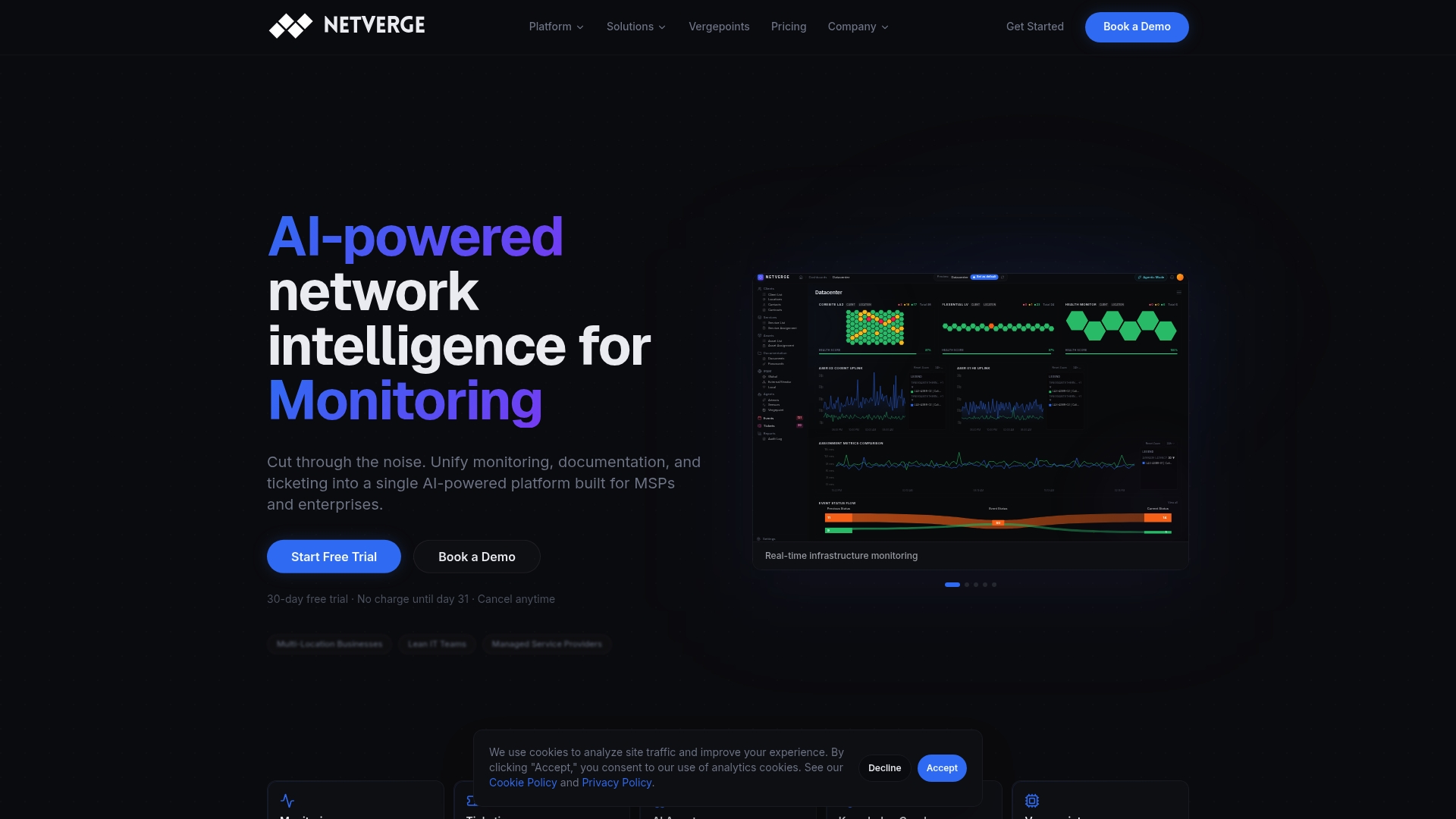
- One platform: monitoring, AI-assisted ticket triage, and documentation in a single interface cut tool sprawl.
- Published add-ons: sensors, clients, sites, AI agents, and storage have listed prices on our pricing guide, so growth is predictable.
- Hardware when you need it: Vergepoints give you on-site visibility at the sites that need it.
- Estimator tools: our pricing calculator turns your device and site counts into a monthly figure.
Enter your numbers in the calculator, then start your free trial to confirm the estimate under real load.
FAQ
What is the best free network monitoring software?
There is no single best free option, because the right choice depends on your size and skills. Free and open-source tools remove license fees but leave support, upgrades, and tuning to your team. Compare them on staff hours as well as price, as The Uptime Budget recommends with its TCO approach.
Is Zabbix really free?
Zabbix is open source, so there is no license fee, and Capterra's comparison confirms free and open-source choices remain available. You still pay for the servers, storage, setup, and the engineering time to maintain it. Paid support is optional but costs extra.
How much does network monitoring software cost for a small business?
Expect a wide spread. Capterra's analysis found an average first-year cost of about $1,400 for small businesses, with a median of $390. Your own number depends on device count, sensors, and retention.
How do I compare quotes that use different billing units?
Convert every quote into a single unit, such as cost per monitored device per month, using your real device and sensor counts. Then add retention, support, and integration fees. Ask each vendor to price a growth scenario so you can see how the bill scales.