Use agents when you need forensic depth on critical hosts, use agentless when you need fast, broad coverage of cloud assets and network gear, and use a hybrid model for almost every enterprise running mixed infrastructure. Agent-based tools win on visibility and remediation; agentless wins on deployment speed and reach into closed systems. Most IT teams end up running both, and platforms built for hybrid telemetry, including Netverge, exist precisely because that split is now the operational default rather than the exception.
TL;DR:
- Agent-based monitoring provides deep system insights, such as kernel and process details, crucial for security and forensic work on critical hosts.
- Agentless monitoring offers rapid discovery of cloud and network assets, with minimal deployment effort, but faces scalability issues as environment size grows.
- A hybrid approach, combining agent-based on key servers and agentless for broader coverage, is the industry standard for most organizations.
- Proper implementation requires careful credential management, network segmentation, and capacity planning to prevent outages and security risks.
- The best path involves a phased, 90-day rollout with ongoing re-evaluation as infrastructure and compliance needs evolve.
Table of Contents
- Agentless vs. Agent-Based Monitoring: The Core Technical Difference
- Agent-Based Monitoring: Strengths, Limits, and When It's Required
- Agentless Monitoring: Strengths, Limits, and Where It Wins
- Key Decision Criteria for Choosing a Monitoring Approach
- Building a Hybrid Monitoring Architecture That Works
- Implementation Checklist: What to Nail Down Before Rollout
- Recommendation: A 90-Day Path to the Right Monitoring Mix
- Why Netverge Treats This as a Hybrid Problem, Not a Binary Choice
- Get Unified Hybrid Monitoring Running in Weeks, Not Quarters
- Sources
Agentless vs. Agent-Based Monitoring: The Core Technical Difference
The real distinction between agentless and agent-based monitoring isn't philosophical. It's about where the collection code physically runs. Agent-based monitoring installs a persistent process on the target device, using techniques like eBPF hooks, kernel-level tracing, or lightweight daemons to pull metrics from inside the box. Agentless monitoring polls the device remotely, using protocols like SNMP, WMI, or SSH, or hitting a cloud provider's API.
That single architectural choice determines almost everything downstream. As TechTarget notes, "agentless" is something of a misnomer. Every monitoring system runs code somewhere. The question is whether that code lives on the target or on a central poller, and that affects your failure domain, your network topology, and your risk profile in ways that aren't obvious until something breaks at scale.
Two quick examples make this concrete:
- A database server running an agent can capture query-level latency and slow-log details in real time, even during a network outage, because the data collection doesn't depend on a live connection back to the monitoring server.
- A fleet of ephemeral cloud containers is usually monitored agentlessly, since a remote poller hitting a cloud API can enumerate resources that spin up and disappear within minutes, something an installed agent would struggle to keep pace with.
The failure domains differ too. An agent that crashes takes down visibility into one host. A poller that goes down, or a credential that expires, can blind you to hundreds of devices at once. That asymmetry is worth remembering before you commit an entire environment to either model.
Agent-Based Monitoring: Strengths, Limits, and When It's Required
Agents earn their overhead when you need to see what's happening inside a system, not just whether it's responding. That distinction shows up constantly in security and database work, where surface-level checks miss the failure entirely.
Where agents genuinely outperform:
- Kernel and process-level visibility. Agents can trace system calls, monitor file integrity, and capture process trees, none of which a remote poll can replicate.
- Local log tailing and correlation. An agent reads logs as they're written, catching transient errors that vanish before a poller's next cycle.
- Remediation on the spot. Because the agent already runs on the host, it can restart a service or kill a runaway process without a separate remote-execution channel.
- Offline resilience. Agents can buffer telemetry locally during a network blip and flush it once connectivity returns, something eG Innovations points to as a real advantage of the push model, since pre-aggregating data locally also cuts down on network chatter.
The costs are just as real. Agent-based monitoring means managing a software lifecycle: packaging, version compatibility across operating systems, patch cadence, and a CPU and memory footprint on every host you touch. Orca Security's comparison frames this well. Agentless shifts your maintenance burden to credentials and poller capacity, while agent-based shifts it to fleet-wide software management. Neither burden disappears; it just moves.
That's why agents are typically reserved for the hosts where the visibility gap actually matters: database servers, security endpoints doing forensic work, and any system where you need sub-second detection or local remediation.
Pro Tip: Cap collector CPU usage with GOMAXPROCS constraints on Go-based agents, and stagger your scrape intervals by metric class. Spike detection during a load test might need one-second polling, but routine trend data rarely needs anything tighter than fifteen seconds, and running everything at one-second intervals is how agents quietly become the resource hog everyone complains about.
Agentless Monitoring: Strengths, Limits, and Where It Wins
Agentless monitoring wins the moment installation isn't an option. Closed network appliances, most virtualization hosts, and cloud-native resources often can't run a third-party agent at all, which makes remote polling the only realistic path to coverage, a point Endpoints Registry makes clearly when comparing collection methods across device types.
Where agentless genuinely outperforms:
- Discovery speed. You can point a poller at a subnet and inventory hundreds of devices in minutes, with no rollout plan and no software to push.
- Cloud and SaaS telemetry. Services like AWS CloudWatch or a SaaS provider's metrics API are built to be queried remotely, not instrumented locally.
- Network gear coverage. Routers, switches, and firewalls almost universally expose SNMP, which remains the default way to pull interface counters and error rates without touching the device's firmware.
- Zero footprint on the target. No CPU cycles stolen from production workloads, no compatibility testing against a vendor's locked-down OS image.
The trade-off shows up in two places most teams underestimate. First, credential risk concentrates in one spot. NinjaOne's guidance points out that agentless tools simplify onboarding precisely because they centralize access, but that same centralization means one compromised poller credential can expose everything it touches. Second, and more operationally painful, agentless polling shifts compute and bandwidth cost onto the central poller itself.
That second point isn't theoretical. SentinelOne's analysis documents how agentless architectures can trigger scalability bottlenecks and even socket exhaustion once the target count climbs into the thousands, because every poll cycle opens a connection, and a poller pool that isn't horizontally distributed will hit that ceiling faster than most teams expect.
A number worth remembering: the same SentinelOne research flags that this bandwidth and connection load grows with fleet size in a way that's easy to miss during a small pilot but becomes the first thing that breaks once an environment scales past a few hundred nodes.
Key Decision Criteria for Choosing a Monitoring Approach
Deciding between agent vs agentless monitoring for a specific environment comes down to five axes, not a single feature comparison. Walk through these before you commit budget or headcount to either path.
- Data granularity required. If you need process-level or kernel-level detail, agentless can't get you there. If you need inventory and uptime across a thousand devices, an agent rollout is overkill.
- Security blast radius. Ask what happens if the credential store or the poller itself is compromised. Centralized agentless credentials are a single high-value target; distributed agents spread that risk but multiply your patch surface.
- Scale and churn rate. Environments with containers and serverless functions spinning up and down by the hour favor agentless discovery. Static, long-lived infrastructure tolerates agent installs just fine.
- Maintenance capacity. Be honest about whether your team has the bandwidth to patch and version-manage agents across every operating system in your fleet, or whether that effort is better spent hardening a smaller number of pollers.
- Compliance and audit requirements. Some frameworks require local log integrity verification or forensic-grade process tracing that only an agent can provide, which makes the compliance question a real tie-breaker in regulated environments.
Bring these questions to any vendor conversation:
- What's the credential scope for your poller service, and can it be limited to read-only access?
- How does your platform handle a device that appears and disappears within the same polling interval?
- What's your agent's memory footprint on a constrained host, and is that documented anywhere buyers can check?
A short pilot, typically two to four weeks, will surface most of these answers faster than any vendor datasheet, though the real cost curve, patch cadence for agents versus poller scaling for agentless, only becomes clear after three to six months of production traffic.
Building a Hybrid Monitoring Architecture That Works
Most mature environments land on a hybrid model, and for good reason. NinjaOne's recommendation is to use agentless polling for discovery and cloud assets while reserving agents for the servers where deep telemetry actually changes an operational decision. That split maps cleanly onto how most infrastructure is actually shaped: a stable core of critical hosts surrounded by a much larger, more transient population of cloud and network assets.
The pattern that works in practice:
- Deploy agents on databases, security-critical endpoints, and any host requiring sub-second detection or local remediation.
- Use agentless polling for network gear, cloud resources, and general inventory across the rest of the fleet.
- Normalize telemetry at ingestion so both collection paths land in a common schema, rather than forcing analysts to reconcile two different data formats during an incident.
The gotcha almost every team hits first is double counting. When an agent and a poller both report on the same interface or the same host metric, dashboards start showing duplicate or conflicting values, and nobody trusts the numbers anymore. The fix is a deduplication layer at ingestion, tagging each metric with its collection source and reconciling overlaps before storage rather than after.
For scale, the same implementation guidance from Endpoints Registry recommends distributing polling targets across a poller pool using consistent hashing, so no single poller becomes a bottleneck, and routing everything through a Prometheus Remote Write or OpenTelemetry collector pattern to compress and aggregate before long-term storage.
Pro Tip: Tag every metric at the point of collection with its source type (agent or poller). It costs almost nothing to implement and saves hours of confusion the first time someone asks why the same interface shows two different traffic numbers.
Implementation Checklist: What to Nail Down Before Rollout
A hybrid or single-method rollout succeeds or fails based on a handful of unglamorous details that rarely make it into architecture diagrams.
- Credentials and least privilege. Scope every polling credential to read-only where possible, and rotate secrets on a defined schedule rather than leaving static keys in place indefinitely.
- Network segmentation. Place pollers on a dedicated management VLAN, and for agentless SSH access, Endpoints Registry recommends using restricted
authorized_keyscommand entries so a compromised credential can't pivot beyond its intended scope. - Outbound-only agent connections. Configure agents to initiate outbound connections rather than accepting inbound traffic, which avoids opening firewall ports that a security team will otherwise flag during every audit.
- TLS and certificate lifecycle. Set expiration alerts well ahead of renewal dates. A lapsed certificate on a poller is one of the more common causes of a sudden, unexplained monitoring blackout.
- Compatibility testing before fleet-wide agent rollout. Test against every OS version and kernel variant in your environment, and keep a rollback plan ready for the inevitable version that breaks on one subset of hosts.
- Poller capacity planning. Watch for TIME_WAIT socket accumulation under high connection churn, and tune scrape intervals per metric class rather than defaulting every check to the same frequency.
Skipping any one of these tends to surface as a 2 a.m. incident rather than a planning-meeting footnote.
Recommendation: A 90-Day Path to the Right Monitoring Mix
Static infrastructure with long-lived servers favors agent-based depth. Cloud-native, ephemeral workloads favor agentless discovery. Security-first environments with compliance obligations usually need both, agents for forensic detail, agentless for broad asset coverage.
A practical rollout: weeks one through two, pilot both methods on a representative slice of your environment and capture baseline metrics. Weeks three through six, expand agent coverage to identified critical hosts while agentless polling handles everything else. Weeks seven through twelve, formalize governance: credential rotation policy, dedupe rules, and a documented escalation path for poller failures.
Re-evaluate the split whenever your container churn rate spikes, when a compliance audit flags gaps in log integrity, or when poller latency starts creeping up as fleet size grows. Learn more about structuring that architecture before locking in a long-term tooling decision.
Why Netverge Treats This as a Hybrid Problem, Not a Binary Choice
Every environment I've looked at that tried to pick one side of agent vs agentless monitoring eventually built the other half anyway, usually under pressure, after an outage exposed the gap. That's the pattern Netverge was built around rather than against.
Netverge combines Vergepoints hardware for on-site visibility with 24 software sensors and AI-driven triage, unifying agent-based depth and agentless reach into a single telemetry stream instead of two dashboards fighting for attention. That matches the hybrid recommendation running through this entire piece: pick the collection method the workload demands, then make sure the data lands somewhere coherent. Read more on how unified monitoring closes that gap in practice.
— Jim
Get Unified Hybrid Monitoring Running in Weeks, Not Quarters
If you've read this far, you already know that running agents on critical hosts and agentless polling everywhere else usually means stitching together two separate tools and hoping the data reconciles. Netverge skips that step. It's built for MSPs and multi-site enterprises that need agent-based depth on the systems that matter and agentless reach across cloud and network assets, delivered through one dashboard with AI-driven anomaly detection and automated ticket triage instead of two consoles you have to check separately.
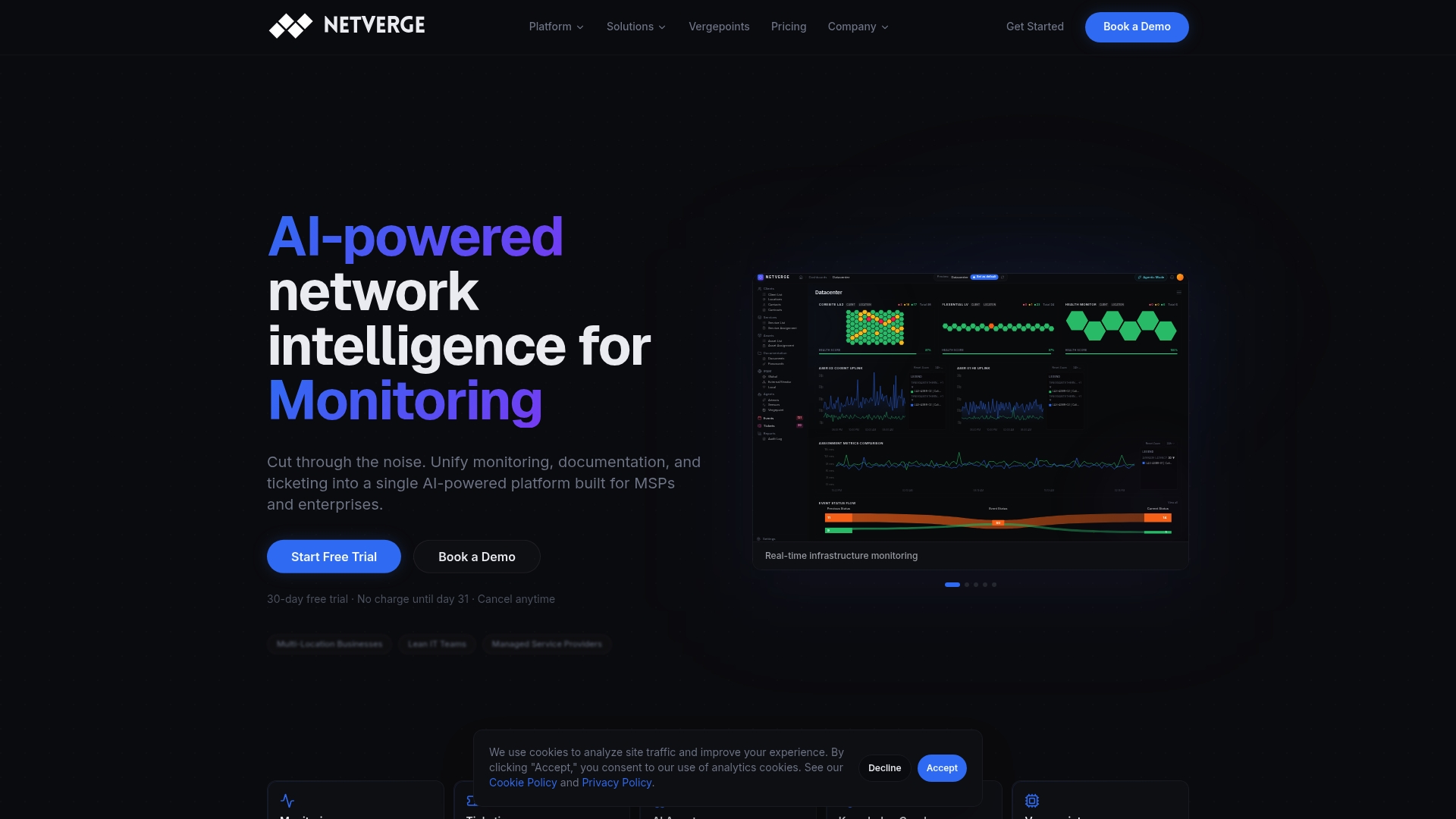
The platform's AI-powered monitoring handles the deduplication and normalization work this article walked through automatically, so your team isn't building a schema-reconciliation layer from scratch. If a hybrid rollout is on your roadmap, start with a trial of Netverge's monitoring platform and see how quickly baseline telemetry comes together across both collection methods.
Sources
- Agent vs. agentless: Monitoring choices for diverse IT ops needs — TechTarget
- How to Choose Between Agent-Based and Agentless Monitoring — NinjaOne blog
- Choosing Between Agent Based and Agentless Monitoring — Endpoints Registry
- Agent vs Agentless security — SentinelOne
- Agentless vs Agent-Based monitoring — eG Innovations