
Network access control devices are the enforcement layer that decides which endpoints, users, and devices gain network access before a session is established. In a Zero Trust architecture, they function as Policy Enforcement Points (PEPs), blocking or segmenting connections until identity, device posture, and context are verified against policy. The four solution classes worth evaluating for most enterprise deployments are:
- Integrated NAC platform (Cisco ISE, Aruba ClearPass, Forescout): full-featured policy engine with device profiling, posture assessment, and CoA enforcement
- Cloud RADIUS/NAC-as-a-service (Portnox Cloud): lighter operational footprint, RADIUS delivered as a subscription
- Agent-based microsegmentation (Ivanti Policy Secure, FortiNAC): endpoint posture gating with remediation workflows
- Lightweight port-based 802.1X + RADIUS: NPS or open-source RADIUS for organizations with simpler infrastructure
For organizations that need observability and NAC-like enforcement integration in a single workflow, start with Netverge's enterprise platform. Its AI-driven monitoring and Vergepoints hardware feed device telemetry directly into enforcement and automation triggers, giving MSPs and multi-location enterprises a unified starting point before layering a dedicated NAC solution.
Table of Contents
- What are network access control devices and why do they matter now?
- How does network access control work? Architecture and components
- Primary enterprise use cases for NAC
- How do leading NAC solutions compare?
- How do you choose the right NAC solution for your environment?
- How NAC maps to Zero Trust: NIST guidance and integration patterns
- Key Takeaways
- The operational reality of running NAC at scale
- Netverge gives your NAC deployment the observability layer it needs
- Useful sources and next reading
What are network access control devices and why do they matter now?
Network access control (NAC) is the practice of enforcing per-connection access decisions based on three variables: who is connecting, what device they are using, and the context of that request. The devices and software components that execute those decisions, collectively called network access devices (NADs), include switches, wireless access points, RADIUS/NAC appliances, and cloud RADIUS services. Each one acts as an authenticator that either permits, restricts, or quarantines a session based on policy.
The urgency behind NAC today comes directly from Zero Trust adoption. NIST SP 800-207 defines Zero Trust architecture around the principle that no implicit trust is granted based on network location. Every access request must be evaluated at a Policy Enforcement Point (PEP), with a Policy Administrator (PA) and Policy Engine (PE) making the access decision. NAC hardware and software map precisely onto those roles: the authenticating switch or WAP is the PEP, and the RADIUS/policy server is the PE and PA.
What counts as a network access control device in practice:
- NAC appliances and platforms — Cisco ISE, Aruba ClearPass, Forescout, FortiNAC, and similar products that combine policy engine, profiling, and enforcement
Pro Tip: Frame NAC as an enforcement mechanism inside a broader Zero Trust architecture, not as a standalone endpoint control. A NAC device that cannot trigger a Change of Authorization (CoA) or integrate with your EDR is a visibility tool, not an enforcement tool.
NIST SP 800-46r2 reinforces this by recommending NAC specifically for verifying telework device posture and segregating unmanaged BYOD devices, a use case that has expanded significantly as distributed workforces became the norm.
How does network access control work? Architecture and components
The core authentication flow follows a consistent sequence regardless of vendor: the supplicant (endpoint) presents credentials or a certificate to the authenticator (switch or WAP), which forwards the request to the authentication server (RADIUS/NPS). The RADIUS server queries the policy engine, which evaluates identity, device posture, and context before returning an Access-Accept or Access-Reject with VLAN assignment or downloadable ACL instructions. If posture changes post-admission, the policy engine sends a CoA (Change of Authorization) message to the authenticator to re-evaluate or terminate the session.
The 802.1X authentication flow, EAP method tradeoffs, and CoA operational guidance are well-documented in practitioner guides. EAP-TLS is the recommended long-term end state because it uses mutual certificate authentication, eliminating password-based credential capture risk. PEAP/MSCHAPv2 is a common bridge for organizations mid-migration, but it requires strict server-certificate validation to prevent man-in-the-middle attacks.
Agent vs. agentless: where each approach fits
| Dimension | Agent-based | Agentless |
|---|---|---|
| Visibility depth | Deep: OS version, patch level, AV status, running processes | Surface: MAC address, DHCP fingerprint, traffic behavior, SNMP |
| Coverage | Managed endpoints only | Any device on the network, including IoT and printers |
| Operational overhead | Higher: agent deployment, updates, compatibility testing | Lower: no endpoint software to manage |
| Continuous monitoring | Yes: real-time posture telemetry | Partial: periodic scans or traffic analysis |
| Best fit | Corporate laptops, servers, managed workstations | IoT, OT, BYOD, guest devices, contractor endpoints |
Most production NAC deployments use both. Agent-based posture assessment covers managed Windows and macOS endpoints; agentless profiling handles everything else. Forescout's platform is built around this hybrid model, using passive network traffic analysis alongside optional agents for deeper posture data.
Architectural components to account for in your design:
- Authenticator — 802.1X-capable switch or WAP (Cisco Catalyst, Aruba, Juniper EX)
Primary enterprise use cases for NAC
The three highest-value use cases for NAC in enterprise environments are BYOD and contractor access control, IoT and medical device segmentation, and guest and temporary access management. Each maps to a different enforcement model and a different set of required capabilities.

BYOD and contractor access: An unmanaged personal laptop connecting to a corporate WLAN should never land on the same VLAN as production servers. NAC enforces this by profiling the device, checking for a valid certificate or MDM enrollment, and assigning it to a restricted VLAN with internet-only or limited application access. NIST SP 800-46r2 specifically recommends segregating unmanaged BYOD devices when feasible, treating them as untrusted endpoints regardless of user identity.
IoT and medical device segmentation: Agentless NAC is the only practical option for devices that cannot run a supplicant, such as IP cameras, building management systems, infusion pumps, and industrial controllers. The NAC platform profiles these devices by MAC OUI, DHCP fingerprint, and traffic behavior, then assigns them to isolated VLANs. In healthcare environments, this directly supports HIPAA technical safeguard requirements for access control and audit controls.
Guest and temporary access: Captive portal workflows with sponsor approval, time-limited credentials, and automatic session expiry are table-stakes for any NAC platform serving a campus or enterprise with regular visitor traffic. PCI DSS Requirement 1.3 requires isolating cardholder data environments from untrusted networks, and a properly configured guest VLAN with NAC enforcement is a direct control for that requirement.
Where NAC alone is insufficient:
- Encrypted east-west traffic — NAC enforces at the network edge; microsegmentation tools (Illumio, Guardicore) handle intra-segment traffic.
How do leading NAC solutions compare?
The table below maps the primary NAC platforms and devices against the dimensions that matter most in enterprise evaluation. Gartner's NAC peer reviews provide additional practitioner context for shortlisting. Netverge leads as the observability-first option that feeds NAC enforcement workflows; the remaining entries follow by deployment model and use-case fit.
| Solution | Best for | Deployment model | Agent vs. agentless | Key integrations | Policy granularity | Remediation options | Pricing model |
|---|---|---|---|---|---|---|---|
| Netverge | MSPs and multi-location enterprises needing unified observability + NAC enforcement integration | Cloud/SaaS + on-site Vergepoints hardware | Agentless (hardware sensors) + API-driven | AD, Azure AD, SIEM, EDR, multi-vendor network | Context-aware, AI-driven anomaly triggers | Automated remediation triggers, alerting, ticket triage | Subscription SaaS + hardware |
| Cisco ISE | Large campus and enterprise environments | On-prem / hybrid | Agent + agentless | AD, Azure AD, CrowdStrike, Splunk, Cisco fabric, MDM | Role/attribute-based, context-aware | CoA, VLAN, quarantine, captive portal | Per-device / subscription tiers |
| Aruba ClearPass | Campus with heavy WLAN use | On-prem / hybrid | Agent + agentless | AD, Azure AD, MDM, SIEM, Aruba WLAN | Role-based, strong guest workflows | CoA, VLAN, captive portal, OnGuard agent | Per-device / subscription |
| Forescout (Vistara / eyeSegment) | IoT-heavy and mixed-device networks | On-prem / hybrid / cloud | Primarily agentless | AD, EDR, SIEM, MDM, firewalls, SDN | Attribute-based, device-class policies | CoA, VLAN, quarantine, orchestration | Per-device subscription |
| Forescout Vistaro Platform | Large-scale heterogeneous environments | On-prem / hybrid | Agentless-first | Broad multi-vendor | Attribute-based | CoA, quarantine, orchestration | Per-device subscription |
| FortiNAC | Organizations using Fortinet security fabric | On-prem / hybrid | Agent + agentless | Fortinet firewalls, switches, SIEM | Role-based, Fortinet fabric policies | CoA, VLAN, quarantine | Per-device / Fortinet licensing |
| Ivanti Policy Secure | Enterprises needing endpoint posture gating | On-prem / hybrid | Agent-first | AD, MDM, EDR, SIEM | Posture-driven, remediation-focused | Agent-led remediation, quarantine, VLAN | Per-seat / subscription |
| Portnox Cloud | Cloud RADIUS and lighter on-prem footprint | Cloud/SaaS | Agentless + lightweight agent | AD, Azure AD, MDM, SIEM | Role-based, certificate-driven | VLAN, quarantine, captive portal | Per-device subscription |
| macmon NAC | SMB to midmarket with simpler infrastructure | On-prem | Agentless (MAC-based) | AD, SIEM | MAC-based, role-based | VLAN, quarantine | Per-device |
| iMaster NCE-Campus | Campus-scale Huawei network deployments | On-prem | Agent + agentless | Huawei campus fabric | Controller-driven policy | VLAN, quarantine | Vendor licensing |
| MetaDefender NAC | Organizations wanting pre-admission endpoint scanning | On-prem / hybrid | Agent + agentless | AD, EDR, SIEM | Posture-driven, scan-gated | Pre-admission quarantine, VLAN | Per-device |
| Extreme Management Center / ExtremeControl | Networks invested in Extreme switching and WLAN | On-prem | Agent + agentless | AD, SIEM, Extreme fabric | Role-based | CoA, VLAN, quarantine | OEM licensing |
| RUCKUS Cloudpath | Certificate-based 802.1X at scale | On-prem / cloud | Agentless (enrollment) | AD, Azure AD, MDM, RADIUS | Certificate/role-based | VLAN, captive portal, onboarding | Per-device / subscription |
| EasyNAC | Niche/legacy environments | On-prem | Agentless | Limited | Basic MAC/port-based | VLAN | Per-device |
| NETSHIELD | Specialized vertical deployments | On-prem | Agentless | Vendor-specific | Basic | VLAN, quarantine | Vendor licensing |
| NACVIEW | Niche environments | On-prem | Agentless | Limited | Basic | VLAN | Per-device |
| Auconet BICS | Infrastructure asset management + NAC | On-prem | Agentless | AD, SIEM, CMDB | Asset-driven policies | VLAN, quarantine | Per-device |
| CGX | Specialized access control | On-prem | Agentless | Limited | Basic | VLAN | Vendor licensing |
| S3M Hybrid NAC | Hybrid on-prem/cloud environments | Hybrid | Agent + agentless | AD, cloud directories | Role-based | VLAN, quarantine | Per-device |
| NAC Appliance (Legacy) | Legacy Cisco environments | On-prem (legacy) | Agent-based | Cisco legacy fabric | Basic posture | VLAN, quarantine | Legacy licensing |
| Cisco Access Manager | Legacy Cisco campus deployments | On-prem (legacy) | Agent-based | Cisco fabric, AD | Role-based | VLAN, quarantine | Legacy licensing |
| Extreme Management Center (Legacy) | Legacy Extreme environments | On-prem (legacy) | Agent + agentless | Extreme legacy fabric | Role-based | VLAN, quarantine | Legacy licensing |
Verdict notes by solution class:
- Cisco ISE — remains the reference platform for large campus deployments with complex policy requirements and deep Cisco switching/WLAN infrastructure. Its breadth of integrations is unmatched, but operational complexity and licensing costs are significant.
How do you choose the right NAC solution for your environment?
Start with a clear POC objective: within the first month, you should have profiled devices on a pilot segment; within the next couple of months, begin enforcing VLAN assignment for compliant and non-compliant device classes; later, validate CoA automation, remediation workflows, and SIEM integration.
Sequential POC test list:
- Device onboarding: enroll 50–100 managed endpoints using 802.1X EAP-TLS. Measure time-to-authenticate and certificate enrollment success rate.
- Profiling accuracy: connect a representative sample of IoT, BYOD, and unmanaged devices. Evaluate classification accuracy against your known device inventory.
- CoA automation: simulate a posture failure (disable AV on a test endpoint) and verify the platform sends a CoA to quarantine the device within your target SLA.
- Remediation workflow: confirm the quarantine VLAN provides remediation instructions and that the device is re-evaluated automatically after remediation.
- Scale test: simulate peak authentication load for your environment. Verify RADIUS response times stay within acceptable bounds under load.
- Failover test: take the primary RADIUS server offline and confirm secondary RADIUS handles authentication without session drops.
Vendor questions checklist:
- Does the platform support RadSec (RADIUS over TLS) for encrypted RADIUS traffic?
- What is the certificate lifecycle management model? Does it support SCEP or ACME for auto-renewal?
- Which RFC 3576 CoA attributes does the platform support, and which authenticator models are tested?
- What device profiling data sources does the platform use (DHCP, SNMP, traffic analysis, API feeds)?
- How does the platform integrate with your SIEM and EDR? Does it support bidirectional event exchange?
Red flags to watch for:
- Single RADIUS server with no redundancy in the architecture proposal
- MAB configured as the default fallback for all unknown devices rather than a controlled exception
- No CoA support or CoA limited to session disconnect only (no VLAN reassignment)
- Audit logs that cannot be forwarded to a SIEM in real time
- Posture checks limited to a single attribute (e.g., domain membership only)
How NAC maps to Zero Trust: NIST guidance and integration patterns
NAC is the PEP and enforcement mechanism inside a Zero Trust architecture. NIST SP 800-207 defines the PEP as the component that enables, monitors, and terminates connections between subjects and enterprise resources. The NAC authenticator (switch, WAP, VPN gateway) is that PEP. The NAC policy engine evaluates the request and the PA communicates the decision back to the PEP.
NIST's implementing Zero Trust architecture guidance provides practical integration patterns that teams can follow when combining NAC with identity, EDR, and microsegmentation. The patterns that translate most directly to NAC deployments are:
- Microsegmentation coupling — NAC assigns devices to segments at admission; microsegmentation tools (Illumio, Guardicore) enforce east-west policy within those segments
For organizations evaluating how NAC fits alongside modern remote access, the comparison of VPN and Zero Trust network access (ZTNA) approaches is a useful reference for understanding where NAC enforcement ends and ZTNA begins.
The authoritative recommendation from NIST guidance is to treat NAC as one layer in a defense-in-depth stack, integrated with identity (AD/Azure AD), EDR, and SIEM, not as a sole preventive control. Posture checks at admission are a snapshot; continuous monitoring and CoA automation are what make NAC operationally effective against threats that evolve post-admission.
Key Takeaways
NAC devices are the enforcement layer of Zero Trust: without CoA-capable authenticators integrated with identity, EDR, and SIEM, posture checks are a snapshot, not a control.
| Point | Details |
|---|---|
| NAC is a Zero Trust PEP | NAC authenticators map directly to NIST SP 800-207 Policy Enforcement Points; enforcement requires CoA support. |
| Agent + agentless together | Managed endpoints need agent-based posture depth; IoT and BYOD require agentless profiling for full coverage. |
| POC must test CoA and failover | Validate CoA automation, auth-fail VLAN behavior, and RADIUS failover before committing to production enforcement. |
| Integrate with EDR and SIEM | NAC posture checks alone cannot stop post-admission threats; EDR and SIEM correlation are required for CoA-driven quarantine. |
| Netverge for observability-first teams | Netverge's AI monitoring platform and Vergepoints hardware feed device telemetry into enforcement and automation workflows for MSPs and multi-location enterprises. |
The operational reality of running NAC at scale
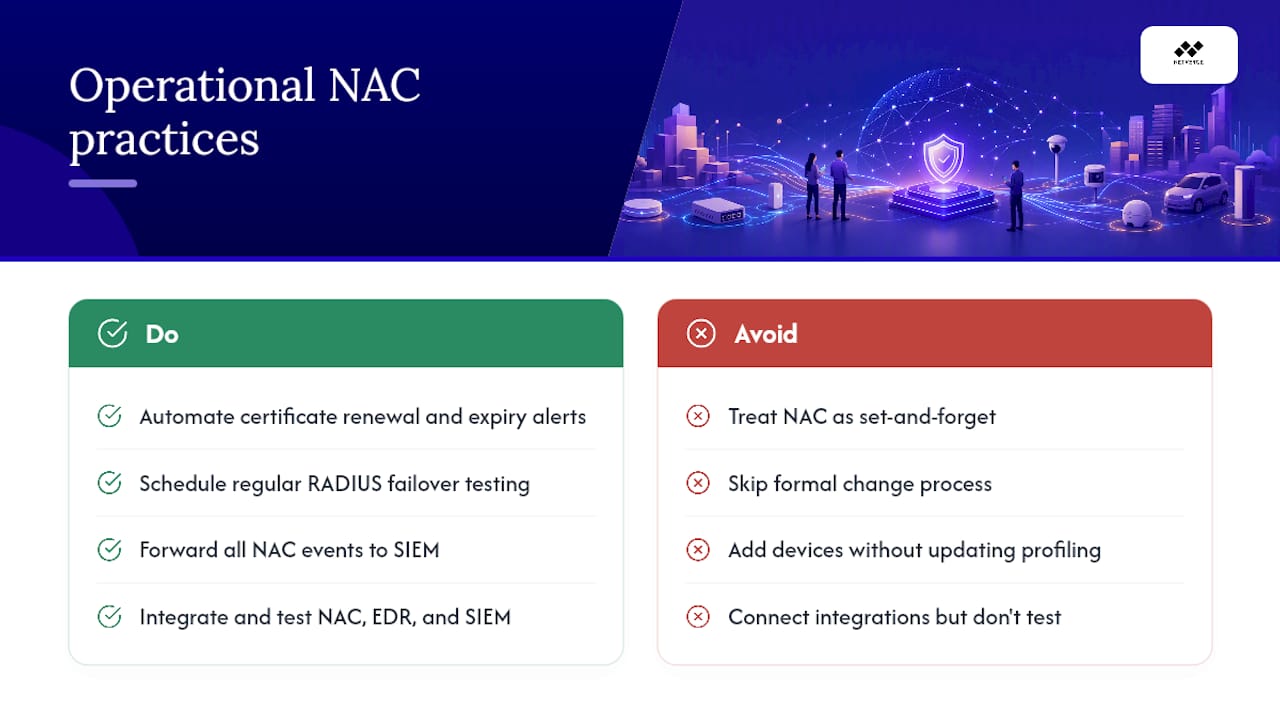
Most articles about NAC focus on the initial deployment. The harder problem is what happens six months after go-live, when certificate renewals start failing silently, RADIUS servers drift out of sync, and the policy engine accumulates exceptions that nobody owns.
The ops teams that run NAC well treat it like any other critical infrastructure service: they own the certificate lifecycle with automated renewal and expiry alerting, they test RADIUS failover on a scheduled basis rather than discovering it during an incident, and they forward every NAC event to their SIEM so that authentication anomalies surface in the same queue as endpoint alerts.
Change management is where most NAC deployments quietly degrade. A new device class gets added to the network, nobody updates the profiling rules, and it lands in the wrong VLAN for months. The fix is a formal change process that requires a NAC policy review for any new device type, network segment, or application onboarding. That sounds bureaucratic, but it is the difference between a NAC deployment that enforces policy and one that enforces the policy you wrote 18 months ago.
Incident response integration is underused. When an EDR platform detects an active threat on an endpoint, the fastest containment path is a CoA-triggered quarantine that isolates the device at the switch port within seconds, before the threat can move laterally. That workflow requires NAC, EDR, and SIEM to be integrated and tested together, not just connected. For organizations building this kind of network infrastructure monitoring and management capability, the observability layer that feeds NAC signals into automated response is as important as the NAC platform itself.
The long-term maintenance reality: NAC is not a set-and-forget control. It requires quarterly policy reviews, annual architecture reviews, and continuous monitoring integration to stay effective as your environment evolves.
Netverge gives your NAC deployment the observability layer it needs
NAC platforms enforce access decisions, but they depend on accurate, real-time device telemetry to make those decisions well. Netverge's AI-powered network monitoring platform and Vergepoints hardware sensors provide the on-site visibility layer that feeds device telemetry into NAC enforcement and automation workflows. For MSPs and multi-location enterprises, that means anomaly detection, automated ticket triage, and remediation triggers that operate across distributed sites without requiring a dedicated NOC at each location.
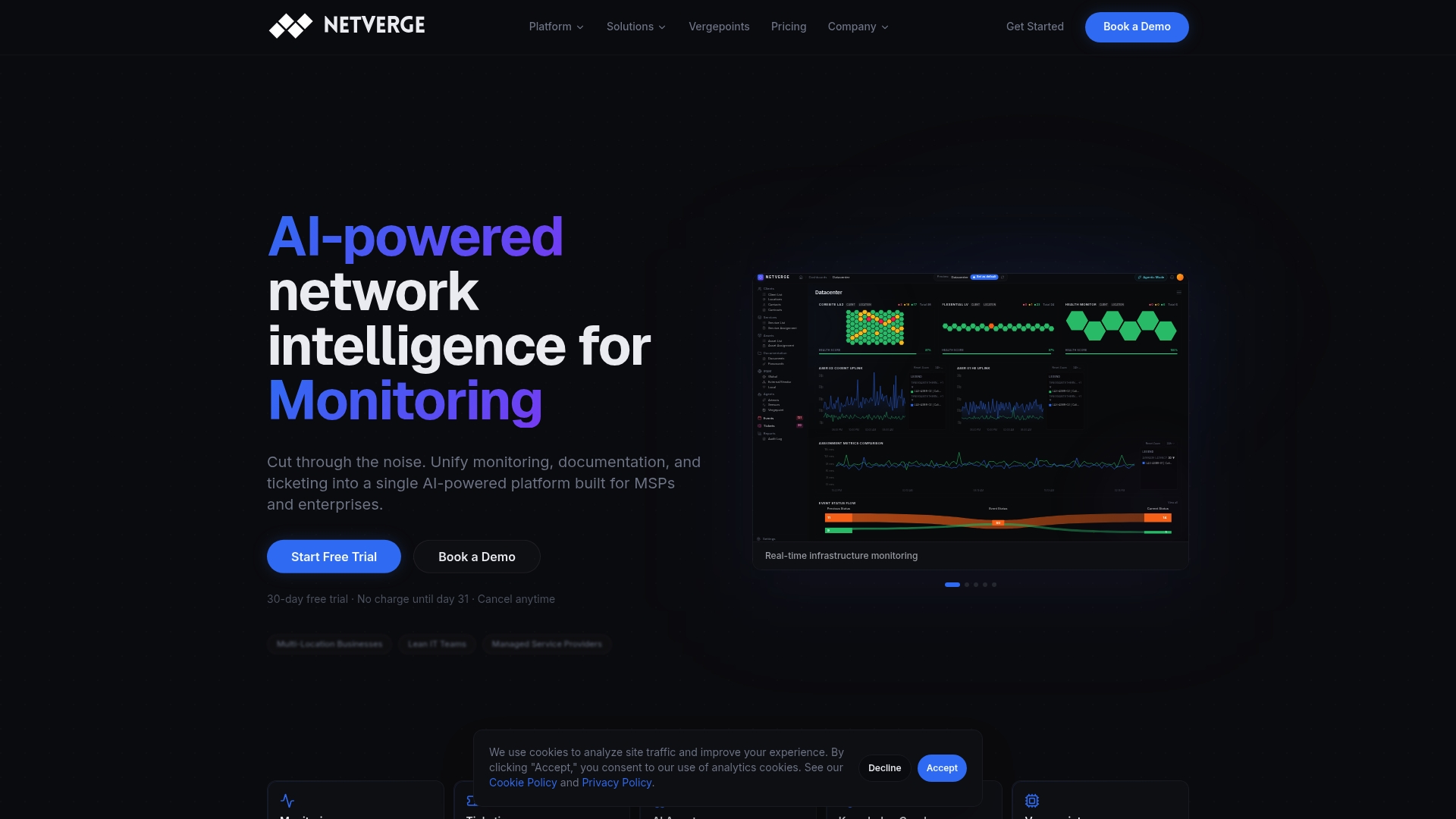
Where traditional NAC deployments rely on periodic posture snapshots, Netverge's 28+ intelligent sensors and AI-driven correlation provide continuous telemetry that can trigger CoA workflows when device behavior deviates from baseline. The result is a tighter enforcement loop: Netverge surfaces the signal, the NAC platform acts on it. For MSPs managing multi-tenant network security, that integration reduces mean time to containment and gives clients audit-ready evidence of enforcement activity. Start a trial or request a demo at netverge.com to see how Netverge fits your NAC architecture.
Useful sources and next reading
The sources below are the canonical references for NAC architecture, Zero Trust mapping, and enterprise deployment guidance. Each one is worth bookmarking for procurement documentation and architecture reviews.
| Source | What it provides |
|---|---|
| NIST SP 800-207, Zero Trust Architecture | Defines PEP/PA/PE roles that map directly to NAC components; the primary reference for Zero Trust architecture alignment |
| NIST Implementing Zero Trust Architecture (High-Level) | Practical integration patterns and example implementations for combining NAC with identity, EDR, and microsegmentation |
| NIST SP 800-46r2: Telework and BYOD Security | Recommends NAC for telework device posture verification and BYOD segregation; useful for remote access policy documentation |
| NAC and 802.1X Guide: EAP-TLS vs PEAP, RADIUS | EAP method tradeoffs, CoA operational guidance, and certificate management advice for enterprise 802.1X rollouts |
| 802.1X NAC with Active Directory: Implementation Guide | Step-by-step NPS/RADIUS configuration, switch port settings, GPO supplicant deployment, and MAB fallback patterns |
| What is a Network Access Device (NAD)? | Quick reference for the hardware categories that constitute network access devices (switches, WAPs, RADIUS appliances) |
| Gartner NAC Reviews and Ratings | Peer reviews and market context for shortlisting NAC vendors; useful for procurement and stakeholder presentations |
| Netverge Enterprise Network Monitoring | Describes Netverge's observability platform and Vergepoints hardware for NAC telemetry integration and automated remediation |