
Network data unification is defined as the process of consolidating fragmented network data sources into a single, governed system that serves as one reliable source of truth. For IT professionals and business leaders, why network data unification matters comes down to a direct operational reality: 80% of enterprise data sits locked in unstructured silos, blocking analytics, slowing incident response, and stalling AI initiatives. The industry term for this practice is "data consolidation architecture," though "network data unification" accurately describes the outcome IT teams need. Organizations that treat unification as a core infrastructure priority gain faster detection, lower costs, and a foundation ready for AI-driven operations.
Why network data unification matters: the fragmentation problem
Data fragmentation in networks occurs when telemetry, logs, configuration records, and performance metrics live in separate, disconnected tools. Each team uses what works for them. The result is a patchwork of systems that cannot share context or correlate events across the infrastructure.
The root causes are predictable. Siloed monitoring tools, decentralized IT teams, inconsistent API integrations, and departmental tool adoption without governance all contribute. Shadow data silos grow silently when individual departments adopt convenient apps that never connect to the central data layer. Convenience at the team level creates inconsistency at the organizational level.
The operational consequences are severe. Fragmented data pipelines cost 25% more to maintain and break 30–47% more often, risking up to $36 million in business value annually for large enterprises. That figure represents not just downtime costs but delayed decisions, duplicated work, and failed audits.
"Data fragmentation leads to multiple conflicting truths, costly maintenance, delayed decisions, and increased operational complexity. It is a system-wide challenge impacting analytics, governance, and AI." Data fragmentation: The hidden challenge in modern data management
The practical impact shows up in incident response. When an engineer troubleshoots a network outage, they must manually pull data from five different dashboards, cross-reference logs from separate systems, and guess at correlations. That manual process adds time, introduces errors, and delays resolution. Unified data eliminates that guesswork entirely.
How does unified network data improve operational efficiency?
The efficiency gains from network data consolidation are measurable, not theoretical. Cisco IT centralized its observability data and reduced Mean Time to Detect and Resolve (MTTR) by 45%, saving 54 minutes per incident. That system now handles 99.998% of approximately 4 million daily alerts through AI-driven automation. The scale of that result shows what a unified data layer actually enables.

The cost reduction case is equally clear. When data pipelines break less often and require less manual intervention, engineering hours shift from firefighting to higher-value work. Automated, fully managed ELT pipelines reduce failures by up to 47% and double the likelihood of exceeding ROI targets in AI-ready environments.
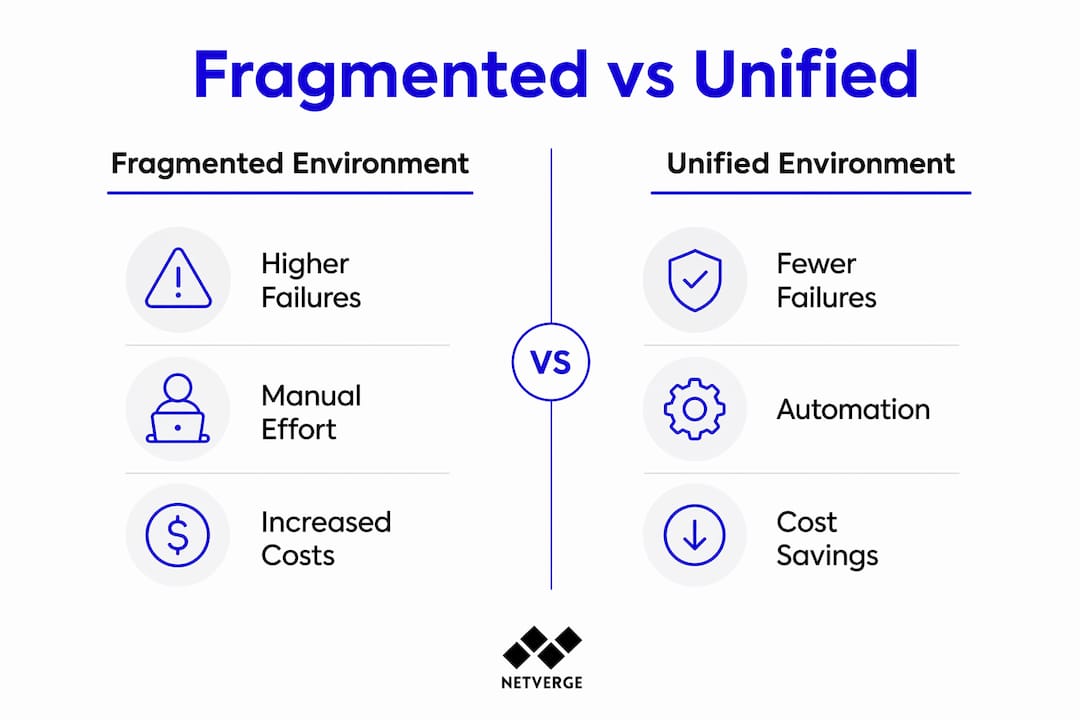
| Metric | Fragmented environment | Unified environment |
|---|---|---|
| Pipeline failure rate | 30–47% higher | Reduced by up to 47% |
| MTTR | Baseline | Reduced by 45% |
| Time saved per incident | None | 54 minutes |
| AI ROI likelihood | Standard | 2x more likely to exceed targets |
Resource allocation also improves. Engineers stop spending hours correlating data manually. Ticket triage becomes faster when the system already has full context. Capacity planning becomes more accurate when all telemetry feeds into one model rather than several disconnected ones.
Pro Tip: Before selecting a unification platform, map every data source your team currently uses, including shadow tools. You cannot unify what you have not cataloged.
What role does data unification play in enabling AI?
AI requires clean, consistent, and governed data. That requirement is non-negotiable. A machine learning model trained on fragmented, inconsistent telemetry will produce unreliable outputs. Garbage in, garbage out applies with full force to network AI.
68% of CEOs identify integrated enterprise-wide data architecture as critical for innovation, yet 85% of organizations face interoperability challenges that block that integration. The gap between intent and execution is the fragmentation problem in another form. AI initiatives stall not because the models are weak but because the data feeding them is inconsistent.
Unified data enables three specific AI capabilities that fragmented environments cannot support:
- Anomaly detection at scale: AI models need a complete, correlated view of network behavior to identify deviations. Partial data produces false positives and missed events.
- Predictive maintenance: Forecasting hardware failure or bandwidth saturation requires historical telemetry from across the network, not just one segment.
- Automated ticket triage: AI-driven ticketing works only when the system can correlate event data, device history, and configuration records in real time.
"AI-driven preventive IT strategies enabled by unified data shift focus from fixing issues to detecting them proactively before service degradation occurs." The future of IT is preventative, not reactive
Viewing data integration as an architectural foundation rather than an operational burden is the mindset shift that separates organizations succeeding with AI from those still piloting it. The architecture comes first. The AI results follow.
What challenges block network data unification, and how do you overcome them?
Achieving unified network data is not a single project. It is an ongoing architectural discipline. Organizations that treat it as a one-time migration consistently fail. The obstacles are real, but each has a practical solution.
The most common challenges IT teams face include:
- Governance gaps: Without clear data ownership policies, teams continue adding tools that create new silos. Governance defines who owns each data domain and how new tools must integrate before adoption.
- Shadow silos: Departmental convenience drives tool adoption outside IT oversight. Regular audits of data sources, combined with a formal intake process for new tools, contain this problem before it compounds.
- Vendor lock-in and data gravity: Large volumes of data stored in proprietary cloud environments become expensive and slow to move. Early planning for high-throughput connectors and parallel processing capabilities reduces migration complexity significantly.
- Schema drift: As systems evolve, data formats change. A unified layer must include schema validation and transformation logic to handle these changes without breaking downstream analytics.
- Pipeline observability gaps: Lack of visibility into data pipeline health creates bottlenecks as damaging as the original silos. Monitoring the pipelines themselves is as important as monitoring the network.
The most effective implementation strategy is incremental. Domain-focused pilots that target one area first, such as the data center, and deliver measurable ROI within 60–90 days consistently outperform "big bang" unification attempts that stretch over 12–18 months and often fail. Start with the highest-value data domain. Prove the model. Then scale.
Pro Tip: Treat your first unification pilot as a proof of concept with a defined success metric, such as MTTR reduction or alert correlation accuracy. A concrete result builds internal support for broader rollout.
Addressing legacy software integration challenges early in the planning process prevents the most common technical failures. Legacy systems often lack modern APIs, require custom connectors, and carry undocumented data schemas. Budget time and engineering resources for these specifically.
Key Takeaways
Network data unification is the single most impactful architectural decision IT teams can make to improve operational efficiency, reduce costs, and enable AI-driven network management.
| Point | Details |
|---|---|
| Fragmentation is expensive | Fragmented pipelines cost 25% more to maintain and break up to 47% more often than unified systems. |
| Unification cuts MTTR sharply | Cisco IT reduced MTTR by 45% and saved 54 minutes per incident after centralizing observability data. |
| AI depends on unified data | Clean, governed, consistent data is a prerequisite for reliable anomaly detection and predictive maintenance. |
| Governance prevents new silos | Shadow silos grow without oversight; formal data governance policies stop fragmentation before it starts. |
| Incremental pilots outperform big bang | Starting with one domain and proving ROI in 60–90 days reduces risk and builds organizational support. |
The shift most IT leaders still haven't made
After working closely with IT operations teams across distributed enterprise environments, the pattern I see most often is this: organizations invest heavily in monitoring tools but almost nothing in the data layer connecting them. They buy more dashboards. They add more agents. They never ask whether the data those tools produce can actually talk to each other.
The uncomfortable truth is that fragmentation is usually a governance failure before it is a technology failure. The tools exist to unify network data. The organizational will to enforce consistent data standards is what is missing. Departments adopt what is convenient. IT leadership inherits the mess.
The teams that get this right treat data architecture the same way they treat network architecture: with documented standards, change control, and regular audits. They do not wait for a major incident to expose the gaps. They map their data flows proactively, identify the inconsistencies, and fix them before those inconsistencies block an AI rollout or slow a critical incident response.
The shift from reactive to proactive IT is real and achievable. But it starts with the data layer, not the AI layer. Get the foundation right, and the advanced capabilities follow naturally.
— Jim
How Netverge supports network data unification
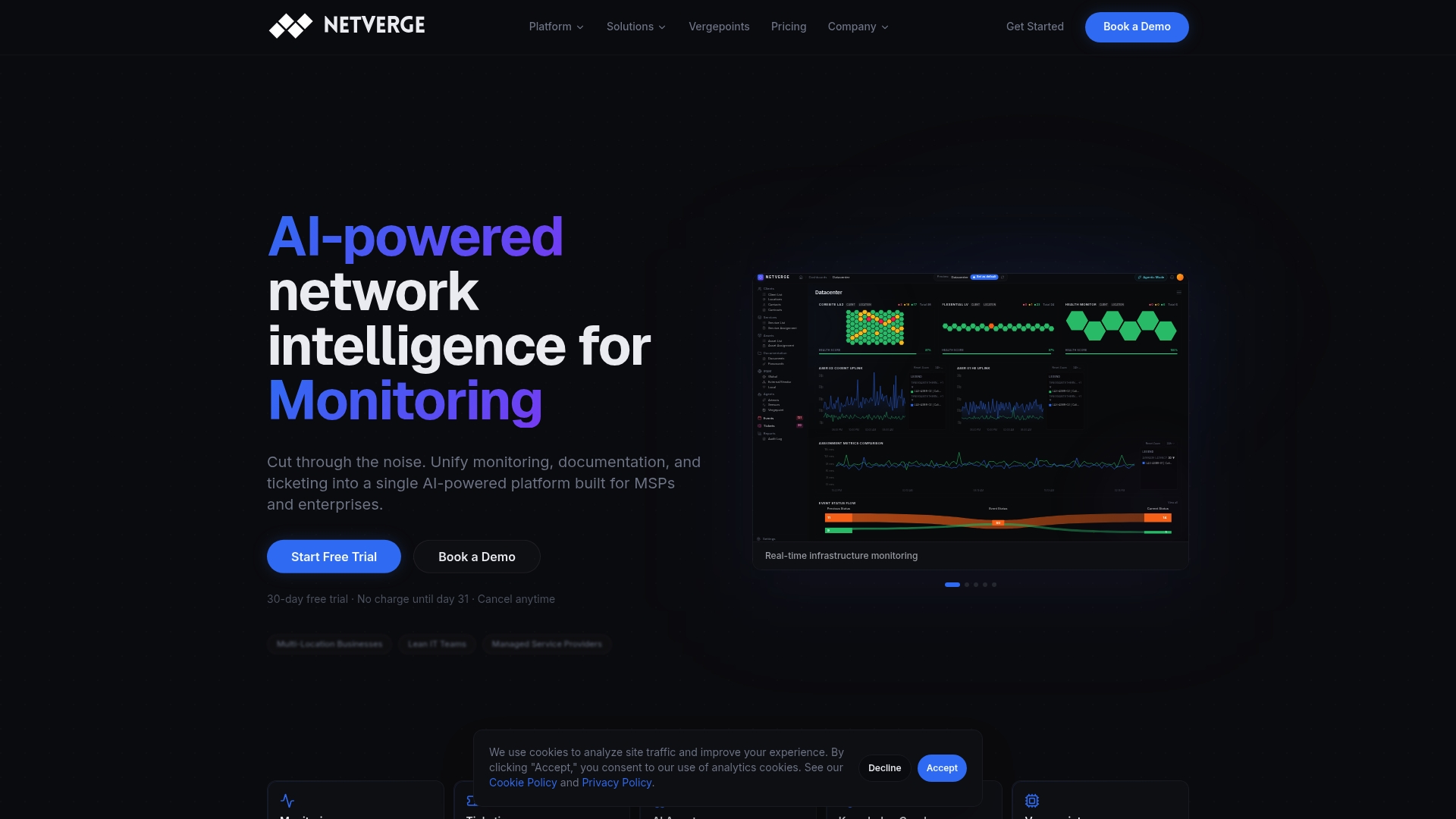
Netverge consolidates network visibility, documentation, ticketing, and automation into one AI-powered platform, purpose-built for MSPs and multi-location enterprises. The platform's AI-powered network monitoring ingests telemetry from across distributed infrastructure, correlates events in real time, and surfaces anomalies before they become outages. Vergepoints provide physical visibility at each location, feeding unified data into knowledge graphs and autonomous AI agents that diagnose and resolve issues automatically. For teams ready to move from fragmented tools to a single, governed data layer, Netverge delivers the architecture and the automation in one place. Request a demo to see the operational impact firsthand.
FAQ
What is network data unification?
Network data unification is the process of consolidating telemetry, logs, configuration records, and performance metrics from across a network into a single, governed data layer. It eliminates conflicting data sources and gives IT teams one reliable view of infrastructure health.
How does data unification reduce IT costs?
Unified data pipelines break 30–47% less often than fragmented ones, reducing maintenance overhead and engineering hours spent on manual correlation. Cisco IT saved 54 minutes per incident after centralizing observability data, which translates directly to lower operational costs at scale.
Why does AI require unified network data?
AI models trained on inconsistent or incomplete data produce unreliable outputs. Unified data provides the clean, correlated telemetry that anomaly detection, predictive maintenance, and automated triage require to function accurately.
What is the best way to start a data unification project?
Start with a single high-value domain, such as the data center, and target a measurable result within 60–90 days. Incremental pilots consistently outperform large-scale "big bang" migrations, which frequently fail over 12–18 month timelines.
How do shadow silos undermine data unification?
Shadow silos form when departments adopt tools independently, without IT governance or integration requirements. They grow silently and create new fragmentation even as formal unification efforts progress. Regular data source audits and a formal tool intake process are the most effective controls.