
Unified dashboards are defined as single-interface platforms that consolidate data from multiple sources into one centralized, real-time view. For IT professionals and business leaders, the benefits of unified dashboards are direct and measurable: organizations that make the switch reduce reporting time by 60% and achieve ROI gains of up to 295% over three years. Platforms like Tableau, Looker, and Snowflake have popularized the concept at the enterprise level, but the real shift happens when network monitoring, ticketing, and operational data all feed into one interface. Netverge is built exactly for that purpose, replacing fragmented tools with a single AI-powered view across your entire infrastructure.
1. Benefits of unified dashboards for decision-making speed
Fragmented dashboards force teams to reconcile data manually before any decision gets made. That reconciliation takes time your leadership does not have. Replacing seven dashboards with a single executive dashboard cuts report generation time from two days to two hours and boosts executive productivity by 40%. That is not a marginal gain. It is the difference between reacting to last week's data and acting on what is happening right now.

Forecast accuracy also improves significantly with consolidation. The same enterprise BI consolidation data shows forecast accuracy climbing from 68% to 89% after unification. Better forecasts mean better resource allocation, fewer emergency responses, and more confident budget decisions.
Key drivers of faster decision-making with unified dashboards:
- Single source of truth: All teams reference the same data, eliminating conflicting reports
- Live data streaming: Real-time feeds replace scheduled batch exports
- Automated alerts: Threshold breaches trigger notifications without manual monitoring
- Drill-down access: Leaders can move from summary to detail in one click
Pro Tip: Connect your dashboard to live data streams rather than scheduled refreshes. A dashboard that updates every 15 minutes is still a lagging indicator. Real-time telemetry feeds give you the early warning window that batch data cannot.
2. What cost savings do unified dashboards deliver?
The financial case for dashboard consolidation is concrete. Consolidating BI platforms into a unified architecture saves large organizations 30–50% on annual licensing costs alone. That figure does not include the hours saved from eliminating manual reporting cycles, which represent a significant hidden labor cost in most IT and operations teams.
Marketing and operations teams also recover wasted spend. Organizations that unify their data reduce wasted marketing spend by 47% by identifying which channels and campaigns are actually driving results. Without a unified view, that money disappears into attribution gaps.
| Metric | Fragmented dashboards | Unified dashboards |
|---|---|---|
| Annual BI licensing cost | Full multi-vendor cost | 30–50% lower |
| Report generation time | 2 days average | 2 hours average |
| Wasted marketing spend | Baseline | 47% reduction |
| 3-year ROI | Minimal or negative | Up to 295% gain |
| Forecast accuracy | ~68% | ~89% |
The ROI figure of up to 295% over three years reflects both direct cost savings and productivity gains. For IT leaders building a business case for consolidation, this table gives you the numbers to put in front of finance.
3. How unified dashboards improve team alignment
The greatest overlooked advantage of integrated dashboards is not speed or cost. It is the shared language they create across departments. When every team sees the same numbers, data disagreements disappear. Finance stops arguing with operations. Sales stops questioning the numbers marketing reports. That alignment accelerates cross-departmental decisions that previously stalled in reconciliation meetings.
Unified dashboards also reduce firefighting. When teams have forward-looking visibility into trends and anomalies, they address problems before they escalate. That shift from reactive to proactive is where operational efficiency gains compound over time.
Pro Tip: Resistance to a unified dashboard often comes from teams that previously "owned" their own data. Treat the rollout as a change management project, not just a technical migration. Assign a data champion in each department to advocate for the new system and address concerns early.
The cultural shift matters as much as the technology. Many dashboard initiatives fail not because of technical limitations but because teams resist giving up their siloed reports. Active change management is the difference between adoption and abandonment.
4. What unified dashboard features strengthen network monitoring?
Network monitoring is where unified dashboard features deliver the most direct operational value for IT teams. Modern unified dashboards function like cockpit instruments, pulling in streaming telemetry from across the network to give operators a continuous, real-time picture of infrastructure health. That visibility lets teams intercept issues before they become outages.
Netverge's real-time network monitoring platform is built on this principle. Hardware components like Vergepoints feed live sensor data directly into the dashboard, covering everything from device status to bandwidth utilization across distributed sites.
Key technical features that define effective network monitoring dashboards:
- Streaming telemetry: Continuous data ingestion from network devices, IoT sensors, and endpoints
- AI-powered anomaly detection: Automatic identification of traffic spikes, device failures, and configuration drift
- Automated audit trails: Timestamped logs of all network events, supporting HIPAA and SOX compliance requirements
- Role-based access control: Granular permissions ensuring each team sees only the data relevant to their function
- Data lineage tracking: Clear documentation of where each metric originates, building confidence in the numbers
"Automated audit trails integrated with dashboards support regulatory compliance and build executive trust." — Why Finance Teams Need Unified Dashboards
Continuous, automated risk monitoring replaces the periodic manual reviews that leave compliance gaps between audit cycles. For IT teams managing multi-location networks, that continuous coverage is not optional. It is the baseline for responsible infrastructure management.
5. How do unified dashboards impact leadership productivity?
Leadership teams that treat unified dashboards as revenue tools rather than IT costs get measurably different outcomes. The strategic impact of unified dashboards shows up in faster responses to market changes, better resource allocation, and higher confidence in forecasts presented to boards and investors.
The comparison below shows where the productivity gap between fragmented and unified approaches is widest at the leadership level.
| Leadership activity | Fragmented dashboards | Unified dashboards |
|---|---|---|
| Weekly reporting cycle | Manual compilation, 2+ days | Automated, available in hours |
| Strategic response time | Delayed by data reconciliation | Immediate, based on live data |
| Forecast confidence | ~68% accuracy | ~89% accuracy |
| Cross-team alignment | Requires reconciliation meetings | Built into shared data view |
| Compliance readiness | Manual audit preparation | Automated audit trail |
Executive teams using consolidated dashboards spend less time validating data and more time acting on it. That shift in how leadership time gets spent is where the 40% productivity improvement shows up in practice. For IT leaders making the case to the C-suite, framing unified dashboards as a productivity tool for executives, not just a technical upgrade, changes the conversation.
6. Why data quality determines dashboard success
A unified dashboard built on poor data does not solve the problem. It accelerates the display of incorrect information at scale. Data lineage and enforced semantic models are the foundation that makes consolidated dashboards trustworthy. Shared definitions for dimensions like date, product, and region prevent the confusion that undermines confidence in the numbers.
For network monitoring specifically, this means every metric flowing into the dashboard needs a clear origin. Netverge's network dashboard architecture enforces data lineage from the sensor level up, so teams can trace any anomaly back to its source device and timestamp.
The practical implication is that data governance work must precede dashboard consolidation. Teams that skip this step end up with a beautiful interface displaying numbers nobody trusts. That outcome is worse than fragmented dashboards because it creates false confidence.
Key takeaways
Unified dashboards deliver measurable gains in speed, cost, and alignment when built on clean data and supported by active change management.
| Point | Details |
|---|---|
| Decision speed improves significantly | Report generation drops from two days to two hours after consolidation. |
| Cost savings are immediate and compounding | BI licensing costs fall 30–50%, with ROI reaching up to 295% over three years. |
| Team alignment requires shared data | A single data view eliminates reconciliation meetings and cross-team data disputes. |
| Network monitoring needs real-time telemetry | Streaming data and AI anomaly detection catch issues before they become outages. |
| Data quality is non-negotiable | Enforced semantic models and data lineage are prerequisites for dashboard trust. |
What I've learned from watching dashboard consolidations succeed and fail
The organizations that get the most from unified dashboards share one trait: they treat data quality as a prerequisite, not an afterthought. I have seen teams invest in consolidation projects, build impressive interfaces, and then watch adoption collapse because the underlying data was inconsistent. When finance sees a revenue number that does not match what sales reported last week, trust in the dashboard evaporates fast.
The second pattern I keep seeing is underestimating the cultural dimension. Revealing bottlenecks that were previously hidden creates resistance that no amount of technical elegance can overcome. Teams that owned their own reporting processes feel exposed when a unified view makes their numbers visible to everyone. The fix is not better software. It is deliberate change management, starting with leadership alignment and working down.
The third lesson is about automation. The dashboards that deliver sustained value are the ones connected to live data streams and automated alerts. Static dashboards that require manual updates become shelfware within six months. Real-time feeds, automated anomaly detection, and AI-driven triage keep the dashboard relevant and actively used. That is the difference between a tool your team checks daily and one they stopped opening in Q2.
— Jim
Netverge brings unified visibility to your network operations
IT teams managing distributed networks need more than a reporting tool. They need a platform that consolidates monitoring, ticketing, and event management into one live view.
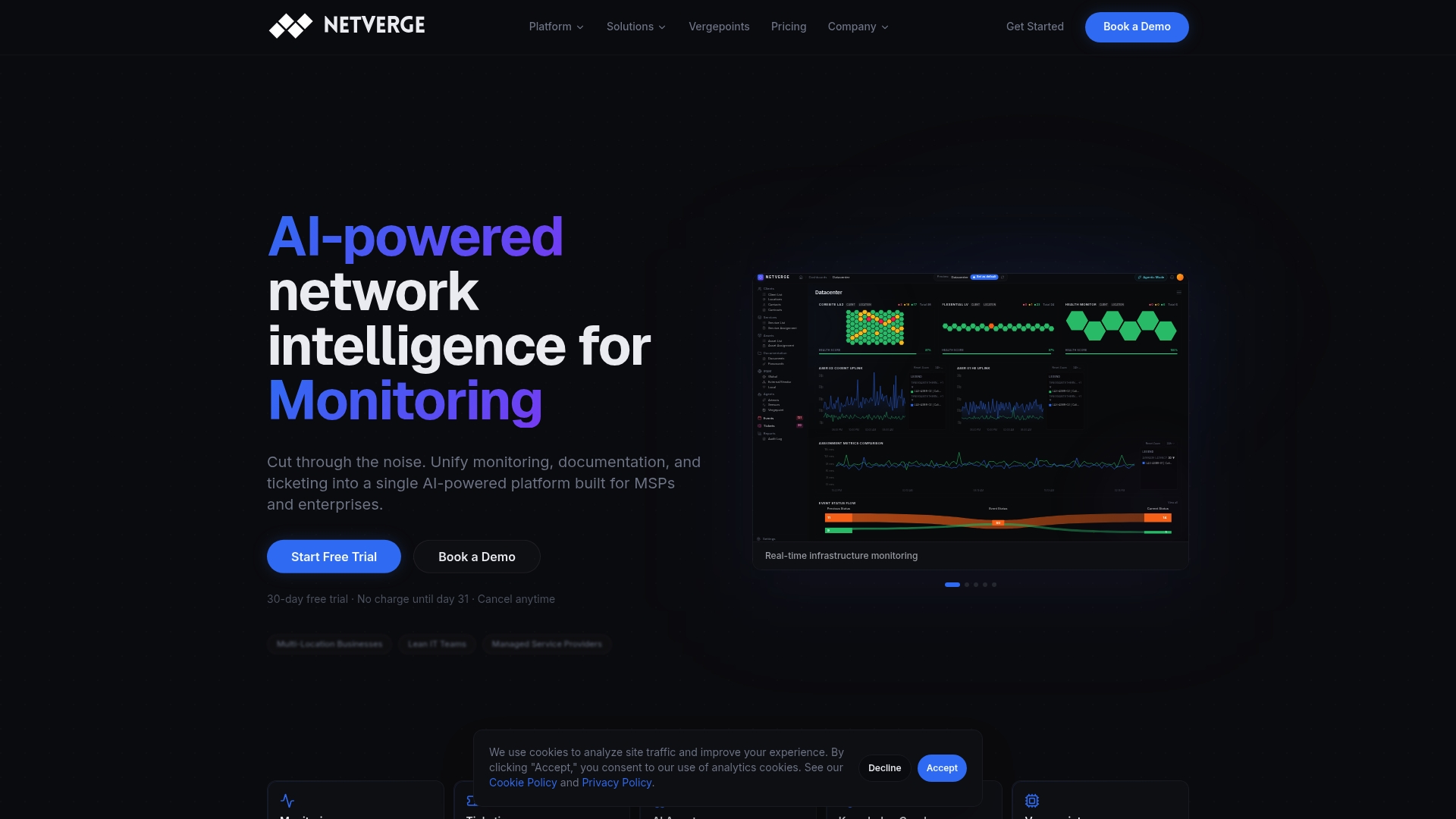
Netverge delivers exactly that. The platform's AI-powered monitoring pulls real-time telemetry from across your infrastructure, flags anomalies automatically, and routes incidents through integrated ticketing without manual intervention. Vergepoints hardware extends physical visibility to every site, feeding data directly into the unified dashboard. For MSPs and multi-location enterprises ready to replace fragmented tools with a single intelligent interface, Netverge is built for that exact transition. Visit netverge.com to request a demo or estimate your cost with the pricing calculator.
FAQ
What are the main benefits of unified dashboards?
Unified dashboards reduce reporting time by 60%, improve forecast accuracy from 68% to 89%, and deliver ROI of up to 295% over three years. They also eliminate data disagreements across teams by providing a single source of truth.
How do unified dashboards improve network monitoring?
Unified dashboards pull streaming telemetry from network devices and sensors into one real-time view, enabling AI-powered anomaly detection and automated alerts that catch issues before they cause outages.
What is the biggest risk when implementing a unified dashboard?
Poor data quality is the primary risk. A unified dashboard built on inconsistent or poorly governed data accelerates the display of incorrect information, which destroys team trust in the system.
How much can organizations save by consolidating dashboards?
Large organizations save 30–50% on annual BI licensing costs by consolidating platforms. Combined with reduced labor hours and lower wasted spend, the total ROI can reach 295% over three years.
Why do unified dashboard projects fail?
Most failures trace back to change management gaps, not technical problems. When teams resist giving up siloed reports and leadership does not actively manage the transition, adoption stalls regardless of how capable the platform is.