
Root cause analysis AI is the application of machine learning, causal modeling, and data correlation techniques to automatically identify the true underlying causes of complex system failures, rather than just their visible symptoms. Where a traditional root cause analysis (RCA) investigation might take a team of engineers days of manual log review and hypothesis testing, AI-powered RCA compresses that process to minutes of output, processing thousands of variables simultaneously. Platforms like Coroot, Databricks, and causaLens are actively advancing this technology across IT and manufacturing environments.
The core capabilities of root cause analysis AI include:
- Automated data ingestion from logs, sensors, telemetry, and unstructured sources like technician notes
- Anomaly detection by comparing live signals against learned behavioral baselines
- Signal correlation across multiple systems and time windows to surface linked deviations
- Causal ranking of probable root causes using statistical and causal discovery algorithms
- Continuous learning that improves diagnostic accuracy with each resolved incident
How AI performs root cause analysis step by step
AI-powered RCA follows a structured workflow that replaces manual guesswork with systematic, data-driven diagnosis. Understanding each step helps you evaluate where AI fits into your existing operations.
- Data collection. The AI ingests structured data (sensor readings, performance metrics, maintenance logs) and unstructured data such as technician notes, using NLP to connect textual evidence with sensor anomalies.
- Baseline learning. The system builds behavioral models from historical data, establishing what "normal" looks like for each monitored component or service.
- Anomaly detection. When live data deviates from the learned baseline, the AI flags the deviation and timestamps it for correlation.
- Signal correlation. The AI maps relationships between anomalies across systems and time, identifying which deviations cluster together and likely share a common origin.
- Causal discovery. Algorithms rank candidate root causes by probability, using causal models rather than simple correlation to distinguish actual drivers from coincidental patterns.
- Human validation. The AI presents evidence-backed hypotheses to analysts, who confirm, reject, or refine the suggested causes before remediation begins.
- Feedback and learning. Validated outcomes update the AI's knowledge base, so each incident improves future diagnostic accuracy.
Pro Tip: Before deploying AI RCA, run a data sufficiency check on your historical logs and sensor feeds. Sparse or inconsistent historical data produces weak correlations and undermines the system's baseline models from day one.
Why AI-enabled RCA outperforms traditional methods
The efficiency gap between AI-driven and manual root cause analysis is measurable and wide. AI-powered RCA resolves issues up to 75% faster and cuts investigation effort by 50% compared to traditional approaches, compressing diagnostic cycles from hours to minutes.
Key figure: Organizations using AI for root cause analysis report significantly faster issue resolution and a notable reduction in engineering effort, according to causal ML research.
Traditional RCA depends on experienced engineers manually reviewing logs, convening meetings, and testing hypotheses sequentially. That process is slow, incomplete, and heavily dependent on individual expertise. AI removes those bottlenecks by analyzing thousands of variables in parallel and surfacing ranked candidates automatically.
| Dimension | Traditional RCA | AI-powered RCA |
|---|---|---|
| Speed | Hours to days | Minutes |
| Variable scope | Limited by analyst capacity | Thousands simultaneously |
| Hypothesis testing | Manual and sequential | Automated and ranked |
| Data sources | Primarily structured | Structured and unstructured |
| Learning over time | Relies on human memory | Continuous knowledge base updates |
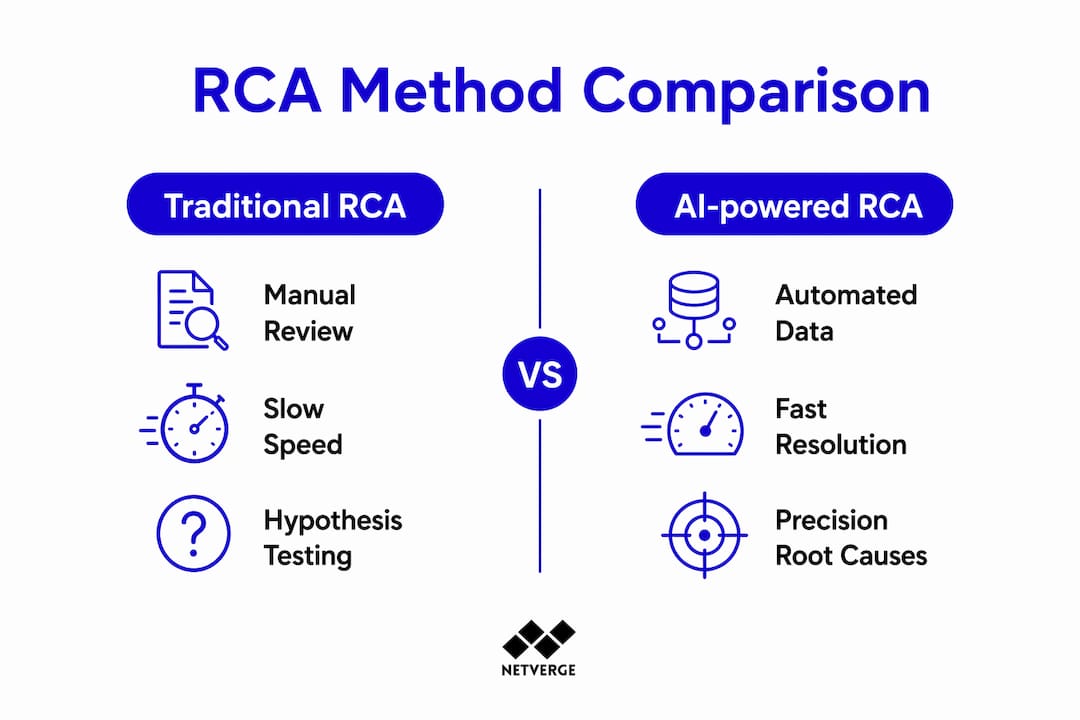
Beyond speed, AI RCA improves precision. It isolates true root causes rather than stopping at surface symptoms, which reduces recurrence. And because each incident updates the knowledge base, the system gets more accurate over time rather than plateauing.

How causal AI takes root cause accuracy further
Standard machine learning finds correlations. Causal AI finds cause-and-effect relationships, and that distinction determines whether you fix the actual problem or just its most visible symptom.
Causal AI models, such as those used by Databricks in manufacturing RCA workflows, encode prior domain knowledge into causal Bayesian networks. These networks represent the actual dependencies between system components, so when a failure occurs, the model can trace the causal chain rather than flagging every correlated variable. Research from the University of South Carolina's Artificial Intelligence Institute, in collaboration with the Bosch Center for Artificial Intelligence, demonstrates this with a rocket assembly line dataset: a causal neuro-symbolic AI framework identified failure causes, suggested corrective interventions, and generated counterfactual scenarios to prevent recurrence.
causaLens has built its platform around this principle, applying causal discovery algorithms to enterprise datasets where correlation-based models routinely misidentify symptoms as causes. The practical result in complex manufacturing environments is fewer false positives, faster confirmation of the true driver, and better-targeted corrective actions.
| AI approach | Basis | Risk | Best fit |
|---|---|---|---|
| Correlation-based ML | Statistical co-occurrence | Confounds symptoms with causes | Simple, well-instrumented systems |
| Causal AI | Cause-and-effect modeling | Requires domain knowledge input | Complex, multi-variable environments |
Enterprise AI systems must also provide transparent, explainable recommendations so analysts understand what the model considered and why it ranked causes as it did. Without that explainability, adoption stalls regardless of accuracy.
Where AI-powered RCA is already working in manufacturing and IT
The clearest evidence for AI RCA comes from production environments where the cost of downtime is concrete and measurable.
Manufacturing use cases:
- Sensor correlation detecting process drift causing dimensional defects on assembly lines before a batch is scrapped
- Predictive maintenance systems flagging bearing wear patterns in rotating equipment days before failure
- Quality control AI tracing surface defects back to upstream temperature deviations in coating processes
- Rocket assembly line diagnostics using causal neuro-symbolic AI to identify missing components and suggest corrective interventions
IT incident management use cases:
- Network outage diagnosis using telemetry correlation across logs, metrics, and traces to rank probable causes automatically
- Application performance degradation traced to a specific microservice dependency failure rather than the downstream service showing the error
- Security incident triage correlating authentication anomalies, traffic spikes, and configuration changes to identify the entry point
Databricks documents this shift in manufacturing: moving from reactive RCA meetings to proactive intelligence, where every incident feeds a growing knowledge base that makes the next investigation faster and more accurate.
How Netverge applies AI RCA principles to network operations

Netverge's platform is a working example of AI root cause analysis applied to distributed network infrastructure. The system unifies telemetry from across your network into a single interface, then applies AI to detect anomalies, correlate signals, and triage incidents automatically.
The platform's core capabilities map directly onto the RCA workflow described above:
- Real-time anomaly detection flags deviations from learned baselines across all monitored nodes
- Automated troubleshooting correlates signals across the network to surface ranked probable causes
- Intelligent ticket triage routes incidents to the right team with context already attached
- Vergepoints hardware provides physical visibility at distributed sites, feeding structured telemetry into the AI layer
- Knowledge graphs retain causal models and incident outcomes, improving future diagnostic accuracy
Pro Tip: Netverge's AI agent designer lets you build custom automation workflows without writing code, so you can encode your team's institutional knowledge directly into the RCA process.
For IT teams managing multi-location infrastructure, the AI-powered troubleshooting approach Netverge delivers means engineers spend less time gathering data and more time acting on it. AI serves as a force multiplier for analysts, not a replacement for their judgment.
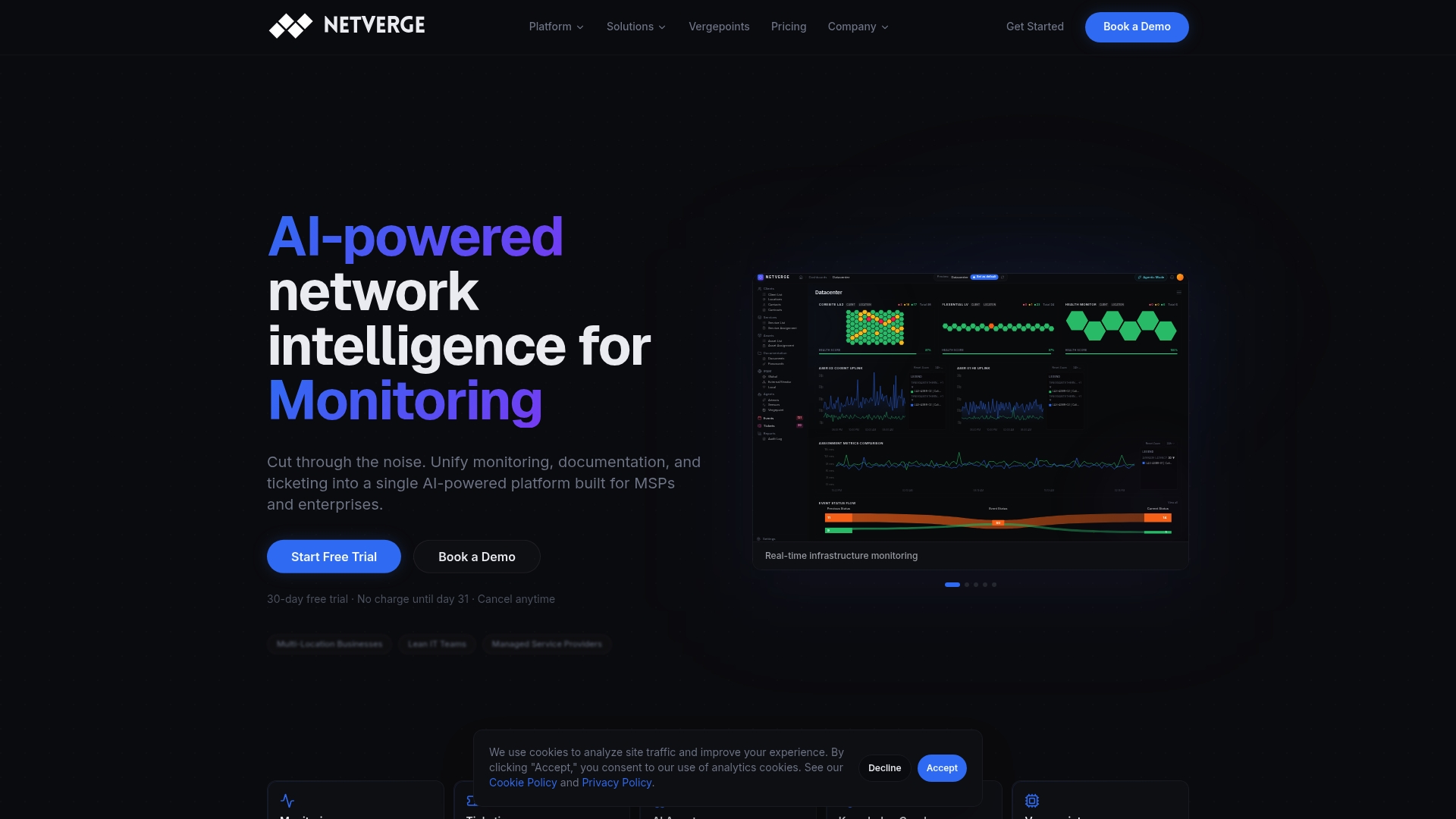
Explore how Netverge's AI network monitoring platform puts these RCA capabilities to work for your infrastructure today.
Key Takeaways
AI-powered root cause analysis resolves issues substantially faster than traditional methods by automating data correlation, causal ranking, and hypothesis validation across thousands of variables simultaneously.
| Point | Details |
|---|---|
| Speed and effort gains | AI RCA resolves issues up to 75% faster and cuts investigation effort by 50% versus manual methods. |
| Causal AI vs. correlation | Causal AI models cause-and-effect relationships, avoiding the common mistake of treating symptoms as root causes. |
| Human-AI collaboration | AI surfaces ranked, evidence-backed hypotheses; human analysts confirm and act, keeping expert judgment central. |
| Continuous improvement | Each resolved incident updates the AI knowledge base, making every future investigation more accurate. |
| Network operations example | Netverge applies AI RCA principles to distributed network monitoring, automating anomaly detection and incident triage. |