
A knowledge graph is a structured representation of real-world entities and their explicit relationships, where those relationships are first-class, queryable data rather than hidden inside complex multi-table joins. In network management, entities are concrete: routers, switches, interfaces, services, customers, and tickets. The connections between them carry meaning. A knowledge graph does not just store that a router exists; it captures that the router hosts a service, that the service is under a customer SLA, and that a downstream interface is currently degraded.
For MSPs and network engineers using AI-powered tools, this structure is the foundation for everything from anomaly detection to automated root cause analysis. Netverge's platform applies this model directly, using a knowledge graph module to unify infrastructure data and power its AI agents.
At a glance, a knowledge graph consists of:
- Entities (nodes): Devices, services, customers, tickets, interfaces
- Relationships (edges): Typed, directional connections with explicit meaning
- Semantics: Formal definitions that let AI reason across the graph, not just traverse it
Table of Contents
- How knowledge graphs differ from traditional databases
- Why ontology and semantics are the core of a knowledge graph
- What makes an enterprise knowledge graph different
- How knowledge graphs power AI-driven network monitoring
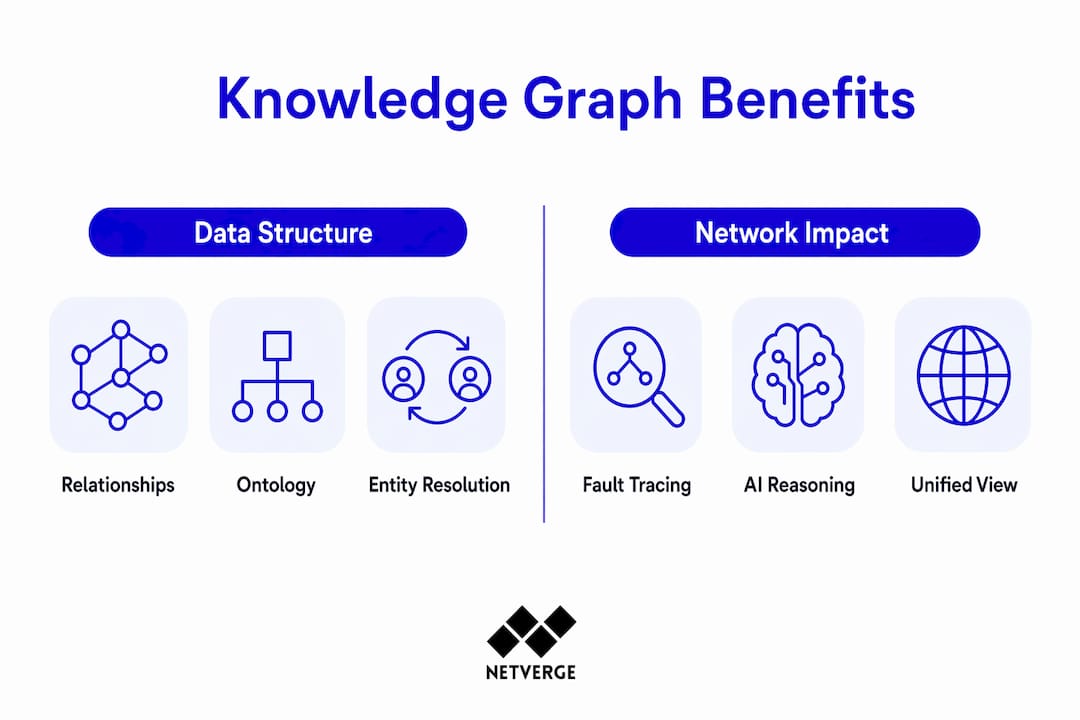
- Benefits of knowledge graphs in network management
How knowledge graphs differ from traditional databases
Relational databases store data in tables connected by foreign keys. Querying relationships requires joins, and as the number of hops grows, query complexity and latency grow with it. A three-hop dependency trace across a relational schema can require dozens of joined tables.
Graph databases store relationships natively, allowing fast traversal regardless of depth. A knowledge graph adds a semantic layer on top, meaning every node and edge carries a defined type and meaning, not just an identifier. This distinction matters for network troubleshooting, where you need to trace a fault from an application through its underlying network path in a single query.
Key differences at a glance:
- Query complexity: Relational joins multiply with each hop; graph traversal stays efficient
- Schema flexibility: Relational schemas require migration to add new entity types; graph schemas evolve without restructuring
- Relationship representation: Foreign keys imply relationships; graph edges make them explicit and typed
- Reasoning capability: Traditional databases store facts; knowledge graphs enable inference from those facts
Why ontology and semantics are the core of a knowledge graph
A plain graph stores nodes and edges. A knowledge graph adds formal ontology: a specification of what each entity type means, what relationships are valid between them, and what constraints apply. Ontology defines what each entity and relationship type means, enabling automated reasoning beyond mere connection storage.
Without ontology, a graph cannot distinguish a "monitored-by" relationship from a "depends-on" relationship. With it, an AI agent can infer that if a monitoring sensor reports degradation on interface A, and interface A is depended on by service B, then service B is at risk. That inference chain is only possible when the graph carries semantic meaning.
Ontology also governs vocabulary consistency across teams and source systems. When your network management database calls a device a "node" and your ticketing system calls it an "asset," the ontology maps both to a canonical entity type. The semantic layer models rich entity relationships, giving AI the infrastructure context it needs to act accurately.
Ontology and semantics deliver:
- Standardized vocabulary across all integrated data sources
- Formal constraints that prevent invalid relationship types
- Inference rules that generate new facts from existing ones
- Multi-hop dependency tracing in a single semantic query
What makes an enterprise knowledge graph different
An enterprise knowledge graph adds governance, provenance, and entity resolution on top of the core graph structure. Enterprise knowledge graphs add formal ontology governance and provenance tracking to maintain consistency and traceability across teams and data sources.
Continuous entity resolution is critical: when your CMDB, monitoring platform, and ticketing system each use different identifiers for the same physical device, the graph must resolve them into a single canonical entity. Without this, you get duplicate nodes and broken relationship chains. Ontology and provenance governance ensures consistent terms and traceability, which is what makes collaborative querying across teams reliable.
Enterprise-grade features include:
- Formal ontology governance: Shared definitions enforced across all ingestion pipelines
- Entity resolution: Canonical identifiers unified from multiple source systems
- Provenance tracking: Every fact traces to its source system, extraction method, and timestamp
- Access controls: Stewardship roles and quality validation per data domain
- Continuous ingestion: Near real-time synchronization keeps the graph current
How knowledge graphs power AI-driven network monitoring
A knowledge graph acts as a semantic integration layer on top of existing data systems, not a replacement for them. It unifies telemetry, configuration data, and ticketing records into a digital twin of your physical network. AI agents query this unified graph to detect anomalies, trace dependencies, and recommend or execute remediation.

Multi-hop reasoning allows tracing faults from applications through underlying network devices and interfaces during troubleshooting. Instead of manually correlating alerts across three separate dashboards, an AI agent traverses the graph from the affected service down to the physical interface in a single query. Netverge's AI-powered monitoring platform uses this approach, combining Vergepoints hardware sensors with a knowledge graph backend to deliver real-time anomaly detection and automated ticket triage.
Pro Tip: When evaluating AI network tools, ask whether the AI reasons over a knowledge graph or just correlates raw telemetry. Graph-based reasoning traces root cause across dependency chains; telemetry correlation only flags symptoms.
For teams building toward this architecture, understanding knowledge architecture for AI is a practical starting point for structuring data your AI agents can actually use.
Benefits of knowledge graphs in network management
The operational advantages are concrete and measurable in day-to-day network operations:
- Unified visibility: All infrastructure data, from physical hardware to logical services, is queryable from one graph
- Faster root cause analysis: Multi-hop traversal replaces manual correlation across siloed tools
- Proactive incident detection: AI agents identify at-risk services before tickets are opened, using dependency relationships in the graph
- Reduced alert fatigue: Semantic context filters noise by distinguishing correlated alerts from independent ones
- Accurate documentation: The graph reflects live infrastructure state, not a snapshot from last quarter's CMDB export
- Scalable automation: AI agents built on a knowledge graph can handle new device types and relationship patterns without retraining from scratch
- Cross-team collaboration: Shared ontology means network engineers, NOC staff, and MSP account managers query the same data with consistent terminology
Netverge's network data unification approach demonstrates how eliminating data silos through a knowledge graph directly reduces mean time to resolution across distributed client environments.
Knowledge graphs are the structural foundation that separates reactive network monitoring from genuinely intelligent, AI-driven operations.
| Point | Details |
|---|---|
| Relationships are first-class data | A knowledge graph makes connections between entities directly queryable, unlike foreign keys in relational tables. |
| Ontology enables AI reasoning | Formal ontology gives the graph semantic meaning, allowing AI agents to infer new facts and trace multi-hop dependencies. |
| Entity resolution prevents duplication | Canonical identifiers must unify the same device across CMDB, monitoring, and ticketing systems. |
| Provenance builds operational trust | Every fact in an enterprise knowledge graph traces to its source system and timestamp for auditability. |
| Digital twin enables proactive management | Unifying telemetry and configuration data into a graph creates a live model AI can act on before incidents escalate. |
Netverge's AI-powered platform puts a governed knowledge graph at the center of your network operations, connecting Vergepoints sensor data, configuration records, and ticketing into a single queryable model. See how it works for your infrastructure at netverge.com/monitoring.