
Autonomous troubleshooting is the automated process of detecting, diagnosing, and resolving network problems without manual intervention. The role of autonomous troubleshooting in modern network operations is significant: engineers spend 30–40% of their time on manual validation and ticketing workflows that AI-driven systems can handle automatically. That recaptured time translates directly into faster incident response, fewer human errors, and more capacity for high-value engineering work. This article covers how automated troubleshooting works, where it delivers the most value, where it still falls short, and how IT teams can implement it without losing operational control.
What is the role of autonomous troubleshooting in network operations?
Autonomous troubleshooting, also called self-healing network automation or agentic network operations, covers the full cycle from anomaly detection through root cause analysis to remediation. It replaces the manual steps that slow incident response: log review, ticket creation, cross-team escalation, and change verification. The result is a tighter feedback loop between detection and resolution.
The benefits show up across three operational dimensions.
Speed and mean time to resolution
Faster resolution is the most visible gain. A multi-vendor AI-native architecture in a live telco environment resolved an outage in just minutes by shifting network applications autonomously. That outcome is not achievable with manual workflows, where even a well-staffed team needs time to gather evidence, align on a diagnosis, and execute a fix.
Governance and auditability
Automated incident resolution standardizes fixes and creates auditable trails, eliminating the inconsistent responses that occur when engineers work under pressure. Every automated action is logged with a timestamp, a triggering condition, and the remediation applied. That record satisfies compliance requirements and makes post-incident reviews far more productive.
Error reduction and consistency
Human error during network changes is a leading cause of outages. Automated troubleshooting applies the same logic every time, without fatigue or distraction. The consistency benefit compounds over time: repeated incidents get resolved faster as the system refines its response patterns.
Key autonomous troubleshooting benefits at a glance:
- Reduced mean time to resolution (MTTR) through automated root cause analysis
- Standardized incident response with full audit trails
- Recaptured engineer time from manual validation and ticketing
- Lower risk of human error during network changes
- Continuous monitoring without shift-based coverage gaps
How does autonomous troubleshooting work in complex networks?
The technical foundation of autonomous troubleshooting rests on three components: telemetry collection, AI-based analysis, and automated remediation. Each layer depends on the quality of the one below it.

AI agent hierarchies
Hierarchies of specialized AI agents improve diagnostic accuracy by assigning different agents to different domains. One agent monitors routing tables, another tracks interface utilization, and a third correlates application performance with underlying infrastructure. These agents work concurrently, which compresses the time needed to isolate a fault to a specific layer or device.
Telemetry, logs, and configuration data
Effective automated diagnosis requires telemetry from every relevant source: SNMP traps, syslog streams, NetFlow records, API-based device state, and configuration snapshots. Gaps in telemetry create blind spots that cause misdiagnosis. The system needs a complete picture of device state at the moment of the incident, not just the alert that triggered the investigation.
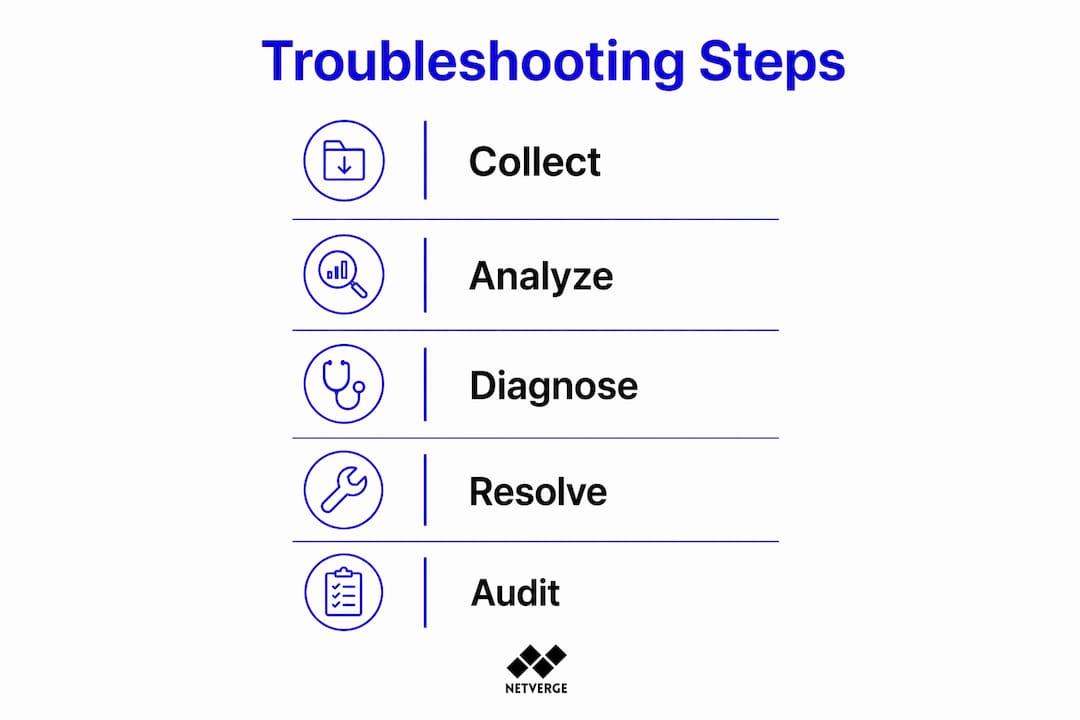
Digital twins for change management
Building a full-fidelity digital twin of a production network requires modeling every device, dependency, and vendor-specific behavior. That model lets the system predict the impact of a proposed change before it executes. Change verification through a digital twin is one of the most underused capabilities in network automation, and it directly reduces the risk of automated remediation causing secondary outages.
Device aliasing and topology awareness
Device aliasing and topology awareness are critical to avoiding misdiagnosis in multi-domain networks. When devices share overlapping IP addresses or non-unique hostnames, an AI agent without proper topology context will correlate alerts to the wrong device. This is one of the most common failure points in early autonomous troubleshooting deployments.
Pro Tip: Before deploying any AI-based troubleshooting agent, audit your network inventory for duplicate hostnames and overlapping IP ranges. Resolving aliasing issues before deployment prevents a large class of misdiagnosis errors.
What are the current limitations of autonomous troubleshooting?
Autonomous troubleshooting is not a complete replacement for human judgment. Understanding where it breaks down helps you design a system that stays reliable under pressure.
AI models trained on historical patterns lack the real-time heuristic expertise needed for novel failure scenarios. When a failure mode has no precedent in the training data, the system either misclassifies the incident or escalates without a diagnosis. That gap is significant in environments that change frequently through new hardware, new applications, or new vendor integrations.
The current limitations include:
- Novel incidents: AI cannot reliably diagnose failure modes it has not seen before. Human engineers must handle genuinely new scenarios.
- Incomplete telemetry: Mislabeling root causes due to incomplete telemetry is a documented pitfall. Partial visibility produces confident but wrong diagnoses.
- The observability paradox: More automation increases telemetry volume, which can actually extend the time needed to understand an outage. More data is not always clearer data.
- Automation opacity: When an automated system takes an action, engineers need to understand why. Without explainability, trust erodes and teams start bypassing automation rather than improving it.
- Skill erosion: Engineers who rely entirely on automated troubleshooting lose the manual diagnostic skills needed when automation fails. This is a long-term organizational risk.
The observability paradox deserves particular attention. As you add more sensors, agents, and automated workflows, the volume of telemetry grows faster than your team's ability to interpret it. The solution is not less automation. It is better signal prioritization and correlation, which is exactly where well-designed AI agents add value when they are configured correctly.
How can IT teams implement autonomous troubleshooting effectively?
Successful implementation follows a clear sequence. Skipping steps, particularly the data quality and governance steps, produces systems that generate noise rather than resolution.
Audit and complete your telemetry coverage. Map every device, link, and application against your current monitoring coverage. Identify gaps before deploying any AI agent. An agent operating on incomplete data will produce unreliable diagnoses.
Build and validate a network topology model. Your AI agents need an accurate map of device relationships, not just a device list. This model is the foundation for correct root cause analysis and change impact prediction.
Start with explainable AI workflows. Choose systems that surface human-readable evidence for every automated decision. Human-readable evidence contracts and manual override capabilities are not optional features. They are the mechanism by which engineers build trust in automated decisions over time.
Run a pilot program on a defined network segment. Deploy autonomous troubleshooting on a subset of your infrastructure first. Measure MTTR, false positive rates, and engineer time saved. Use that data to refine thresholds before expanding.
Define governance policies for automated remediation. Not every fix should be automated without approval. Classify incidents by risk level and require human confirmation for changes that affect core routing, authentication, or security policy.
Maintain manual troubleshooting skills. Schedule regular exercises where engineers diagnose and resolve incidents without automation assistance. This preserves the judgment needed when automated systems escalate or fail.
Pro Tip: Treat your first autonomous troubleshooting deployment as a data collection exercise, not a cost-cutting measure. The insights from a well-instrumented pilot will shape a far more effective full deployment.
Automated network diagnostics work best when the underlying data model is accurate and the governance rules are explicit. Platforms that combine AI agents with no-code workflow builders let network administrators customize remediation logic without writing code, which shortens the gap between pilot and production.
The importance of automated troubleshooting grows as networks scale. Multi-location enterprises and MSPs managing dozens of client environments cannot rely on manual incident response at scale. Autonomous systems provide consistent coverage across every site, every shift, and every time zone.
My honest assessment of where autonomous troubleshooting stands
I have watched IT teams adopt network automation in waves over the past decade. The current wave, driven by agentic AI and real-time telemetry, is genuinely different from earlier rule-based automation. The diagnostic capability is orders of magnitude better. But the adoption mistakes are remarkably similar to the ones teams made with earlier automation tools.
The most common mistake is treating autonomous troubleshooting as a black box that you deploy and forget. Engineers who do not understand what their AI agents are doing cannot improve them, cannot trust them, and cannot catch the cases where the system is confidently wrong. AI accelerates alert correlation and anomaly detection but cannot fully replace human judgment for complex root cause analysis. That boundary is not a flaw. It is the correct division of labor.
The teams I have seen succeed with autonomous troubleshooting share one trait: they invest as much in the human side as the technical side. They train engineers to read AI-generated evidence, question automated diagnoses, and override when something does not add up. Autonomous troubleshooting requires trust in AI interventions, and that trust is built through verified models and rigorous testing, not through blind deployment.
My advice: start smaller than you think you need to, instrument everything, and treat every false positive as a data point rather than a failure. The teams that do this consistently end up with systems that genuinely reduce operational load. The teams that rush to full deployment end up with automation they do not trust and engineers who have learned to work around it.
— Jim
Netverge brings autonomous troubleshooting into a single platform
Netverge unifies AI-powered monitoring, anomaly detection, and automated remediation into one platform built for MSPs and multi-location enterprises. The AI-powered monitoring platform provides real-time telemetry, knowledge graphs, and autonomous AI agents that diagnose and resolve issues automatically, with full audit trails for every action. Netverge's no-code agent designer lets your team build and customize troubleshooting workflows without writing code, so you can move from pilot to production faster. Vergepoints hardware delivers physical network observability that feeds your AI agents with accurate, complete telemetry from day one.
FAQ
What is autonomous troubleshooting in networking?
Autonomous troubleshooting is the automated process of detecting, diagnosing, and resolving network faults without manual intervention. It uses AI agents, telemetry data, and predefined remediation workflows to close the gap between alert and resolution.
How much time can autonomous troubleshooting save engineers?
Engineers currently spend 30–40% of their time on manual validation and ticketing workflows. Autonomous troubleshooting automates these tasks, freeing that time for higher-value engineering work.
What are the biggest challenges in autonomous troubleshooting?
The main challenges are incomplete telemetry, AI blind spots for novel failure scenarios, and the observability paradox, where more automation produces more data than teams can easily interpret. Governance policies and human-in-the-loop overrides address most of these risks.
Does autonomous troubleshooting replace network engineers?
Autonomous troubleshooting does not replace network engineers. It handles repetitive, well-defined incidents automatically while escalating complex or novel failures to human engineers who provide judgment and context that AI cannot replicate.
How do I start implementing autonomous troubleshooting?
Start with a full telemetry audit and a validated network topology model. Then run a step-by-step pilot on a defined network segment, measure results, and expand incrementally with explicit governance policies for automated remediation.
Key takeaways
Autonomous troubleshooting delivers the most value when accurate telemetry, explainable AI, and human oversight work together as a system rather than in isolation.
| Point | Details |
|---|---|
| Time savings are real but conditional | Engineers recapture 30–40% of manual workflow time only when telemetry coverage is complete and AI models are validated. |
| Governance is non-negotiable | Automated remediation must produce auditable logs and support manual overrides to maintain compliance and engineer trust. |
| AI has a hard limit on novel incidents | AI agents trained on historical data cannot reliably diagnose failure modes they have not encountered before. |
| Pilot before full deployment | A scoped pilot on one network segment produces the data needed to tune thresholds and governance rules before scaling. |
| Human skills must be preserved | Engineers who stop practicing manual diagnosis lose the judgment needed when automated systems escalate or fail. |