
For MSPs and large enterprises, SaaS application monitoring means continuously tracking the performance, availability, security, and cost of cloud-delivered applications across every client tenant — and the most effective approach combines centralized, multi-tenant, AI-enabled monitoring with multi-source signal validation and automated triage. Centralized monitoring with agentic AI can reduce unnecessary "ghost" helpdesk tickets by up to 70%, giving NOC teams proactive visibility instead of reactive firefighting. Netverge maps directly to these requirements, unifying telemetry, tenant mapping, and autonomous agents into a single platform built for MSP and enterprise scale.
Table of Contents
- What does SaaS application monitoring actually cover?
- How do you evaluate and procure a SaaS monitoring platform?
- What does agentic AI actually do for SaaS monitoring?
- What does a realistic rollout timeline look like?
- How should you architect integrations and handle security?
- How does Netverge meet the MSP and enterprise procurement checklist?
- Key Takeaways
- Why AI-first monitoring is an operational decision, not a feature choice
- See Netverge in action for your environment
- Recommended reading and sources
What does SaaS application monitoring actually cover?
SaaS application monitoring spans several distinct observability layers, each contributing different signal types to a complete picture of application health.
Core signal types to collect:
- Metrics: Response times, error rates, uptime percentages, and resource utilization per application and per tenant
- Logs: Access logs, permission changes, authentication events, and audit trails
- Traces: Request-level tracing across distributed SaaS APIs to pinpoint latency sources
- Real user monitoring (RUM) and synthetic checks: Actual user experience data plus scripted probes that confirm availability from specific locations
- Vendor status pages: Useful for context, but vendor status pages are often delayed and omit partial degradations
- Community and third-party signals: Crowd-sourced outage reports that surface faster than vendor acknowledgments
- Identity and access signals: Anomalous login patterns, privilege escalations, and orphaned accounts
Scope for MSPs and enterprises: Enterprises use a large number of SaaS applications, and MSPs typically manage multiple applications per client. Per-tenant mapping is not optional at that scale. You need to attribute every alert and every degradation to a specific client environment, isolate impact across tenants, and generate per-client SLA evidence without cross-contaminating data.
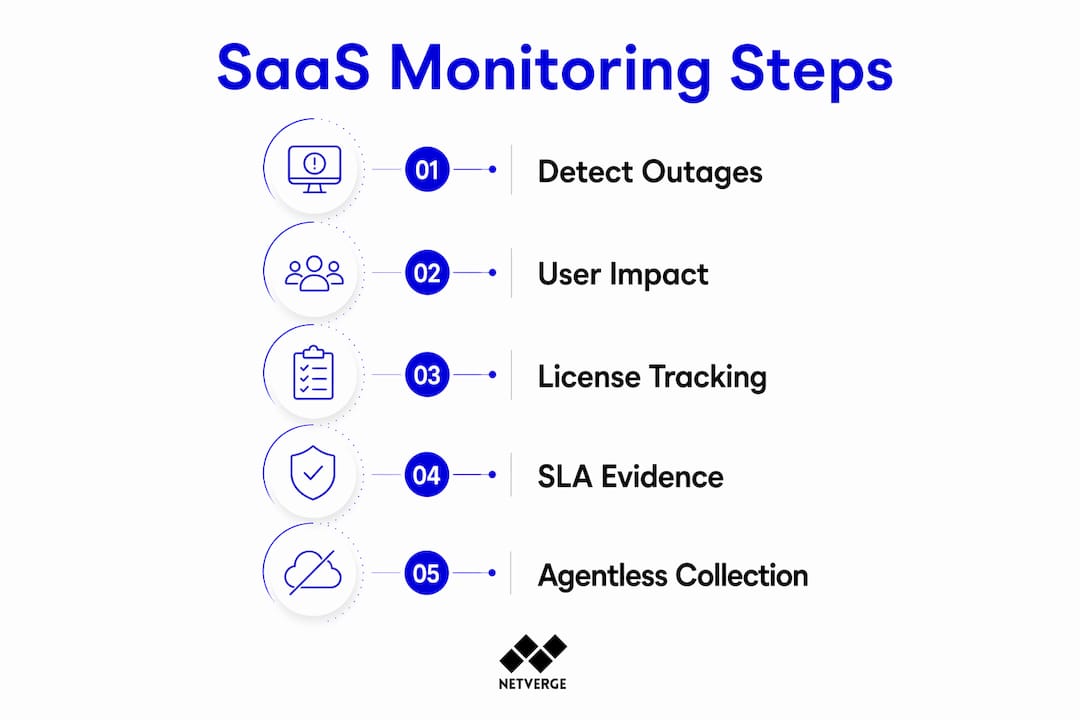
Common use cases include outage detection and user-impact triage, license and entitlement monitoring, SLA evidence capture for dispute resolution, and cost and usage optimization.
Agent vs. agentless: Agentless collection via vendor APIs works well for most SaaS monitoring scenarios and avoids deployment overhead. Agent-based or edge-probe collection becomes necessary when you need synthetic checks from a client's local network, when API rate limits restrict polling frequency, or when you need telemetry from on-premises gateways that bridge to cloud services.
How do you evaluate and procure a SaaS monitoring platform?
Procurement decisions for MSPs and enterprises hinge on a specific set of capabilities. Generic APM tools rarely satisfy multi-tenant requirements out of the box.
Capabilities to require from any platform:
- Automated multi-source validation (vendor status + synthetic checks + internal telemetry + community signals)
- Per-tenant mapping with strict data segregation between client environments
- Multi-tenancy and role-based access control (RBAC) with client-specific permission scopes
- Native integrations with PSA/ITSM platforms, RMM tools, and SSO providers
- Alert correlation and noise reduction before tickets are created
- Automated root cause analysis (RCA) and remediation workflow support
- Per-tenant billing and usage reporting for MSP chargeback models
Procurement questions to ask vendors:
- Where is data stored, and does the platform support US-based data residency?
- What are the retention policies for logs, metrics, and traces?
- What are the contractual SLAs for detection latency and notification delivery?
- How does the platform handle API rate limits across dozens of vendor integrations simultaneously?
Pro Tip: During any pilot, test multi-source triangulation speed specifically. A platform that can cross-validate a SaaS outage across vendor status, synthetic probes, and internal telemetry within a few minutes gives you a decisive advantage over the typical vendor acknowledgment window — and that speed is what separates proactive client communication from reactive damage control.
What does agentic AI actually do for SaaS monitoring?
Agentic AI in observability enables DevOps, SRE, and platform engineering teams to query telemetry data in plain language and trigger automated RCA and remediation without writing custom scripts. For an MSP NOC, that means a technician can ask "which tenants are affected by the current Microsoft 365 degradation?" and receive a structured, tenant-mapped answer in seconds rather than manually correlating dashboards.

The operational improvements are measurable. Accounts using AI observability reported a lower noisy-alert rate compared to non-AI accounts, with mean time to contain (MTTC) improved. AI-strengthened grouping can achieve higher correlation rates, collapsing repetitive error messages into single actionable incidents rather than flooding queues.
Key benefits:
- Reduced alert noise and engineer burnout
- Faster MTTC through automated incident grouping
- Plain-language queries accessible to non-expert stakeholders
- Proactive remediation triggered before users report issues
Risks and guardrails to build in:
- Automation drift: AI-triggered remediation without approval gates can cause unintended changes
- Incorrect remediation: High-risk actions (account locking, access revocation) require human-in-the-loop thresholds
- Data quality dependency: AI correlation is only as reliable as the telemetry coverage underneath it
Operationalizing agentic AI requires governance from day one: approval gates, audit logs for AI actions, and defined escalation paths for actions above a risk threshold. Once correlation is reliable, you can simplify alerting rules and let AI handle grouping — but that simplification is earned, not assumed.
What does a realistic rollout timeline look like?
A pilot-first approach de-risks enterprise rollout and generates ROI evidence before full commitment.
| Phase | Weeks | Key Activities |
|---|---|---|
| Discovery | — | Inventory top 5 SaaS dependencies; map tenant structure; define detection SLAs |
| Integration | 3–5 | Connect APIs, PSA/ITSM, SSO; configure synthetic checks; establish baselines |
| Pilot validation | 6–8 | Run multi-source validation; measure ghost-ticket reduction and MTTC; review alert noise |
| Expand and scale | — | Onboard remaining tenants; tune AI correlation rules; publish per-tenant SLA reports |
Primary cost drivers: Integration engineering for APIs and SSO, multi-tenant mapping complexity, data ingestion and retention volume, SLA-grade synthetic check frequency, and automation workflow development. Building a proprietary system typically costs $50,000–$100,000 in development and maintenance — a figure that makes purpose-built platforms significantly more attractive for most MSPs.
Pilot success criteria to measure before wide rollout:
- Multi-source outage detection confirmed within 1–2 minutes
- Ghost-ticket volume reduced measurably versus pre-pilot baseline
- Per-tenant alert isolation verified (no cross-tenant data bleed)
- PSA/ITSM integration creating and closing tickets automatically
- AI correlation grouping alerts without generating false positives
- SLA evidence reports generated per tenant without manual export
ROI shows up fastest in ghost-ticket reduction, NOC efficiency gains, and the ability to produce SLA dispute evidence on demand. Integrated NOC dashboards accelerate this by eliminating context switching across fragmented tools.
How should you architect integrations and handle security?
The architecture for enterprise-grade SaaS monitoring follows a clear pattern: central ingestion collects signals from vendor APIs, synthetic probes, and identity platforms; a tenant-aware metadata layer enriches every event with client context; a correlation engine groups related signals into incidents; an AI agent layer performs RCA and triggers remediation workflows; and downstream ITSM integration handles intelligent ticket routing and automated client communication.
When edge probes are required: Netverge's Vergepoints provide on-premises or edge collection for synthetic checks that must originate from a client's local network, for telemetry from on-prem gateways, and for environments where API polling alone cannot confirm local connectivity.
Security checklist for US enterprise procurement:
- Data segregation enforced at the storage and query layer, not just the UI
- Encryption in transit (TLS 1.2 minimum) and at rest for all telemetry
- Least-privilege API credentials with scoped permissions per integration
- Comprehensive audit trails for all platform actions, including AI-triggered remediations
- Compliance alignment with SOC 2, HIPAA (where applicable), and relevant US data residency requirements
- MFA and SSO enforcement for all platform access
API rate-limit handling is where many DIY builds fail at scale. A production-grade platform must queue and throttle vendor API calls intelligently, use multi-source validation to compensate when a single source is rate-limited, and cache vendor status data to avoid redundant polling. This backend complexity is the primary reason purpose-built platforms outperform custom builds at MSP scale.
How does Netverge meet the MSP and enterprise procurement checklist?
Netverge's architecture maps directly to the requirements above. Its AI-powered monitoring platform combines real-time dashboards, Vergepoint edge probes, a knowledge graph for tenant-aware context, and autonomous AI agents that diagnose and resolve issues without manual intervention.
Feature-to-requirement mapping:
- Multi-tenant isolation: Netverge enforces per-tenant data segregation with RBAC scoped to individual client environments
- Automated RCA: Autonomous agents surface probable root causes and suggested remediation steps, reducing the time a technician spends investigating before acting — see how AI triage works in practice
- Vergepoints: Edge probes deliver local synthetic checks and on-premises telemetry where API-only collection is insufficient
- Knowledge graph: Maintains a live topology of tenant dependencies, so impact radius is calculated automatically when a SaaS service degrades
- PSA/ITSM integration: Tickets are created, enriched with tenant context, and closed automatically, directly reducing ghost-ticket volume
- SLA evidence capture: Per-tenant reporting provides timestamped incident records for dispute resolution
For enterprise procurement teams, Netverge's security posture covers data segregation, audit logging, and US-based compliance alignment. The no-code agent designer lets NOC teams build and modify remediation workflows without engineering support, which shortens the gap between pilot validation and full-scale rollout.
Key Takeaways
AI-powered, multi-tenant SaaS application monitoring with automated triage and multi-source validation is the only approach that scales reliably for MSPs managing more than a handful of clients or enterprises running more than 130 SaaS applications.
| Point | Details |
|---|---|
| Multi-source validation is critical | Cross-validating vendor status, synthetic checks, and internal telemetry detects outages within a few minutes vs. longer vendor delays. |
| AI correlation cuts noise significantly | AI observability reduces noisy-alert rates and improves mean time to contain (MTTC). |
| Ghost-ticket reduction is the fastest ROI | Centralized monitoring can reduce unnecessary helpdesk tickets by up to 70%, measurable within a pilot period. |
| Build vs. buy math favors platforms | DIY monitoring systems typically cost $50,000–$100,000 to build and maintain, before accounting for multi-tenant complexity. |
| Netverge covers the full checklist | Netverge combines Vergepoints, autonomous agents, a knowledge graph, and PSA/ITSM integration for MSP and enterprise-scale monitoring. |
Why AI-first monitoring is an operational decision, not a feature choice
The conventional framing treats AI in monitoring as a premium add-on — something you bolt on after the basics are working. That framing is wrong, and it leads teams to under-invest in correlation and automation precisely when alert volumes are highest.
The real argument for AI-first monitoring is operational: when your NOC is processing billions of alert events across dozens of client tenants, human triage at that volume is not a process problem, it is a physics problem. AI correlation is not a convenience; it is the mechanism that keeps detection SLAs achievable without proportional headcount growth.
The caution worth stating plainly: agentic AI without governance is a liability. Approval gates, audit logs, and human-in-the-loop thresholds for high-risk actions are not bureaucratic overhead — they are what make automated remediation trustworthy enough to run at scale. Treat your monitoring strategy as a detection-plus-communication SLA, not a promise about third-party uptime you cannot control.
See Netverge in action for your environment
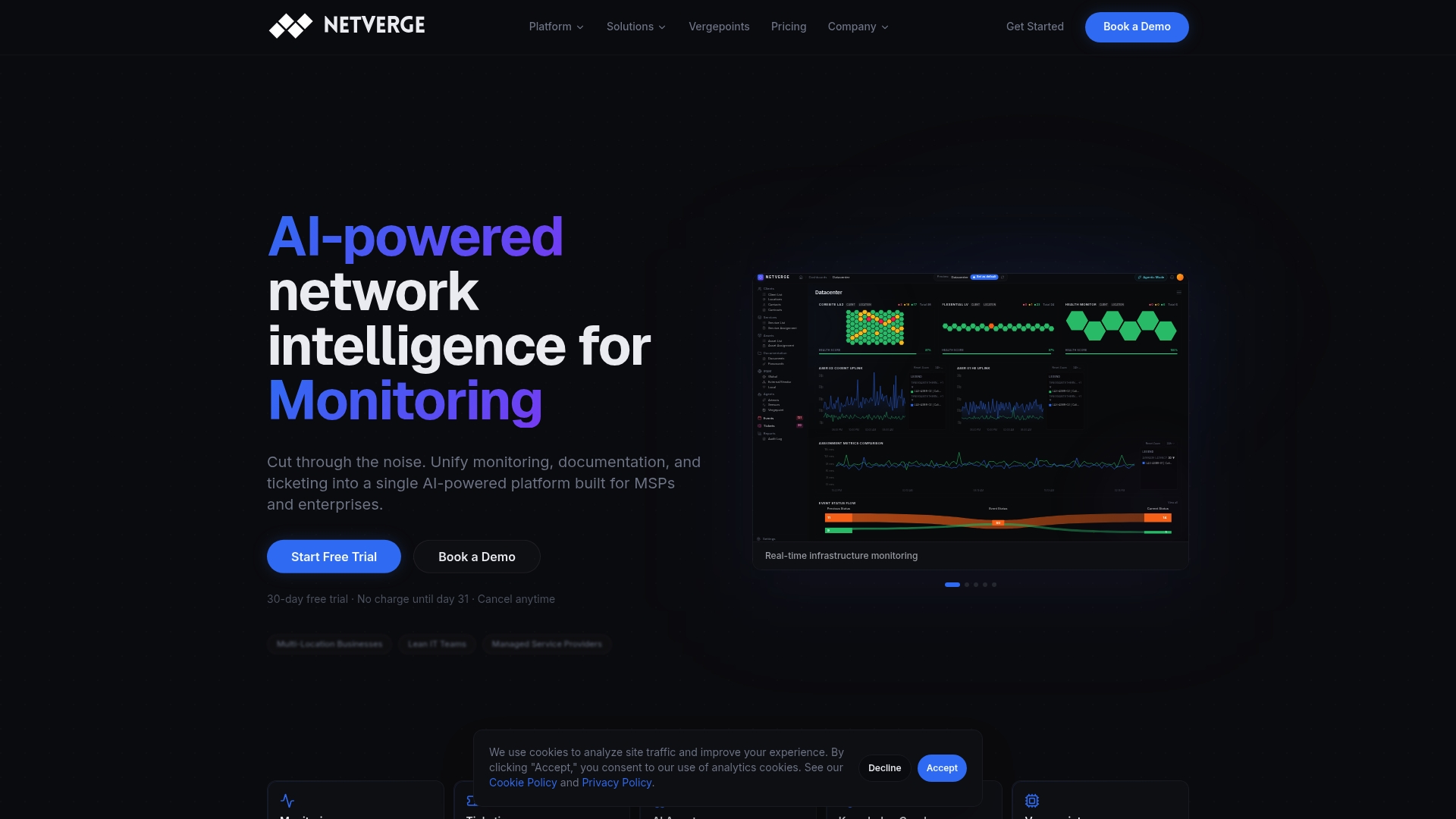
The fastest way to validate fit is a focused 6–8 week pilot scoped to your top five critical SaaS dependencies. Netverge's platform gives MSPs and enterprise NOC teams real-time tenant-mapped visibility, autonomous RCA, and PSA/ITSM integration from day one — without the $50,000–$100,000 build cost of a custom solution. You will have ghost-ticket and MTTC baselines within the first two weeks of the pilot.
Request a demo, run the pilot against your live tenant environment, and measure detection time, MTTC improvement, and ghost-ticket reduction before committing to full rollout. Use the pricing calculator to estimate your monthly cost based on tenant count and ingestion volume, or go straight to the Netverge monitoring platform to see the full capability set.
Recommended reading and sources
- Multi-tenant SaaS governance is now an MSP control problem — governance and tenant mapping requirements at MSP scale
- Why Every MSP Needs Centralized SaaS Monitoring — ghost-ticket reduction data, multi-source validation, and build-vs-buy cost analysis
- Agentic AI observability and operations — plain-language querying, automated RCA, and governance requirements for agentic AI
- 2026 AI Impact Report — noisy-alert rate data, MTTC improvement figures, and AI correlation benchmarks
- Monitoring vendor status pages during incidents with AI — practical guidance on combining vendor status with supplementary signals for faster detection
For technical implementation depth, prioritize the agentic AI and multi-source validation sources. For procurement and business-case use, the MSP governance and centralized monitoring references provide the clearest ROI framing.