
The fastest path to reducing tool sprawl is to mandate an automated discovery and owner-mapping project, then enforce a single authorized catalog under centralized governance. CIS Control 2 calls for exactly this: active, automated inventory of every software asset so only authorized tools run. Commission a discovery sprint this quarter and assign one cross-functional owner to lead it.
TL;DR:
- Automated discovery and inventory of all software assets should be completed within 30 days to prevent outdated data from impacting decision-making.
- Every tool must be mapped to a business capability and classified to identify which should be retained, consolidated, replaced, or retired.
- Licensing, support, and migration costs should be tallied comprehensively, including unused licenses, to build a convincing ROI case.
- Security checks must include continuous validation of an authorized inventory, secure migration plans, and clear rollback procedures to avoid introducing risks.
- Recurring governance, such as appointing stewards, maintaining a single catalog, and scheduling regular reviews, is essential to prevent tool sprawl from returning within a year.
Table of Contents
- What tool sprawl looks like and why it should be an executive priority
- A prioritized 6-step roadmap executives can mandate
- How to measure the true cost and ROI of consolidation
- Security and compliance controls to require during consolidation
- Governance, procurement, and process rules to stop sprawl from returning
- Netverge example: how a unified platform reduces monitoring and network-tool sprawl
- Author checklist and common pitfalls
- Where to go next: Netverge for consolidated monitoring and automation
- FAQ
- Sources
What tool sprawl looks like and why it should be an executive priority
Tool sprawl happens when an organization accumulates more software than it can track, support, or secure, which calls for a shift to products that adapt to you to reduce complexity and improve management. It rarely starts as a single bad decision. A department buys a point solution to solve one problem, a team signs up for a free trial that becomes permanent, or a vendor's "quick fix" tool survives long after the project that justified it ends. Shadow SaaS, departmental purchases outside procurement, and temporary tools that never get retired are the usual root causes.
The business impact shows up fast once you look for it:
- Productivity drag: employees waste time switching between overlapping tools that do the same job differently.
- Slower incident response: fragmented monitoring and documentation mean responders hunt across systems instead of resolving issues.
- Financial waste: unused licenses, duplicate subscriptions, and hidden migration costs quietly erode budget, a pattern Flexera's IT priorities research ties directly to fragmented ownership and visibility.
- Security and compliance exposure: unmanaged software is software nobody is patching, auditing, or accounting for.
Each of these compounds the others, which is why sprawl belongs on the executive agenda rather than buried in an IT backlog.
A prioritized 6-step roadmap executives can mandate
Reducing sprawl works best as a sequence with named owners and hard gates, not an open-ended cleanup effort. Here is the order that holds up under scrutiny from finance, security, and operations alike.
- Discover and inventory automatically. Use automated discovery to build a normalized inventory covering owners, usage, integrations, data sensitivity, and total cost, the same approach CIS Control 2 recommends for enterprise-wide software control.
- Map and classify each tool. Tie every tool to a business capability, then sort it into retain, consolidate, replace, renegotiate, or retire.
- Select pilot candidates. Choose a small set of consolidation targets with explicit security checkpoints and a rollback plan before anyone touches production workflows.
- Migrate and verify. Move data and workflows to the target tool, confirm functionality and data integrity, and only then decommission the source.
- Reconcile contracts and licenses. Compare the inventory against procurement records to catch unused seats and capture the savings in the next renewal cycle.
- Govern continuously. Maintain an authorized catalog, require purchase approvals through it, and schedule recurring reviews so sprawl cannot quietly return.
Pro Tip: Run steps 1 and 2 in parallel with a 30-day cap: an inventory that takes six months to finish is already out of date by the time it ships.
This sequence mirrors the approach NIST IR 8011 describes for software asset management: compare the discovered, actual state against an authorized, desired state, then prioritize fixes based on risk. Treat each step as a deliverable with a named owner and a date, not a general direction. A roadmap without accountability at each stage tends to stall at step 2, when classification debates replace action.

How to measure the true cost and ROI of consolidation
A consolidation business case only holds up when it accounts for the full cost of a tool, not just its sticker price. That means tallying license fees, implementation effort, ongoing support, integration work, training time, migration labor, and exit costs when a contract ends.
- License utilization: the share of purchased seats actually in active use.
- Cost per user: total tool spend divided by active users, tracked before and after consolidation.
- Reduction in SaaS monthly recurring spend: the clearest line item finance will ask for.
- MTTR improvement: whether consolidated monitoring and ticketing shorten time to resolve incidents.
Unused software licenses remain a persistent, measurable drain when inventories and purchase records are not reconciled, according to GAO's review of federal software license management, which recommends centralized tracking and routine comparison against purchase records as leading practice. To build the business case, compare your inventory against procurement data line by line, flag every license with low or no usage, and use that list as a negotiation lever at renewal: vendors discount faster when you can show exactly which seats you plan to cut.
Security and compliance controls to require during consolidation
Before approving any consolidation move, require proof that the new state is as secure as the one it replaces. The CISA SWAM capability description frames this clearly: software asset management exists to give visibility into what is installed and to assign clear responsibility for removing or authorizing it.
- Authorized inventory, continuously compared. Maintain an approved software list and check it against discovered reality on an ongoing basis, not just at audit time.
- Device roles and allow lists. Enforce which software can run on which systems, using software identity tagging where it is practical to deploy.
- Secure migration and retention. Define where data goes, how long it is retained, and how it is verified before a legacy tool is decommissioned.
- Lifecycle visibility and rollback plans. Consolidation reduces the number of tools but can concentrate risk into fewer systems, so require a documented rollback path before any tool goes offline.
Skipping these checks to hit a timeline is the single most common way consolidation projects create new incidents instead of preventing them.
Governance, procurement, and process rules to stop sprawl from returning
A cleanup without lasting rules reverts within a year. Lock in these controls before declaring the project done.
- Name a steward for every business capability who owns approval decisions for tools in that category.
- Maintain one authorized catalog with a documented exception process and time-bound renewals, so nothing lingers indefinitely without review.
- Set procurement pre-conditions: no new tool gets approved without a documented integration plan, data export path, and exit strategy.
- Schedule recurring reviews. Pair automated discovery with a governance check at least twice a year to catch drift early.
Netverge example: how a unified platform reduces monitoring and network-tool sprawl
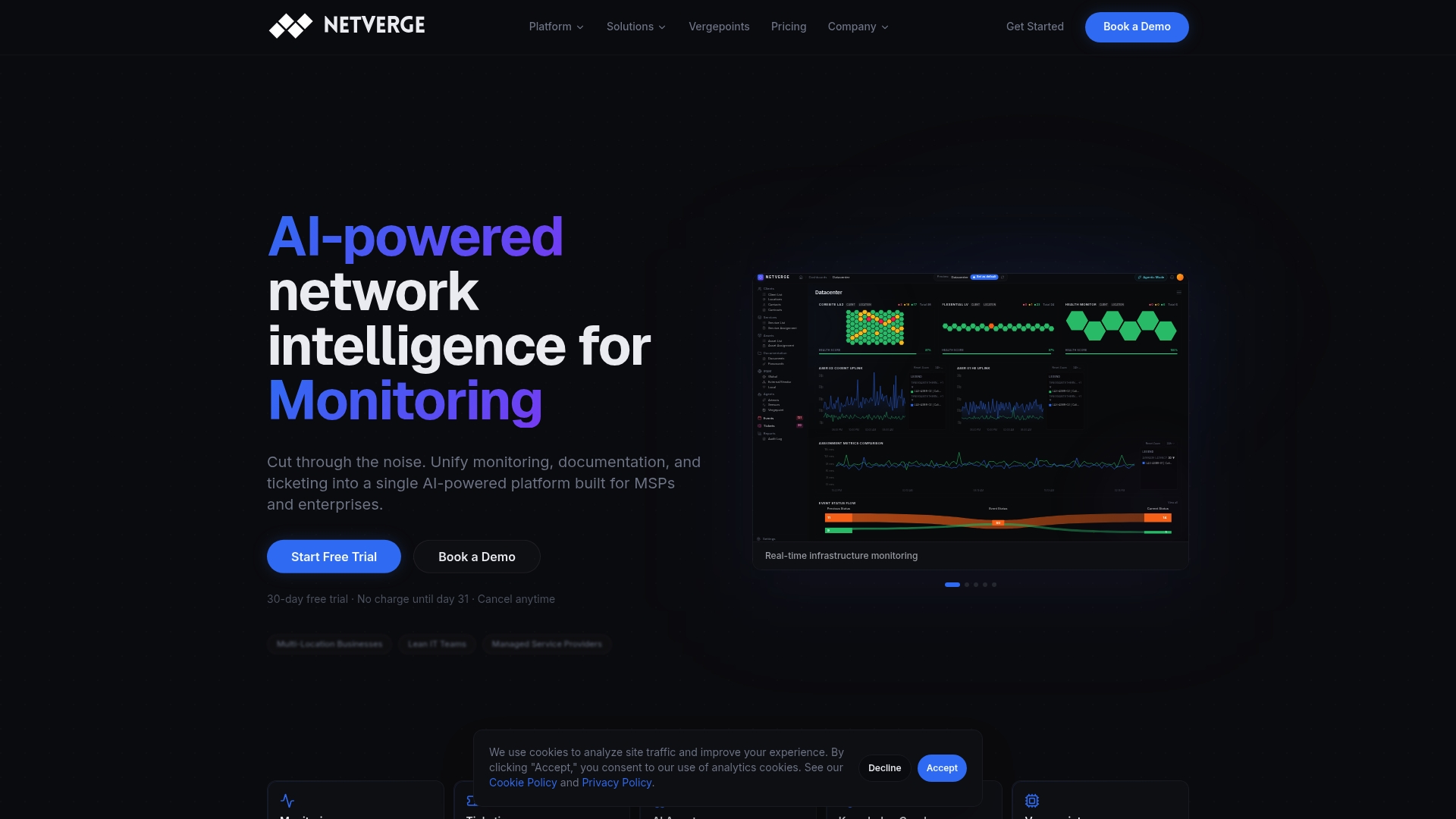
Monitoring, ticketing, and documentation are three of the most commonly duplicated categories in IT toolsets, and consolidating them illustrates the roadmap in practice. Our platform combines these into one system:
- Autonomous AI agents that diagnose and resolve common issues instead of routing every alert to a human queue.
- Vergepoints hardware for on-site network visibility, replacing standalone probes and point sensors.
- A knowledge graph that connects documentation to live infrastructure data, removing the need for a separate wiki or runbook tool.
- AI-powered ticket triage, which we have seen cut ticket backlog for teams that previously split that work across disconnected systems.
These are capabilities we have built specifically to replace fragmented monitoring stacks, consistent with the consolidate step in the roadmap above.
Author checklist and common pitfalls
Before signing off on any sprawl-reduction initiative, confirm four things: discovery is authorized and funded, an owner is named, pilots have budget, and security gates with rollback plans exist in writing. The failures I see most often share one root cause: no single owner, so integration work gets skipped and the "cleanup" becomes a one-time event instead of an ongoing discipline. Plan for a working pilot in 90 days and a scaled rollout in 180.
— Jim
Where to go next: Netverge for consolidated monitoring and automation
If your roadmap calls for discovery, automated triage, and verified migration in one place, our platform is built around exactly that sequence: Vergepoints and 28+ sensors handle discovery and visibility, AI agents and knowledge graphs handle automation and documentation, and ticket triage keeps the handoff from discovery to resolution inside one system instead of three.
- Review package and component pricing on our pricing page and pricing guide.
- Estimate your monthly cost with our pricing calculator before committing budget.
- Start a pilot through our free trial to validate results on one site or client before scaling.
FAQ
What is tool sprawl?
Tool sprawl is the uncontrolled accumulation of software and platforms across an organization, often arising from shadow SaaS purchases and unretired point tools. It leads to duplicated functionality, higher costs, and gaps in security oversight because no single team tracks the full inventory.
How can we reduce urban sprawl?
This question refers to city planning and land use, not IT, and falls outside the scope of this guide. For software environments, the equivalent concern is reducing tool sprawl through discovery, classification, and governance as outlined above.
What does data sprawl mean?
Data sprawl describes information scattered across many disconnected systems, storage locations, and formats, often as a side effect of tool sprawl itself. When every added tool creates its own data silo, the organization loses a unified view of where information lives and who can access it.
What does "application sprawl" mean?
Application sprawl refers specifically to the proliferation of software applications across an organization, frequently overlapping in function and poorly tracked by IT or procurement. It is closely related to tool sprawl and is addressed by the same discovery, classification, and governance steps.
How much does Netverge cost for a consolidation project?
Our Starter Package is available for $299 per month, with hardware Vergepoints at $49 per month per device and software Vergepoints at $29 per month per vergepoint listed on our pricing guide. Additional sensors, clients, sites, AI agents, and storage are available as add-ons at listed rates on the same page.
Sources
- CIS Control 2: Inventory and Control of Software Assets
- Automation Support for Security Control Assessments: Software Asset Management (NIST IR 8011-3)
- Software Asset Management (SWAM) Capability Description (CISA)
- GAO report on federal software license management
- Flexera IT priorities report 2025