
The fastest defensible way to prioritize network incidents is to score each one on an impact × urgency matrix, then apply risk and service-critical modifiers to break ties. At intake, capture the affected service, number of users, available workaround, deadline pressure, and data sensitivity. Assign a provisional priority immediately, fast-path anything that smells like a P1, and let automation suggest the tier so that nobody has to argue about it at 2 a.m.
TL;DR:
- Impact levels range from single user issues to enterprise-wide outages, with impact scores influencing priority alongside urgency and risk factors.
- Data captured at logging must include affected service, number of users, business impact, workaround status, deadlines, data sensitivity, and customer exposure for accurate prioritization.
- Response times are tightly linked to priority, with P1 incidents requiring acknowledgment within 15-30 minutes and resolution within one hour; contractual SLAs can override default scores.
- Automation can suggest priorities based on topology and alert correlation, but human oversight remains essential for final P1 approvals to prevent false positives.
- Implementing a phased rollout and enforcing rules through tools like Netverge ensures consistent, auditable incident prioritization aligned with impact and urgency assessments.
Table of Contents
- How Do You Prioritize Network Incidents With an Impact × Urgency Matrix?
- What Data Should You Capture When Logging an Incident?
- What Are P1, P2, P3, and P4 Incidents?
- Who Owns Triage and When Do You Escalate to Major Incident?
- How Do You Automate Ticket Routing Without Losing Control?
- Which Metrics Prove Your Prioritization Rules Actually Work?
- How Does AI-Assisted Triage Fit Into an Enforceable Priority System?
- Rollout Trade-Offs Most Teams Get Wrong
- How Netverge Helps You Enforce Priority Rules, Not Just Suggest Them
- Sources
- FAQ
How Do You Prioritize Network Incidents With an Impact × Urgency Matrix?
Impact and urgency answer two different questions, and conflating them is the single most common triage mistake teams make. Impact asks "how much of the business is affected?" Urgency asks "how fast is the damage growing?" A matrix that scores both, then maps the combination to a priority tier, standardizes decisions and prevents subjective choices that would otherwise depend on who's on shift.
Impact levels typically break down like this:
- Single user — one person can't print or connect to Wi-Fi in a conference room.
- Team — a shared file server or VPN concentrator goes down for one department.
- Site or department — a branch office loses internet, or a core switch fails and takes a floor with it.
- Enterprise-wide — a WAN backbone outage, a DNS failure, or a data center link drop that touches every location.
Urgency tiers layer on top of that:
- Workaround exists — users can route around the problem, so urgency stays low even if impact is moderate.
- Time-sensitive — a deadline, a live event, or a customer demo is riding on the fix.
- Compliance or launch-critical — a regulatory reporting window, a product launch, or a contractual SLA is at stake.
The matrix gets messy in the middle. A single-user outage during a board presentation is objectively small in scope but demands urgent handling. That's where risk and service criticality earn their keep as tie-breakers: if the affected system touches payment processing, patient records, or a tier-1 customer, bump the priority regardless of how many people are technically affected. A 3×3 or 5×5 grid works for most teams; start with the simpler version.
Two quick examples make this concrete. A misconfigured switch port dropping one laptop is low impact, low urgency: P4. A core router flapping across three sites during a compliance filing deadline is high impact, high urgency: P1, full stop.
What Data Should You Capture When Logging an Incident?
Priority decisions only hold up if the data behind them is complete. Capturing the right fields at the moment of logging turns a gut call into a defensible, auditable decision instead of a guess someone has to justify later.
Here's the minimum intake set worth enforcing on every ticket:
- Affected service or CI — name the specific system, not "the network." Vague tickets can't be routed or scored.
- Number of users affected — a rough count is fine; precision matters less than the order of magnitude.
- Business impact statement — one sentence on what's broken functionally (can't invoice, can't ship, can't log in).
- Workaround availability — yes or no, and what it costs the user if they use it.
- Deadline or time pressure — is there a clock running, and when does it expire?
- Data sensitivity — does this touch regulated, financial, or customer data?
- Customer exposure — internal-only, or is a paying customer watching this unfold?
Each answer maps to a numeric or categorical score. Impact might run 1 to 4, urgency 1 to 3, data sensitivity a simple yes/no flag that adds a point when triggered. Feed those scores into the matrix and the tool spits out a priority the second the ticket is submitted, no debate required.
That initial score is a provisional priority, not a verdict. It should be visible to the resolver within minutes, but only a resolver lead, incident commander, or service owner should have authority to downgrade it. Upgrades can happen faster and with less oversight, since erring toward urgency rarely causes harm.
Pro Tip: Make data sensitivity and customer exposure mandatory dropdown fields, not free text. A ticket that skips these fields should be blocked from submission, not just flagged for follow-up later.

What Are P1, P2, P3, and P4 Incidents?
Priority labels only work if everyone agrees on what triggers them and how fast each tier demands a response. Most IT organizations converge on a four-to-five-tier scheme, and the ITIL priority matrix remains the reference point most service desks build from, even when they simplify it.
- P1 (Critical) — enterprise-wide outage, revenue-impacting, or safety/compliance risk with no workaround. Drop everything.
- P2 (High) — major impact to a site, department, or key service, workaround limited or painful.
- P3 (Moderate) — team-level disruption with a usable workaround; annoying, not urgent.
- P4 (Low) — single-user or cosmetic issues with no business impact.
Some teams add a P5 for enhancement requests or non-incidents that got logged as tickets by mistake. Keep it if your ticket volume justifies the extra tier; skip it if it just adds friction.
By the numbers: Teams that embed the impact/urgency matrix directly into automation, so priority is calculated the moment a ticket is created rather than assigned manually, see more consistent priority assignment across shifts, because the scoring logic doesn't depend on which analyst is on call.
Response clocks should track priority tightly:
- P1 — triage acknowledgment within 15 to 30 minutes, resolver engagement within 1 hour.
- P2 — triage within 1 hour, resolver engagement within 2 to 4 hours.
- P3 — same business day.
- P4 — next available cycle, often batched.
Contractual SLAs and regulatory deadlines override the default matrix outcome. If a customer contract guarantees a 1 hour response on any incident touching their environment, that clause forces a P1 or P2 designation even if the raw impact score says otherwise.
Who Owns Triage and When Do You Escalate to Major Incident?
A priority scheme is only as good as the workflow that enforces it. Every ticket should move through a consistent path from the second it's logged to the moment a human with authority confirms the tier.
- Intake — the ticket is logged with all mandatory fields captured; the system calculates a provisional priority automatically.
- Fast-path check — any ticket that scores as a suspected P1 (enterprise impact, no workaround, compliance flag) skips the normal queue and pages the on-call resolver immediately.
- Confirmation — a resolver lead or incident commander reviews the provisional score within the SLA window and confirms or adjusts it.
- Major-incident invocation — if the confirmed priority is P1 and spans multiple services or sites, the incident commander activates the major-incident playbook: dedicated bridge, defined roles, scheduled status updates.
- Resolution and handoff — once stable, the ticket downgrades and moves to normal change or root-cause workflows.
The roles matter as much as the steps. A service desk analyst owns intake accuracy. A resolver lead owns technical triage and confirms priority. An incident commander owns the major-incident process end to end once one is declared, coordinating resolvers rather than fixing anything personally. A communications lead handles stakeholder updates so the commander isn't drafting emails mid-outage. A service owner has final say on business impact when the technical team and the business disagree about how bad something really is.
How Do You Automate Ticket Routing Without Losing Control?
Automated incident triage earns its keep when it removes the guesswork from repeatable decisions. Manual scoring is fine at low ticket volume; it collapses the moment you're running multi-site infrastructure with hundreds of alerts a day, and that's exactly where AI ticket triage and rule-based routing start paying for themselves.
A few patterns work reliably across most NOC environments:
- Auto-suggest priority from CI failure: if monitoring flags a critical configuration item (a core switch, a payment gateway) as down, the matrix auto-populates a high provisional priority before a human even opens the ticket.
- Conditional intake logic: the intake form forces mandatory fields (data sensitivity, customer exposure) before submission is allowed, and it suggests a priority based on the answers in real time.
- Service-map-aware routing: tickets tied to a mapped critical service auto-route to the resolver group that owns it, cutting the handoff delay that usually eats the first 20 minutes of any incident.
Automation genuinely helps standardize these decisions using service mapping and alert correlation, but it needs governance guardrails to avoid priority inflation, where every alert gets auto-tagged P1 until the label means nothing.
Pro Tip: Automate the obvious mappings, like a critical CI failure triggering a high provisional priority, but require a human approval step before anything is finalized as P1. That single gate stops false positives from paging your entire on-call rotation over a flapping sensor.
Which Metrics Prove Your Prioritization Rules Actually Work?
A matrix that looks good on paper is worthless if it doesn't show up in your numbers. Five metrics tell you whether prioritization is actually working or just adding process for its own sake.
| Metric | What it tells you | Target for mature teams |
|---|---|---|
| Mean time to resolution (MTTR) | Overall triage-to-fix speed | Declining trend by priority tier |
| Time to triage | How fast provisional priority is confirmed | Under 15 minutes for P1 |
| SLA compliance by priority | Whether response clocks are being met | High for P1/P2 |
| Priority distribution | Whether tiers are being used correctly | P1s under 5% of total volume |
| False escalation rate | How often P1s get downgraded later | Low |
Run a post-incident review after every major incident specifically to check whether the initial priority matched the actual impact once the dust settled. Feed those findings back into your thresholds and automation rules rather than treating the matrix as fixed. A dashboard that surfaces priority distribution weekly will catch inflation early, long before it shows up as alert fatigue on your team.
How Does AI-Assisted Triage Fit Into an Enforceable Priority System?
Consolidated topology data changes what's possible at intake. When a knowledge graph already knows which switch feeds which site and which site supports which customer, impact assessment stops being a phone call and starts being a lookup. That's the gap Netverge's platform is built to close for MSPs and multi-site enterprises juggling fragmented tools.
Here's where AI-assisted triage genuinely earns a place in the workflow:
- Auto-suggested priority based on real-time topology and monitoring data, not a static form field.
- Automatic mapping to the correct resolver group using the knowledge graph, cutting the routing delay that usually stalls the first several minutes of a P1.
- Noise deflection, where correlated alerts from a single root cause get grouped instead of flooding the queue as dozens of separate tickets.
None of that replaces human judgment, and it shouldn't. Governance still requires a human-in-loop approval step before any auto-suggested P1 is finalized, along with an audit trail showing who confirmed it and why. Runbooks should stay aligned to the matrix, not the other way around, so automation accelerates a process teams already trust rather than inventing a new one nobody signed off on.
Rollout Trade-Offs Most Teams Get Wrong
The tension in any prioritization system is speed versus accuracy, and most teams pick one without realizing they've made a choice. Move fast with a loose matrix and you'll get inconsistent tiers. Lock down every edge case before launch and you'll spend months in committee while incidents pile up ungoverned in the meantime.
The bigger anti-pattern is seniority bias: letting whoever's loudest on the call decide priority instead of the matrix. A close second is leaving thresholds undefined, "high impact" means something different to every analyst until you write it down with actual numbers attached.
A phased rollout beats a big-bang launch every time. Define your thresholds on paper first, using AWS's approach of assessing impact, assessing urgency, then building the matrix as a reasonable template. Pilot it on one service or one site for a month. Then iterate using the dashboard, not gut feel, before rolling it out everywhere else.
— Jim
How Netverge Helps You Enforce Priority Rules, Not Just Suggest Them
The real problem with most matrix rollouts isn't the framework, it's that nothing enforces it once the spreadsheet gets buried in a shared drive. Netverge is the alternative to piecing together monitoring, ticketing, and documentation across separate tools, because the priority logic runs directly against live topology data instead of a static form.
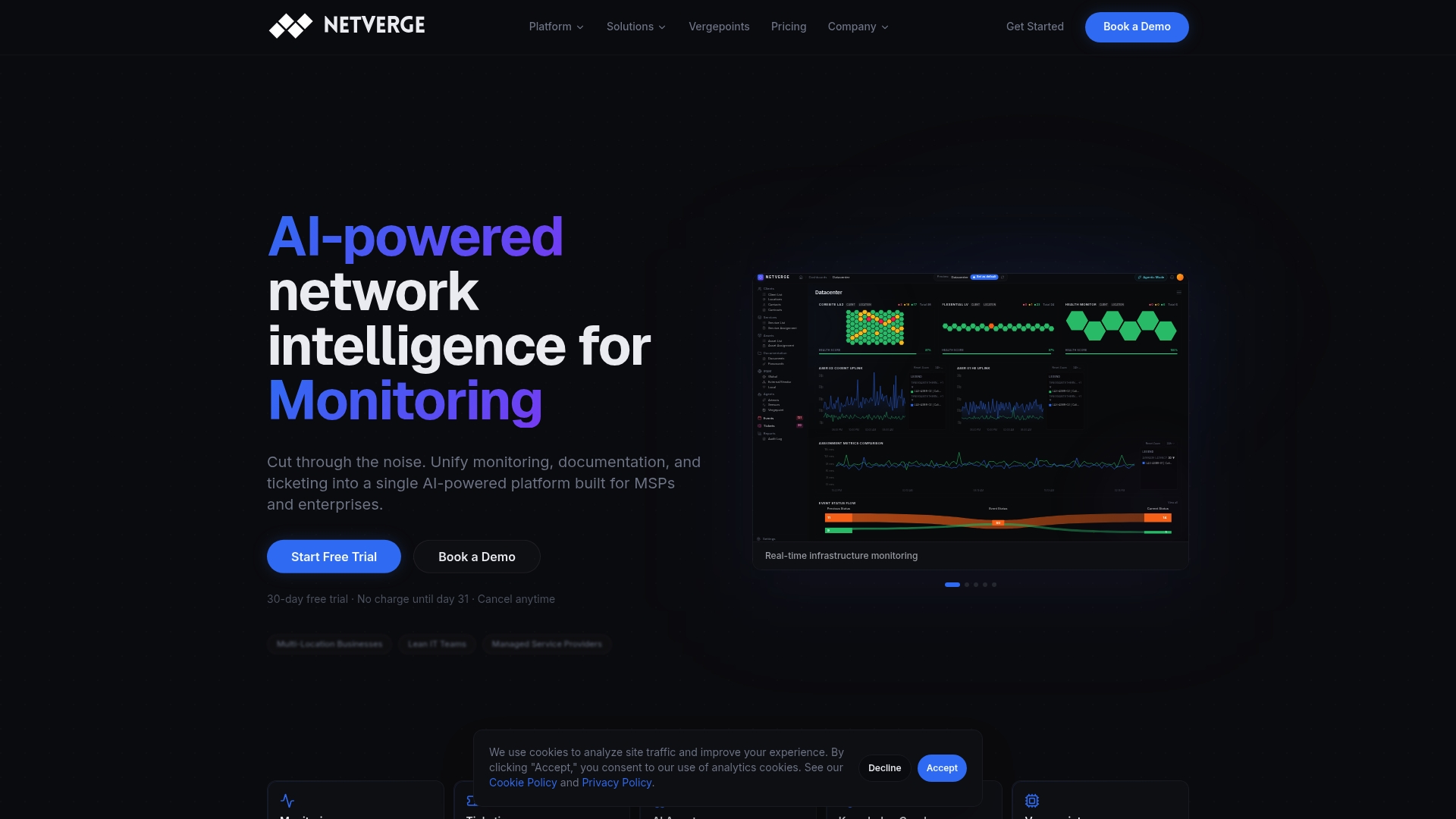
With Netverge, impact assessment draws on a knowledge graph that already knows which service maps to which site, so provisional priority gets calculated the moment an anomaly hits your monitoring layer, not minutes later after someone manually checks a spreadsheet. Autonomous AI agents suggest the tier and route to the right resolver group automatically, while your team keeps the approval gate on anything flagged P1. If you're running physical sites, Hardware Vergepoints add on-site sensor visibility at $49 per month per device, so impact scoring reflects what's actually happening at each location, not just what the WAN link reports.
The Starter Package runs $299 per month and gets your team a working matrix enforced through automation instead of a policy document nobody follows. Start a free trial and see how your current triage times compare once the rules run themselves.
Sources
For teams building or auditing a matrix from scratch, the ITIL priority matrix guide from InvGate covers standard terminology, while AWS's Well-Architected guidance offers a practical operational framework. For regulatory alignment, review NIS2 compliance guidance for cybersecurity operations.
- Mastering incident prioritization techniques in IT Service Management – ITU Online
- Impact urgency priority matrix | HelpMaster docs
- Prioritize events based on business impact | AWS Well-Architected
- ITIL priority matrix guide | InvGate blog
- RS-MA-3: Categorize and prioritize incidents | AuditRubric
FAQ
How Do You Prioritize Network Incidents?
Score each incident on business impact and urgency using a matrix, then apply risk and service-criticality modifiers to resolve close calls, capturing intake data like affected users and workaround status so the score is defensible.
What Are P1, P2, P3, and P4 Incidents?
P1 is a critical, enterprise-wide outage with no workaround; P2 is a major but contained impact; P3 is moderate disruption with a usable workaround; P4 is a low-impact, single-user issue with no urgency.
What Is a Priority 1 Incident?
A priority 1 incident is a critical event with high impact and high urgency, typically an enterprise-wide outage, revenue-impacting failure, or compliance risk with no available workaround, requiring immediate escalation.
What Are the 5 C's of Incident Management?
Definitions of the "5 C's" vary across organizations and aren't a standardized framework, so teams should rely on the impact/urgency matrix and ITIL-style priority tiers instead of a fixed acronym.
Can Netverge Automate Network Incident Prioritization?
Netverge's AI agents auto-suggest priority based on real-time monitoring and knowledge graph data, then route tickets to the correct resolver group while keeping human approval required for any P1 designation.