
Multi-location network visibility is the unified capability to monitor, analyze, and manage network assets and traffic across geographically dispersed sites through a single, centralized system. Rather than managing isolated local views at each branch, data center, or cloud environment, IT teams gain one cohesive picture of the entire infrastructure. This discipline, formally known as network observability or distributed network monitoring, is the operational foundation for any enterprise running more than one physical or virtual site. Without it, performance degradation, security threats, and compliance failures at remote locations go undetected until they cause real damage.
What is multi-location network visibility?
Multi-location network visibility means monitoring and analyzing network assets and traffic across geographically dispersed sites as one cohesive view, rather than isolated local views. TechTarget and Auvik both describe this as central dashboards and global maps that support scalability and unified monitoring across every site in an organization's footprint. The practical implication is significant: your NOC team sees a branch office in Dallas, a data center in Chicago, and a cloud workload in AWS as parts of the same operational picture, not as three separate problems requiring three separate tools.
The concept extends well beyond device uptime checks. Network visibility encompasses discovery, traffic capture, and behavioral analysis to produce a full real-time picture of complex, hybrid environments. That means tracking north-south traffic entering and leaving each site, east-west lateral traffic moving between internal systems, and telemetry from SD-WAN edges, virtual machines, and cloud-native services. Technologies like network TAPs, packet brokers, SD-WAN controllers, and centralized dashboards all contribute to building this picture. Platforms such as Cisco Nexus Dashboard and Netverge's monitoring platform represent the current generation of tools designed to unify these data sources at scale.

What technologies and tools enable multi-location network visibility?
Building visibility across multiple sites requires layering several complementary technologies. No single tool covers every data source, so the architecture typically combines hardware sensors, software agents, and a centralized aggregation and analysis platform.
The core components include:
- Network TAPs and packet brokers: Physical or virtual TAPs capture raw packet data at each site. Packet brokers aggregate, filter, and redirect that traffic to monitoring tools. Cisco Nexus Data Broker performs exactly this function, aggregating and redirecting traffic data to NetOps, SecOps, and compliance teams for coordinated analysis.
- Telemetry collection (SNMP, NetFlow, sFlow, streaming telemetry): Flow data and device metrics provide lightweight, scalable monitoring across large site counts. These sources work well for capacity planning and trend analysis.
- SD-WAN controllers: Software-defined WAN platforms provide built-in telemetry for edge sites and cloud on-ramps, filling a gap that traditional SNMP-based monitoring cannot reach.
- Virtual TAPs and cloud packet brokers: Cloud environments require software-based equivalents of physical TAPs. Hybrid visibility is now considered essential for modern enterprises running workloads across on-premises and cloud platforms.
- Centralized dashboards and unified platforms: Tools like Netverge consolidate telemetry, packet data, and AI-driven analysis into a single interface, giving distributed teams a shared operational view.
Pro Tip: Do not rely solely on SNMP polling for remote sites. Supplement with NetFlow or packet capture at each location to avoid telemetry gaps that leave you blind to application-layer issues.
The most capable platforms today integrate all of these layers. Netverge, for example, deploys Vergepoints as physical visibility sensors at each location and feeds their data into a centralized AI-powered dashboard, giving MSPs and enterprise teams a consistent data model regardless of how different each site's hardware stack may be.
What challenges complicate consistent visibility across multiple locations?
Achieving consistent visibility across every site is harder than deploying a single monitoring tool. The obstacles are both technical and organizational, and they compound as the network grows.
Telemetry data from SNMP is often insufficient at remote or edge locations due to limited availability or varying data models. A branch router may support only basic SNMP MIBs, while a cloud-native workload exports OpenTelemetry metrics in a completely different schema. Reconciling these heterogeneous data sources into a unified view requires normalization logic that many legacy tools simply do not provide.
The organizational challenges are equally significant:
- Team silos: NetOps, SecOps, and compliance teams often operate separate toolsets and see different subsets of network data. Packet-level visibility is the "source of truth" that breaks these silos, but only when all teams share access to the same aggregated data source.
- Data volume at scale: A 50-site enterprise generates enormous volumes of flow records, SNMP traps, and packet captures daily. Processing and correlating this data in real time requires purpose-built infrastructure.
- Hybrid and cloud blind spots: Virtual machines, containers, and serverless functions do not have physical network interfaces that traditional TAPs can access. Virtual TAPs and cloud packet brokers address this gap, but they require additional deployment effort.
- Inconsistent monitoring coverage: Sites added through mergers, acquisitions, or rapid expansion often run different hardware vendors and OS versions, creating gaps in monitoring coverage that take months to close.
"Polling only standard telemetry sources can create blind spots. Supplementing with packet capture and centralized data brokers ensures a comprehensive and consistent network visibility fabric across every site." — BlueCat Networks LiveWire
These challenges explain why many organizations have partial visibility at best. They can see their core data center clearly but have limited insight into what is actually happening at branch offices or in their cloud environments.
How does multi-location network visibility improve network performance and security?
The operational benefits of unified visibility are direct and measurable. 67% of enterprises cite blind spots as major security obstacles, which means the majority of organizations are making security decisions with incomplete data. Closing those blind spots produces concrete improvements across four areas.
Faster incident response. Real-time visibility into traffic patterns at every site means your team detects connectivity failures, latency spikes, and packet loss the moment they occur rather than after users report problems. Mean time to resolution drops because engineers can isolate the affected site and segment without manual log correlation.
Bandwidth optimization. Identifying top talkers and bandwidth consumption patterns across sites lets you right-size WAN circuits and prioritize critical application traffic. Without this data, over-provisioning is the only safe option, and that is expensive.
East-west threat detection. Network visibility solutions improve incident response by providing real-time insights into both north-south and east-west traffic. Lateral movement by an attacker inside your network is invisible without east-west monitoring. Ransomware, credential theft, and data exfiltration all rely on this blind spot.
Compliance and audit support. Consolidated traffic logs and flow records from every site simplify PCI DSS, HIPAA, and SOC 2 audits. Instead of pulling data from a dozen separate tools, auditors access a single repository with consistent timestamps and metadata.
Proactive anomaly detection. AI-driven platforms analyze baseline traffic patterns at each site and flag deviations automatically. AI and automation in network monitoring platforms accelerate issue detection and reduce alert overload, which is essential when managing dozens of locations simultaneously.
The security benefit alone justifies the investment for most enterprises. Detecting a lateral movement event at a branch office before it reaches the core network is the difference between a contained incident and a full breach.
How do enterprises implement multi-location network visibility effectively?
Effective implementation follows a structured approach. Organizations that deploy visibility tools without a clear architecture end up with the same fragmentation they started with, just more expensive.
| Approach | Centralized (single platform) | Federated (per-site tools) |
|---|---|---|
| Data consistency | High: normalized schema across all sites | Low: each site uses its own data model |
| Operational overhead | Lower: one interface, one policy set | Higher: multiple consoles and configurations |
| Scalability | Scales with platform capacity | Scales by adding more tools and staff |
| Cross-team visibility | Full: shared data for NetOps, SecOps, compliance | Partial: teams see only their tool's data |
| AI and automation | Possible at platform level | Difficult: no unified data for model training |
The centralized approach consistently outperforms federated deployments for organizations with more than five sites. Cisco Nexus Dashboard 4.2 demonstrates this with unified deployment, lifecycle management, and security policies from a single interface. Netverge applies the same principle with its AI-powered platform, consolidating monitoring, documentation, and ticketing into one system for MSPs and enterprise teams.
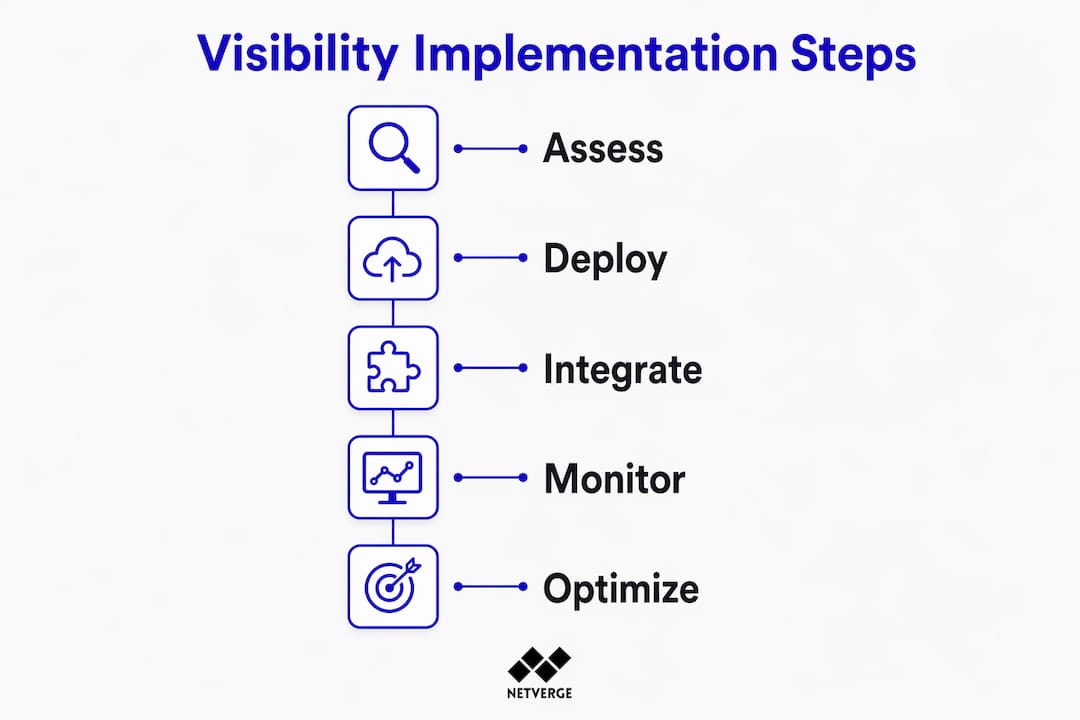
The practical implementation steps are:
- Map your topology first. Document every site, WAN link, and cloud connection before deploying any sensors. You cannot monitor what you have not inventoried.
- Combine telemetry with packet-level data. Flow data gives you volume and direction. Packet capture gives you application context and payload-level detail. Both are required for complete network visibility.
- Consolidate tools and dashboards. Replace per-site monitoring tools with a single platform that ingests data from all locations. This is the step most organizations delay, and it is the one that delivers the most operational improvement.
- Align teams around shared data. NetOps, SecOps, and compliance teams must access the same data source with role-based views. Coordinating these teams around centralized aggregation directly addresses the silo problem.
- Deploy AI-driven triage. Manual alert review does not scale across 20 or 50 sites. Automated anomaly detection and alert correlation reduce noise and surface only the issues that require human attention.
Pro Tip: Roll out visibility in phases, starting with your highest-risk or most complex sites. A phased deployment lets you validate your data model and alert thresholds before scaling to every location.
What I have learned managing distributed network visibility
After working with multi-site network environments across industries, the pattern I see most often is not a technology failure. It is a process failure. Organizations invest in packet brokers, SD-WAN, and monitoring platforms, then discover six months later that their SecOps team is still working from a separate SIEM with no packet context, and their compliance team is still pulling manual reports from individual site firewalls.
The technology is mature enough. What breaks visibility programs is the assumption that deploying a tool automatically creates shared situational awareness. It does not. You need explicit agreements about which team owns which alert category, what data each team can access, and how incidents get escalated across site boundaries. I have seen a well-configured Netverge deployment deliver dramatically faster incident resolution not because the AI was exceptional, but because it forced a conversation about who responds to what.
The other lesson I would stress is gradualism. Organizations that try to achieve full visibility across every site simultaneously almost always stall. The data normalization problems, the agent deployment issues, and the alert tuning work are all manageable in phases. They become paralyzing when attempted all at once. Start with your most critical sites, prove the model, then expand. The distributed network operations discipline is built on iteration, not big-bang deployments.
AI-driven observability is the direction the industry is moving, and it is worth taking seriously. Automated root cause analysis and anomaly detection are not marketing claims anymore. They are functional capabilities that reduce the cognitive load on engineers managing dozens of sites. But AI works only when the underlying data is clean, consistent, and complete. Fix the data architecture first. The AI benefits follow.
— Jim
See how Netverge unifies your multi-site network monitoring
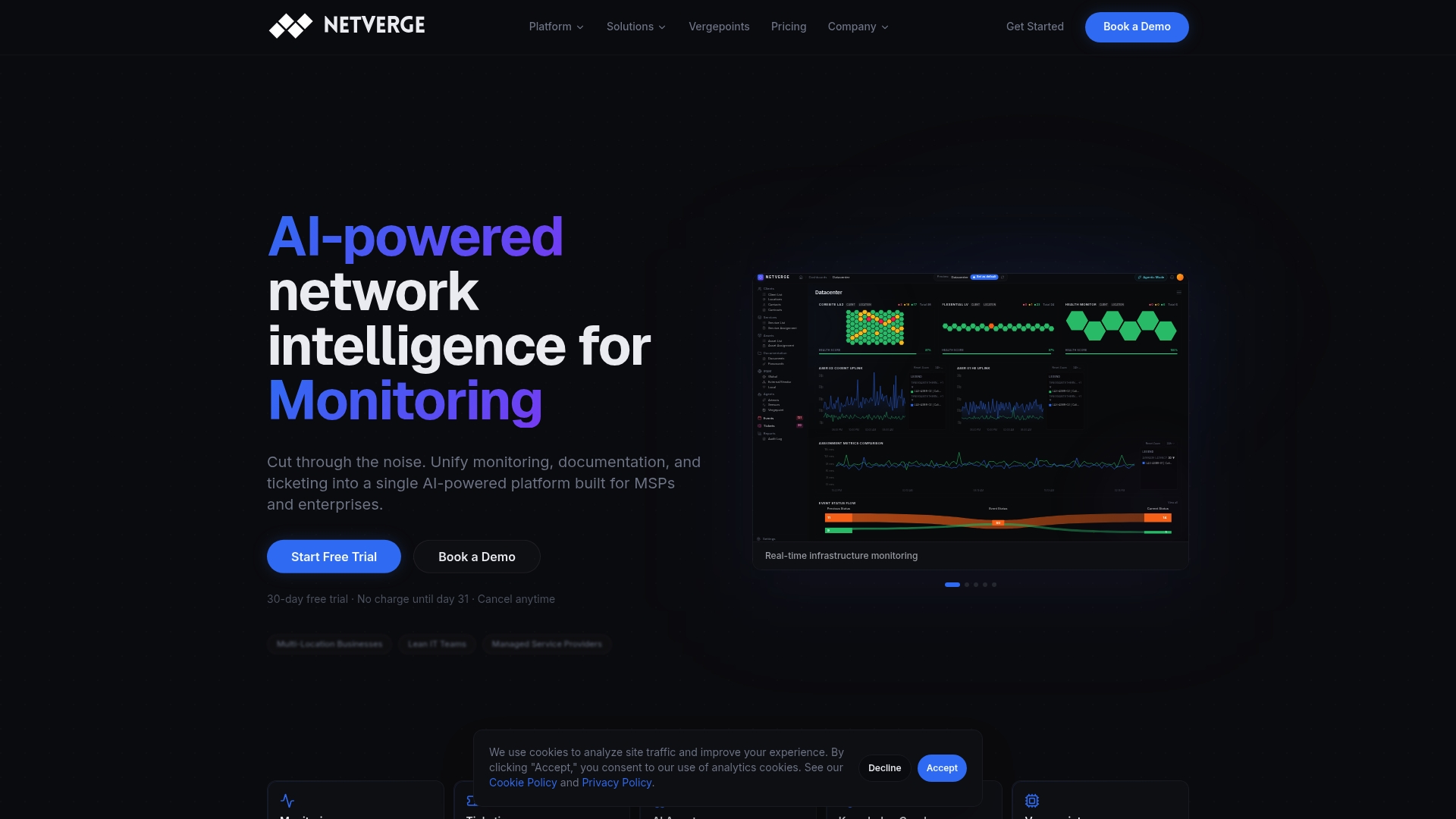
Netverge is built specifically for the challenges described in this article. The platform deploys physical Vergepoints at each location to capture packet-level data, feeds that data into a centralized AI-powered dashboard, and uses autonomous agents to detect anomalies, triage alerts, and initiate remediation automatically. NetOps, SecOps, and compliance teams all work from the same data source with role-based access, eliminating the silo problem at the platform level. If you are managing distributed networks and want real-time network monitoring across every site without the overhead of fragmented tools, Netverge is worth a direct look.
FAQ
What is multi-location network visibility?
Multi-location network visibility is the unified monitoring and analysis of network assets and traffic across geographically dispersed sites through centralized dashboards and tools. It replaces isolated, per-site views with a single cohesive operational picture.
How is network visibility different from network monitoring?
Network monitoring tracks device uptime and basic metrics. Network visibility extends to traffic capture, behavioral analysis, and discovery across all layers, giving teams the context needed to diagnose performance and security issues, not just detect them.
What tools are used for multi-site network monitoring?
Common tools include network TAPs, packet brokers, SD-WAN controllers, flow collectors, and unified platforms like Netverge and Cisco Nexus Dashboard. Effective multi-site monitoring combines hardware sensors at each location with centralized software for aggregation and analysis.
Why do enterprises struggle with consistent visibility across locations?
The primary obstacles are heterogeneous device environments, telemetry gaps at edge and cloud sites, and organizational silos between NetOps, SecOps, and compliance teams. Each team often uses separate tools that see only a subset of the total network data.
How does AI improve multi-location network management?
AI-powered platforms analyze baseline traffic patterns at each site and automatically flag deviations, reducing alert volume and accelerating root cause identification. This is critical at scale, where manual review of alerts from dozens of sites is not operationally feasible.
Key takeaways
Multi-location network visibility requires unified data collection, centralized analysis, and cross-team alignment to deliver consistent monitoring and security across every site.
| Point | Details |
|---|---|
| Centralized visibility is the goal | Unified platforms outperform per-site tools by normalizing data and reducing operational overhead. |
| Telemetry alone is insufficient | Supplement SNMP and flow data with packet capture to close blind spots at remote and cloud sites. |
| Team silos undermine visibility | NetOps, SecOps, and compliance teams must share a common data source with role-based access. |
| AI accelerates issue resolution | Automated anomaly detection and alert triage are necessary for managing more than a handful of sites. |
| Phased rollout reduces risk | Start with the highest-risk sites, validate the data model, then scale to the full network. |