
DNS monitoring continuously verifies that your domain resolves correctly, responds fast, and hasn't been silently altered by a hijack or misconfiguration. It matters because DNS sits upstream of everything: a broken record takes down email, applications, and customer trust before your uptime dashboard even notices. Done right, it protects three things at once, availability, security, and latency. It uses signals like SOA serial checks and DNSSEC validation that most teams never inspect until something breaks.
TL;DR:
- DNS failures can be silent or region-specific, often caused by incorrect records, high TTLs, or hijacks, making external monitoring essential to catch these issues.
- Core checks should verify resolution success, response times under 200 milliseconds, correct record values, and DNSSEC signature validity, especially after zone changes or key rollovers.
- External vantage points must be geographically distributed, supplemented with traceroutes and public probe data, to accurately identify regional path problems or provider outages.
- Alert thresholds should mandate multi-region confirmation, persistent issues, and response times exceeding 200 milliseconds before escalation, with shorter intervals for critical records.
- Implementing an integrated DNS monitoring platform reduces manual effort, improves incident response, and consolidates zone history, anomaly detection, and automated ticketing for efficient management.
Table of Contents
- What DNS Monitoring Actually Covers
- What to Monitor: Checks and Key Metrics
- Internal Metrics vs. External Vantage Points
- Alerting Thresholds and How Often to Check
- How to Detect and Respond to a DNS Incident
- Setting Up DNS Monitoring: A Practical Checklist
- How Netverge Extends DNS Visibility Across Your Network
- Operational Priorities for DNS Monitoring Going Into 2026
- Turning This Checklist Into a Working Monitoring Setup
- Sources
- FAQ
What DNS Monitoring Actually Covers
DNS monitoring has to watch more than "is the site up." It covers a chain of dependent systems, and a weak link anywhere in that chain produces the same symptom: users can't reach you, even though your servers are healthy.
The components that matter:
- Authoritative nameservers — the servers that hold the actual zone data for your domain.
- Resolvers — the recursive servers (ISP, public DNS, or internal) that clients query first.
- Registrar and delegation chain — the NS records at your registrar must match what your DNS provider actually serves.
- DNSSEC signing chain — a broken signature or expired RRSIG can make a validating resolver refuse to answer at all.
The dangerous part is that DNS failures are often silent or partial. A record can resolve correctly from one region and fail from another, or return a stale IP that only some resolvers have cached. Application-level uptime checks miss this because they usually run from a single location using a resolver that already has the right answer cached. According to FourSight's DNS monitoring guide, this kind of partial, intermittent failure is exactly what external monitoring is built to catch, and internal server metrics simply cannot see it.
Typical causes worth building checks for: a mistyped record during a manual edit, a TTL set too high before a migration, an upstream provider outage, or a hijack where someone alters records without authorization.
What to Monitor: Checks and Key Metrics
A DNS monitoring setup earns its keep by watching the specific things that actually fail, not just "is DNS up." Start with resolution success, then layer in correctness and timing.
Core checks to instrument:
- Resolution success — does the query resolve at all, and do the NS records returned match your intended delegation?
- Response time — how long resolution takes, since slow answers degrade page loads and API calls even when the record is technically correct.
- Record-value assertions — confirm A/AAAA, CNAME, MX, and TXT records (including SPF and DKIM) return the exact expected values, not just "a" value.
- SOA serial checks — a serial that hasn't incremented after a change you made is a strong signal that propagation stalled.
- TTL health and propagation consistency — verify the same answer comes back across regions once a TTL window has passed.
- DNSSEC signature validity — expired or mis-signed RRSIG records can cause total reachability failure for validating resolvers.
- Domain and registrar expiry — an expired domain is a self-inflicted outage that monitoring should flag weeks in advance.
Statistic to know: DNS answers slower than roughly 200 milliseconds start to noticeably hurt user experience, according to The New Stack's DNS monitoring principles, which is why response time deserves its own threshold, separate from a basic up/down check.
DNSSEC deserves particular caution. Treat key rollovers as production changes with their own runbook, since a mis-signed zone doesn't just slow things down, it can make a domain unreachable for every resolver that validates DNSSEC, as FourSight notes.

Internal Metrics vs. External Vantage Points
Internal server metrics tell you how your nameservers feel: CPU load, cache hit rate, query volume. They tell you almost nothing about what a user in another region actually experiences when they try to resolve your domain.
External, or exogenous, monitoring closes that gap. It queries your domain from outside your infrastructure, from vantage points scattered across networks and geographies, so it sees the same path problems, resolver quirks, and provider issues your customers see.
A few practices separate reliable external monitoring from noisy monitoring:
- Use geographically distributed vantage points. A single probe reporting a timeout is frequently a false positive caused by that probe's own network, not your DNS. APNIC's guidance on distributed DNS monitoring recommends scaling probe count specifically to build statistical confidence before treating a failure as real.
- Run traceroutes alongside DNS checks. A traceroute helps rule out a network path problem before you escalate it as a server outage, a distinction SIDN Labs flags as a core discipline for distributed DNS teams.
- Pull from public probe networks where possible. Services like RIPE Atlas give you independent, retrospective data to validate whether an incident was systemic or local to one vantage point.
- Verify anycast routing to the nearest point of presence. If your DNS provider uses anycast, confirm that regional queries actually land on the nearest POP rather than routing across an ocean.
Avoid relying only on cloud-region probes hosted by a single provider. If your monitoring vantage points and your DNS infrastructure share an upstream network, an outage on that shared path looks like a DNS failure when it's really a connectivity problem one layer down.
Pro Tip: Health check your vantage points themselves on a schedule. A probe that's degraded or misconfigured generates false alerts that erode trust in the entire monitoring system faster than an actual outage would.
Alerting Thresholds and How Often to Check
Polling frequency should scale with how critical the record is. The New Stack recommends 60-second intervals for critical records, apex A/AAAA, MX, and NS in particular, because longer gaps, even five minutes, give a DNS problem time to cascade into a broader outage before anyone notices.
Lower-priority records, like a rarely-queried TXT entry for a deprecated service, can run on a slower cycle without meaningful risk.
Alert design matters as much as check frequency:
- Require multi-region confirmation before escalating to a high-severity page. One vantage point failing is a data point, not an incident.
- Set response time thresholds in two tiers: a warning around sustained latency above your normal baseline, and a critical alert when response time crosses a threshold that affects user experience, such as consistently exceeding 200 milliseconds.
- Demand persistence, not a single failed check, before paging anyone. A transient blip that clears on the next poll shouldn't wake someone up.
- Build maintenance windows and de-duplication into the alerting logic so planned changes and repeat notifications for the same root cause don't generate alert fatigue.
How to Detect and Respond to a DNS Incident
DNS incidents fall into three recognizable buckets, and each has its own tell.
Hijack signals include DNS records suddenly pointing to unfamiliar IPs, NS records that changed without anyone on your team touching them, unknown TXT entries appearing in the zone, or DNSSEC validation abruptly failing. The SANS white paper on DNS query monitoring notes that attackers increasingly obfuscate malicious query behavior, so detection tooling has to evolve rather than rely on static signatures.
Provider outages look similar to hijacks at first glance, but multi-region checks and traceroutes separate them. If every vantage point across every region fails the same way at the same time, that points to the provider. If failures cluster around specific regions or paths, suspect routing, not the provider itself.
Propagation failures usually follow a recent zone change and show up as inconsistent answers between regions that should have converged by now.
A practical investigation sequence:
- Run
dig +traceto see exactly where resolution breaks down in the delegation chain. - Check the SOA serial against what you expect, to confirm whether your last change actually propagated.
- Verify domain and registrar status directly, since a hijack can start with a compromised registrar account rather than the DNS provider.
- Audit for compromised API keys if records changed without a corresponding ticket or deployment.
Containment steps once you've confirmed an incident: switch to a secondary DNS provider if one is configured, roll back the zone change that triggered it, rotate any exposed credentials immediately, and run through your communication checklist so stakeholders aren't finding out from customers first.
Pro Tip: Keep a printed or offline copy of your DNS runbook. If the incident involves your primary provider's dashboard being unreachable, you don't want your only recovery instructions locked behind the same outage.
Setting Up DNS Monitoring: A Practical Checklist
Standing up DNS monitoring doesn't require exotic tooling, but it does require sequencing the work correctly.
Start with these core checks:
- Monitor the apex A/AAAA records, NS delegation, MX records, and any TXT record tied to SPF or DKIM.
- Add SOA serial checks so you know immediately when a change hasn't propagated as expected.
- Set domain expiry alerts at least 30 to 60 days out, not the week before renewal.
- Configure multi-region assertions for every record you consider business-critical.
Before any planned DNS migration, follow the TTL discipline that avoids stale-cache chaos: lower the TTL a full cycle of the old TTL before you make the change, so caches age out on schedule. Then make the change, verify propagation from multiple regions, and only restore the TTL to its normal value once you've confirmed the new records are stable everywhere, a sequence detailed in this guide to safe DNS record changes.
A few standing practices worth locking in permanently:
- Keep a secondary DNS provider configured as insurance against a primary outage.
- Separate your DNS provider from your CDN provider where practical, since co-locating both creates a single point of failure that's painful to recover from.
- Lock your registrar account and enable registrar-level transfer locks.
- Feed DNS alerts into your existing incident management system so they generate tickets automatically, follow the same playbooks as other infrastructure incidents, and get a postmortem when something breaks.
How Netverge Extends DNS Visibility Across Your Network
Most of the checklist above requires stitching together separate tools: a DNS checker, a ticketing system, and a spreadsheet tracking what changed and when. That fragmentation is exactly what an integrated platform is built to remove.
Netverge maps directly onto the operational needs this guide covers:
- Multi-vantage visibility through deployed hardware devices, giving you the geographically distributed perspective that catches regional propagation and path issues instead of relying on a single check location.
- Anomaly detection that flags the kind of unexpected record changes and DNSSEC failures that signal a hijack, before a customer reports it.
- Automated ticket triage, so a confirmed DNS incident becomes a routed, prioritized ticket instead of a message someone has to remember to follow up on.
- Knowledge graphs and documentation that keep your zone history, TTL changes, and registrar details in one searchable place instead of scattered across tickets and memory.
Operational Priorities for DNS Monitoring Going Into 2026
Most teams over-invest in collecting more DNS telemetry and under-invest in actually rehearsing what happens when an alert fires. More dashboards don't help if nobody's practiced the runbook.
The trade-offs worth arguing about openly are TTL length versus recovery speed, and the cost of a secondary DNS provider versus the downtime risk of skipping one. A shorter TTL costs you a little in cache efficiency and gains you fast recovery when something goes wrong. A secondary provider costs a subscription fee and buys you insurance against a single point of failure that could otherwise take your entire domain offline.
Automation and a quarterly audit of your DNS configuration matter more than chasing every possible metric.
— Jim
Turning This Checklist Into a Working Monitoring Setup
Building DNS checks by hand, stitching together a probe network, a ticketing tool, and a documentation wiki, works until the team scales past a handful of domains. Netverge consolidates that entire workflow: Vergepoints give you the on-site, multi-region vantage points this guide recommends, anomaly detection watches for the hijack and propagation signals covered above, and every confirmed incident routes straight into AI-powered ticketing instead of sitting in someone's inbox.
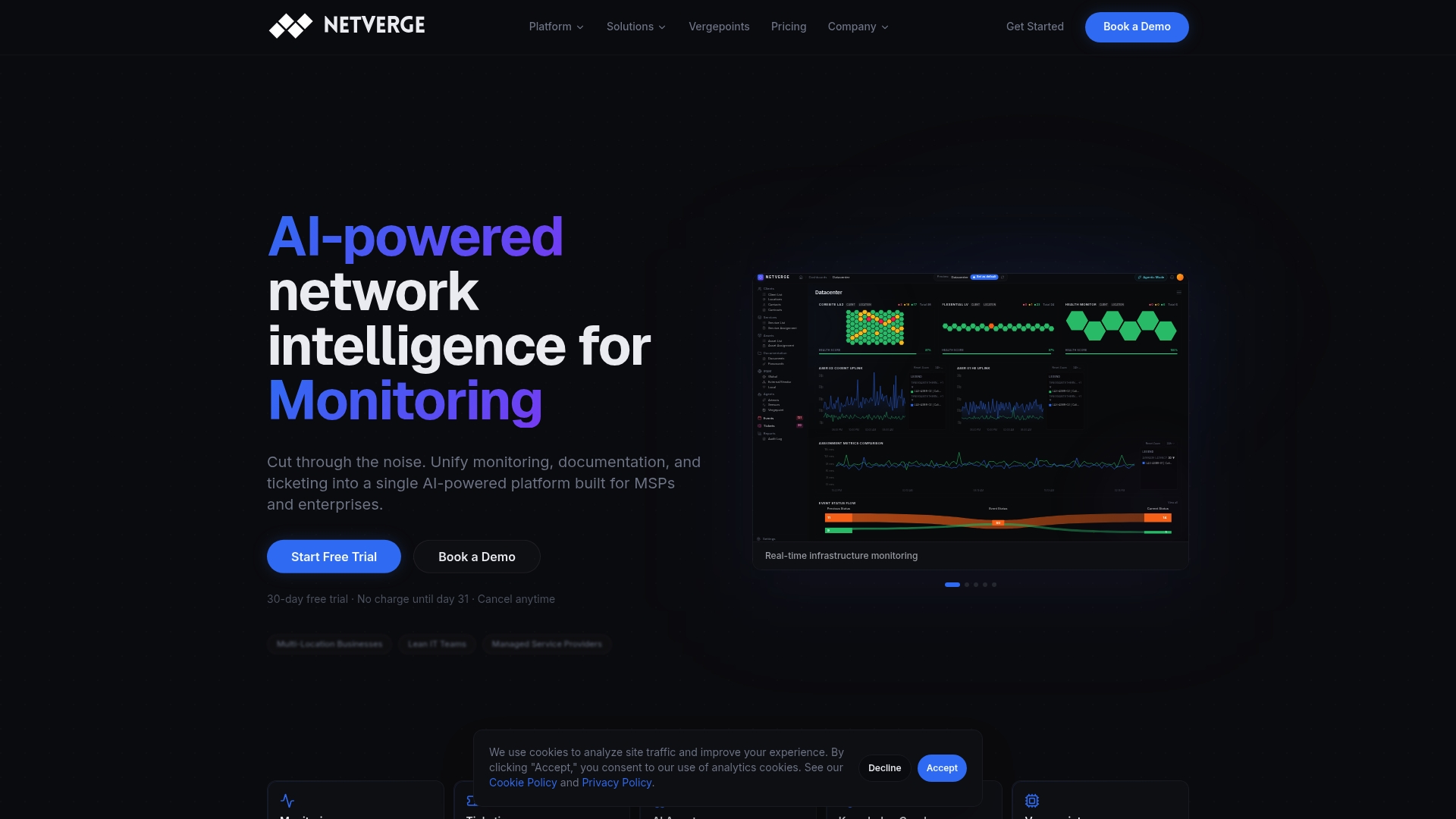
For MSPs managing DNS across dozens of client domains, or enterprises running multiple sites, that consolidation is the difference between chasing alerts manually and having triage happen automatically. If your team is responsible for the accountability that comes with managed services delivery, unifying DNS visibility with the rest of your network monitoring removes one more fragmented tool from the stack. Take a look at Netverge's monitoring platform to see how the checks in this guide map onto a live dashboard, and request a walkthrough to see your own domains in it.
Sources
- Getting DNS Right: Principles for Effective Monitoring - The New Stack
- DNS Monitoring: Catching Silent Failures | FourSight
- Challenges in Effective DNS Query Monitoring (SANS white paper)
- Monitoring highly distributed DNS deployments: Challenges and recommendations | APNIC Blog
- Monitoring highly distributed DNS deployments: Challenges and recommendations | SIDN Labs
FAQ
Can DNS servers track you?
Yes. Every DNS query you send reveals the domain you're looking up, and the resolver you use, whether it's your ISP's, a public one, or a corporate resolver, can log and analyze that query history over time.
How do I tell if my DNS is hijacked?
Watch for records suddenly pointing to unfamiliar IP addresses, NS records that changed without your team making the edit, unexpected TXT entries, or DNSSEC validation failing without any corresponding zone change on your end.
Is DNS safe, or not?
Standard DNS traffic is unencrypted and can be intercepted or spoofed, which is why layering DNSSEC validation, registrar locks, and continuous DNS monitoring matters far more than trusting the protocol to protect itself.
How can I tell if DNS is being blocked?
If a domain fails to resolve from some networks or regions but resolves fine from others, that pattern points to blocking or filtering rather than an actual outage, and multi-region checks are the fastest way to confirm it.
How often should critical DNS records be checked?
Critical records like your apex A/AAAA, NS, and MX entries should run on roughly 60 second check intervals, since longer polling windows can let a DNS problem cascade into a larger outage before anyone gets alerted.