
Configuration drift detection continuously compares a system's actual state against its defined desired state and flags or remediates deviations automatically. The most reliable approach ties automated checks to a version-controlled desired state through infrastructure as code (IaC) and GitOps, backed by observability signals that catch what static diffs miss. Get this right, and you prevent outages, security exposure, and compliance failures before an auditor or an angry customer finds them first.
TL;DR:
- Behavior-aware analysis is more effective than text diffing for detecting configuration drift in critical components like routing and security settings.
- Integrating drift detection into deployment pipelines, scheduled checks, and incident response improves timely identification and containment of unauthorized changes.
- Manual decision-making remains the main bottleneck, making a clear restore-or-update policy essential for reducing false positives and speeding remediation.
- Using unified tools that relate topology, configuration history, and observability data accelerates detection and provides reliable audit trails for compliance.
- Building a comprehensive, role-based governance framework with regular audits and KPIs ensures the drift management program remains effective over time.
Table of Contents
- What Configuration Drift Is and Why It Matters
- How Drift Detection Works: Methods and Trade-Offs
- Tooling and Automation Patterns to Integrate Drift Detection
- Operational Workflow: From Detection to Remediation and Verification
- Governance and Best Practices: The Five Pillars in Practice
- Netverge's Perspective: Cutting Time-to-Detect With Unified Visibility
- The Real Bottleneck Isn't Detection, It's Decision-Making
- Netverge: Centralize Drift Detection Without Stitching Tools Together
- Sources
What Configuration Drift Is and Why It Matters
Configuration drift is the gradual, often invisible divergence between what your infrastructure is actually running and what it was designed to run. It shows up in network device configs that got a "temporary" ACL rule six months ago, cloud resources someone resized during an incident, and application settings tweaked to pass a deploy that nobody rolled back. IBM defines it as an unintended split from a system's golden or baseline state, and it rarely announces itself.
Drift accumulates through a handful of predictable behaviors:
- Manual emergency fixes applied during an incident and never documented
- Rogue automation scripts that touch systems outside their intended scope
- Cloud provider updates and auto-scaling events that quietly alter resource states
- Well-intentioned "quick patches" that skip the change control process
The consequences compound fast. Downtime from drift-related failures can result in significant financial losses once you factor in lost transactions, engineering hours, and customer trust, according to IBM's analysis. Security teams see it differently: an unpatched firewall rule or an open port left from a debugging session is drift with a much sharper edge.
How Drift Detection Works: Methods and Trade-Offs
Not all detection methods deliver the same signal quality, and picking the wrong one for the job creates as much noise as it resolves.
- Text diffing. Comparing raw configuration files line by line is fast and cheap to set up, but it's noisy. A reordered ACL, a timestamp field, or a cosmetic whitespace change can trigger a false positive that buries the one line that actually matters.
- Model-based, behavior-aware analysis. Instead of comparing text, this approach builds a vendor-neutral model of the configuration and evaluates how a change affects real behavior, like BGP adjacency states or ACL enforcement. PyBatfish's research on drift shows this method correlates changes to operational impact rather than reporting every syntactic difference, which makes it the stronger choice for network configuration drift specifically.
- IaC and GitOps state comparisons. Tools built around Terraform or GitOps controllers treat your repository as the canonical desired state and run scheduled or triggered plans to catch divergence early.
- Cloud-native drift services. Provider tools continuously evaluate resources against defined rules and can notify or auto-remediate when something drifts, which is useful when your footprint lives mostly in one cloud.
Each method trades coverage for noise in a different way. Text diffs give you everything and let you sort it out; model-based tools give you less but with far higher signal.
Pro Tip: Reserve raw text diffing for low-stakes configs like documentation templates. For anything touching routing, security groups, or firewall policy, behavior-aware analysis will save your team from chasing phantom alerts.
Tooling and Automation Patterns to Integrate Drift Detection
Drift detection only earns its keep when it's woven into how your team already ships changes, not bolted on as a separate audit step nobody checks.
Think in tool categories rather than individual products:
- Discovery and inventory engines that maintain an accurate map of what exists
- Comparison engines that evaluate actual state against desired state
- IaC health checks, like Terraform's periodic refresh-only plans, that surface drift without applying changes
- Observability platforms that correlate config changes with performance or error signals
- Orchestration and GitOps controllers that enforce desired state continuously
Run checks at three points: as a pipeline gate before deployment, on a scheduled cadence for standing infrastructure, and on demand after incidents. HashiCorp's guidance on resource drift and health recommends tiering alerts so security-impacting drift triggers immediate action while cosmetic differences get batched.
Automation mode matters as much as detection itself. Auto-remediation works well for low-risk, well-tested drift patterns; anything touching production security groups or routing policy should require human authorization with a logged approval trail. Whatever you choose, make sure the tool's permissions, API access, and audit logging match your existing change control policy, not the other way around.
Operational Workflow: From Detection to Remediation and Verification
A detection alert without a decision process just becomes noise in a queue. Build the workflow around four repeatable steps:
- Triage and classify. Automatically tag each drift finding by likely impact, security, availability, or plain configuration inconsistency, before it reaches a human. This single step cuts alert fatigue more than any dashboard redesign.
- Investigate with behavior-aware context. Pull in observability data, logs, metrics, and traces alongside the config diff itself. A latency spike that lines up with a config change tells you far more than the diff alone.
- Decide: restore or update. This is the fork every team eventually hits. If the live change was unauthorized or risky, restore the desired state. If the change reflects a legitimate, approved need, update the desired state instead and route it through change control so it doesn't get flagged as drift again next week.
- Verify and log. After remediation, rerun the check to confirm the state matches policy, then log the action with timestamps and approver identity for audit purposes.
Pro Tip: Write your remediation decisions into a runbook the moment you make them the first time. The second time the same drift pattern shows up, whoever's on call at 2 a.m. shouldn't have to reinvent the decision tree.
Governance and Best Practices: The Five Pillars in Practice
Configuration management under ISO's guidance rests on five disciplines, and skipping any one of them is usually where drift programs quietly fail.
- Baselines and source of truth: maintain version-controlled configs and golden images that define what "correct" actually looks like.
- Identification: run discovery engines and keep your CMDB accurate, because you can't detect drift against an inventory you don't trust.
- Change control: require approvals, documentation, and role-based access for anyone touching production configuration.
- Status accounting: track deviations over time, not just as isolated incidents, so patterns become visible.
- Verification and audits: schedule regular checks and add event-driven scans triggered by deployments or incidents.
Three KPIs tell you whether the program is actually working: time to detect (TTD), time to remediate (TTR), and false positive rate. A team that drives down false positives usually finds TTR falls right along with it, because analysts stop ignoring the queue.
Netverge's Perspective: Cutting Time-to-Detect With Unified Visibility
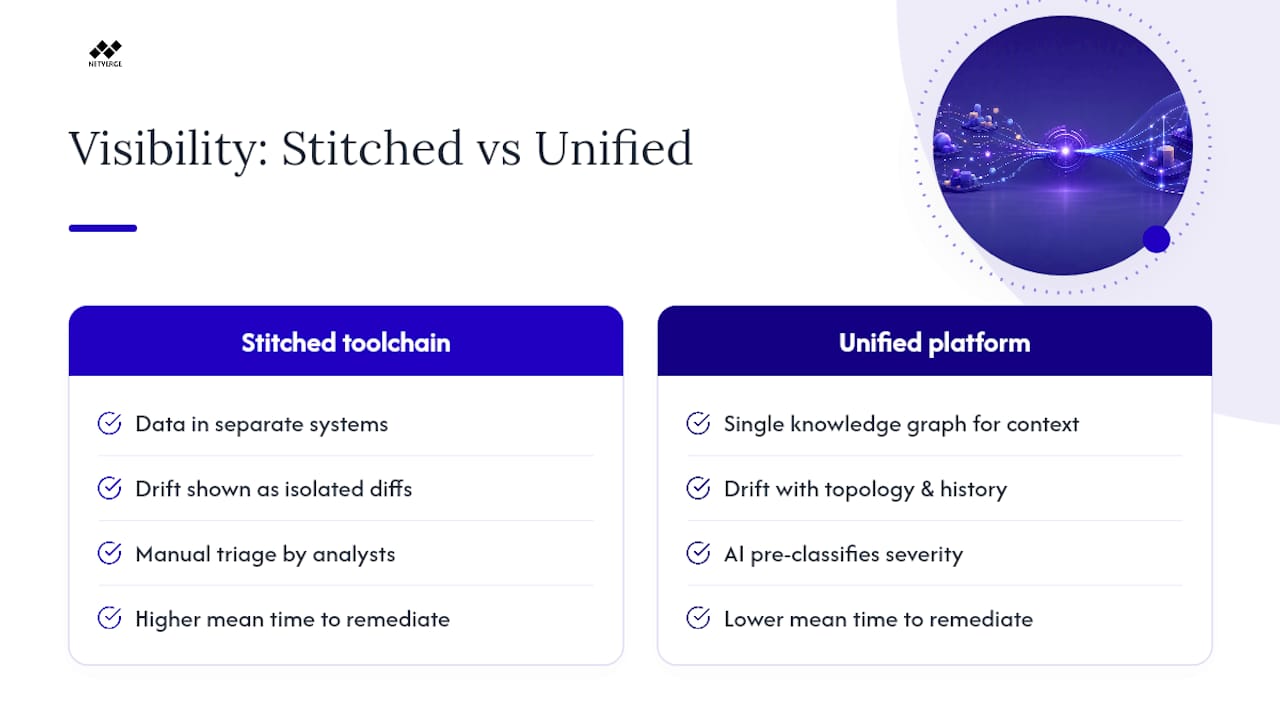
Fragmented tooling is often the real reason drift takes days to surface instead of minutes. When network topology, device configs, and ticketing all live in separate systems, correlating a config change to its downstream impact means manually stitching together data that should already be connected. A knowledge graph approach can keep that context in one place, so a drift finding arrives with the topology and history attached, not as an isolated diff.
AI-based triage matters here too. Instead of an analyst manually sorting through every flagged change, automated ticketing can pre-classify severity and route critical, security-relevant drift straight to the right team. For MSPs managing dozens of client networks, that difference between a managed platform and a stitched-together toolchain shows up directly in mean time to remediate.
The Real Bottleneck Isn't Detection, It's Decision-Making
Most teams treat drift detection as a technology problem: buy the right scanner, get the right diffs, done. That's not where the failure usually happens. Reading through how drift incidents actually resolve, the bottleneck sits in the decision step, restore versus update, that most teams never formalize. Without a documented rule for when to accept a change into the desired state versus reverting it, every alert becomes a fresh argument.
The conventional advice to "just monitor for changes" also undersells how much noise raw text diffing generates on network configs specifically. Behavior-aware analysis isn't a nice add-on; it's the difference between an alert queue analysts trust and one they start ignoring within a month.
If you take one thing from this, prioritize the decision framework before you shop for tools. A team with a clear restore-versus-update policy and a mediocre scanner will outperform a team with an excellent scanner and no policy, every time.
— Jim
Netverge: Centralize Drift Detection Without Stitching Tools Together
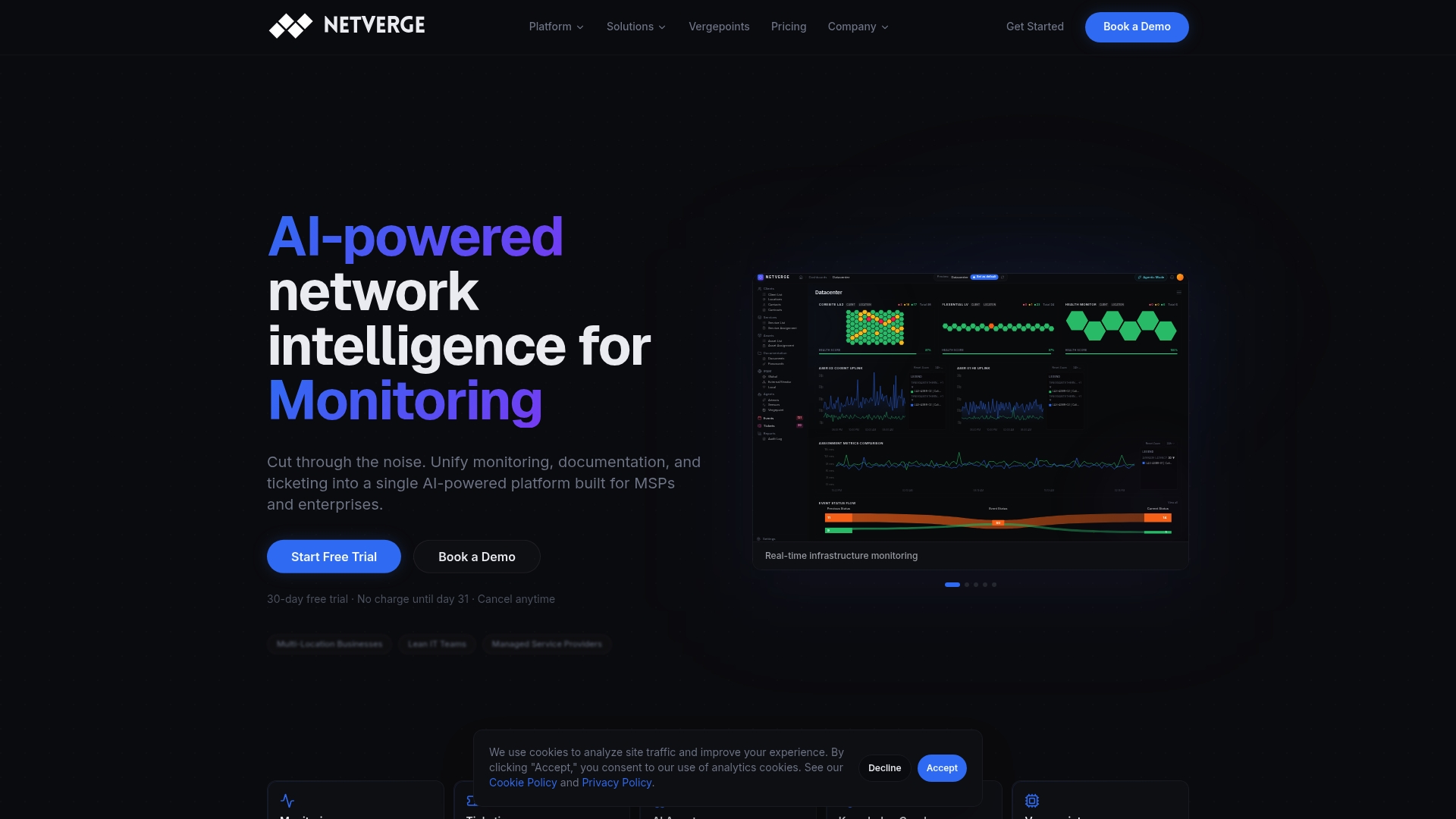
Netverge gives IT teams and MSPs a single place to catch configuration drift before it becomes an outage, instead of piecing together alerts from five different systems. The platform combines real-time infrastructure monitoring, a knowledge graph that maps configuration history to network behavior, and AI-driven ticket triage that flags security-relevant drift the moment it appears. Vergepoints hardware adds physical, on-site visibility for distributed locations where remote monitoring alone leaves gaps.
When you're evaluating a platform for this, ask three questions: does it integrate with your existing IaC and GitOps pipelines, does it correlate config changes with observability data rather than just flagging line differences, and does it give you an audit trail your compliance team can actually use. Netverge's network monitoring platform is built to answer all three, and multi-site enterprises can review the enterprise capabilities directly. Start a trial and see how much faster drift surfaces when your detection, documentation, and ticketing share the same data.
Sources
- Configuration Drift: What It Is, Why It Happens & How to Fix It | IBM
- Automatically detect resource drift and health | HashiCorp Developer
- Uncovering configuration and behavior drift — PyBatfish notebook
- Configuration management and information security | ISO