
Which EventAgent.us alternatives should you actually use?
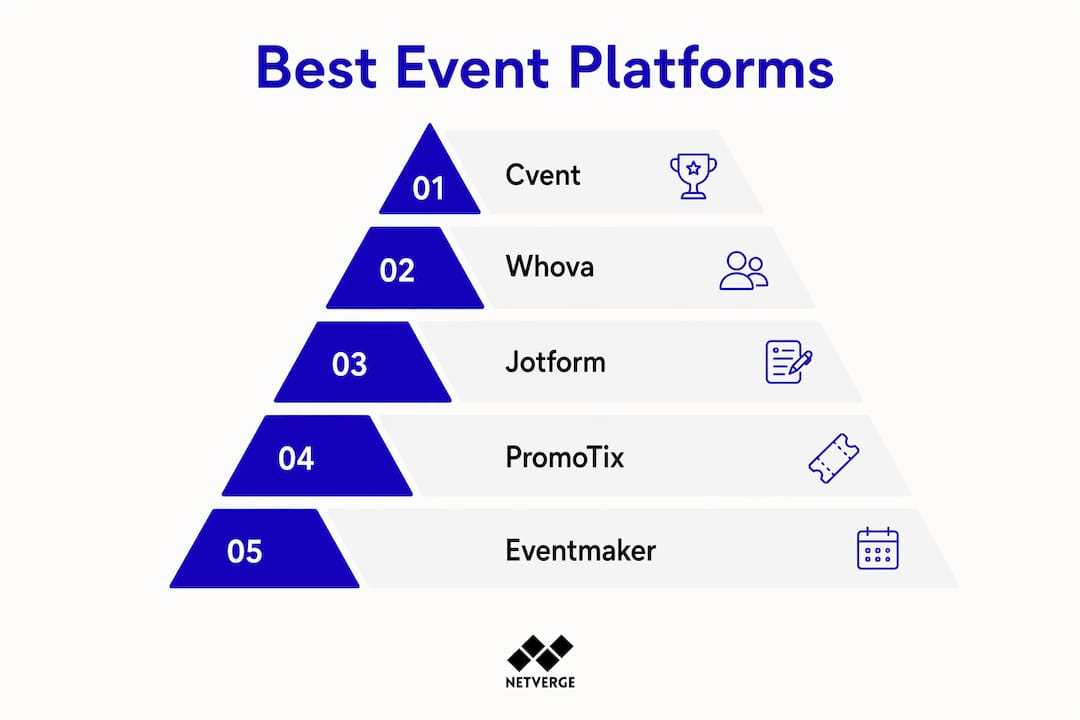
The strongest EventAgent.us alternatives in 2026 are Cvent, Whova, Jotform, PromoTix, and Eventmaker, each built for a distinct event type and budget. Choosing the wrong platform costs you more than money. It costs you data accuracy, CRM connectivity, and the ability to measure ROI after the event closes. The comparison below maps each platform to its best-fit use case so you can shortlist in minutes, not weeks.
| Platform | Best For | Key Features | Integration Capabilities |
|---|---|---|---|
| Jotform | Small to medium events | Customizable forms, data capture | Zapier, Google Sheets, Salesforce |
| Cvent | Large enterprise, multi-venue | Venue sourcing, RFP workflows | 200+ integrations, Salesforce, Marketo |
| Whova | Academic conferences, associations | Community boards, attendee networking | Salesforce, Eventbrite, Zapier |
| PromoTix | Mid-market ticketed events | Ticketing, marketing automation | Mailchimp, Stripe, Facebook Ads |
| Partywirks | Social and consumer events | Consumer promotion, ticketing | Stripe, social media platforms |
| ONevents | Mid-sized corporate events | Workflow automation, attendee management | CRM and email platform connectors |
| Eventpowwow | Community and networking events | AI networking matchmaking | CRM, Slack, Zoom |
| FairOrg | Trade shows, exhibitions | QR lead scanning, floor planning | CRM, exhibitor portals |
| Roamli | Virtual events, online communities | Virtual hosting, team collaboration | Zoom, Slack, collaboration tools |
| Virtual Days | Hybrid events | 3D exhibitor spaces, virtual environments | Video platforms, CRM |
| ConferenceLeap | Interactive conferences | Audience polling, Q&A management | Zoom, Webex, Slack |
| Klik | Marketing-driven events | Lead capture, attendee interaction | HubSpot, Salesforce, Marketo |
| BoomPop | Live events, high participation | Real-time session interaction tools | Slack, Zoom |
| EVENTION | Large-scale event automation | Workflow customization, automation | ERP, CRM, payment platforms |
| Event Manager Systems | Corporate and association events | Extensive integrations, service support | Salesforce, HubSpot, Marketo |
| Eventmaker | Medium to large professional events | Scheduling, registration modules | CRM, email, payment platforms |
| Timely Event Calendar | Centralized event calendars | Calendar overview, registration integration | WordPress, Google Calendar, Zapier |
Pro Tip: Before you request a demo from any vendor, confirm whether their CRM integration is native or runs through a third-party connector like Zapier. Native integrations push data in real time; connector-based ones often introduce delays and sync errors that distort your post-event reporting.
Detailed profiles of the leading alternatives
Cvent and enterprise-grade event management
Cvent is the legacy standard for large enterprises. Its venue sourcing database covers over 300,000 properties, and its RFP workflow is the deepest in the market. The tradeoff is cost and complexity, with pricing that can be substantial and onboarding that may require several months. If global venue sourcing is your primary requirement, Cvent is genuinely hard to beat. If it is not, you are paying a significant premium for infrastructure you will rarely use.
Whova for academic and association events
Whova targets academic conferences and professional associations where attendee networking is the primary goal. Its community boards and in-app messaging tools drive engagement before, during, and after the event. Pricing starts at $2,000 per event, which positions it well for organizations running one or two major gatherings per year. It performs best in venues with reliable WiFi, since its networking features depend on consistent connectivity.
Jotform for flexible registration
Jotform is not a full event management platform. It is a highly customizable form and data capture tool that works exceptionally well for small to medium events needing flexible registration without the overhead of a dedicated system. Its integration library covers Salesforce, Google Sheets, and hundreds of other tools via Zapier. For organizers who already have a CRM and just need a registration front end, Jotform fills that gap at a fraction of the cost of enterprise platforms. Pricing remains affordable compared to large-scale solutions, though exact costs depend on event scale and selected features.

PromoTix, Partywirks, and consumer-facing events
PromoTix combines ticketing with marketing automation, making it a practical choice for mid-market events that need both ticket sales and promotional reach in one place. Partywirks takes a simpler approach, focusing on consumer event promotion and ticketing with minimal setup. Neither platform is built for complex corporate logistics, but both deliver where it counts for public-facing events.
FairOrg for trade shows and exhibitions
FairOrg stands out in the exhibition space with native QR code lead scanning and interactive floor planning built directly into the platform. Exhibitors can capture leads without third-party hardware, and organizers get a real-time view of booth activity. For trade show managers who have dealt with the friction of bolting lead capture tools onto a general event platform, FairOrg's native approach removes a meaningful operational headache.
Virtual Days, Roamli, and the hybrid/virtual segment
Virtual Days delivers immersive 3D exhibitor environments for hybrid events where the virtual experience needs to match the physical one. Roamli focuses on virtual-first events and online community gatherings, with strong team collaboration features built in. Both platforms address the gap that general video conferencing tools leave when organizers need structured virtual event management rather than just a video call.
ConferenceLeap, BoomPop, and session engagement
ConferenceLeap handles audience polling and Q&A management for conferences where session interaction is a priority. BoomPop focuses on real-time interaction tools for live events with high attendee participation. Both are point solutions rather than full event management systems, which means they work best alongside a primary platform rather than as standalone replacements.
Klik, ONevents, Eventpowwow, and marketing-driven events
Klik integrates lead capture directly with marketing platforms like HubSpot and Salesforce, making it a natural fit for events where pipeline generation is the primary success metric. ONevents covers workflow automation and attendee management for mid-sized corporate events. Eventpowwow uses AI-driven networking matchmaking to connect attendees at community-focused gatherings.
EVENTION, Event Manager Systems, and Eventmaker for complex operations
EVENTION targets large-scale event automation with deep workflow customization and ERP connectivity. Event Manager Systems brings an extensive integration ecosystem and hands-on service support, which suits corporate and association events with complex logistics. Eventmaker covers the full event lifecycle with strong scheduling and registration modules, positioned for medium to large professional events.
Timely Event Calendar for calendar-first organizations
Timely Event Calendar serves organizations that need a centralized, public-facing event calendar with registration built in. It connects to WordPress, Google Calendar, and Zapier, making it easy to embed into existing websites. For nonprofits, universities, or municipal organizations managing many recurring events, Timely's calendar-first approach reduces the friction of keeping multiple systems in sync.
How to choose the right platform for your event
The single biggest mistake event planners make is selecting a platform based on feature count rather than event type alignment. Enterprise buyers frequently overpay for all-in-one platforms built around a different event pillar than the one they actually run. A corporate conference organizer paying for a platform optimized for consumer ticketing gets neither the right tools nor the right price.
Use these criteria to narrow your shortlist:
- Event type fit. Match the platform to your MICE pillar: Meetings, Incentives, Conferences, or Exhibitions. A trade show needs native exhibitor tools and lead scanning. A corporate conference needs multi-track scheduling and abstract management. A consumer event needs ticketing and marketing reach.
- CRM integration depth. Ask whether the integration is native or connector-based. Native API connectivity pushes event data to your CRM in real time. Connector-based integrations introduce lag and error risk that distorts pipeline reporting.
- Pricing structure. Per-event pricing punishes organizations running frequent events. Unlimited-event models reduce per-event cost as volume scales. Confirm whether the quoted price includes onboarding, support, and integrations, or whether those are add-ons.
- Scalability. A platform that handles 500 attendees well may not handle 5,000. Ask vendors for references from events at your target scale, not just their largest or most impressive case study.
- Trial and demo availability. Platforms that offer a self-serve trial give you hands-on data before you commit. Those that require a sales call before any access are worth scrutinizing more carefully.
Red flags to watch for: generic project management tools positioned as event software, platforms that require months of onboarding for a single event, and vendors who cannot demonstrate a direct integration with your existing CRM.
Pro Tip: Ask every vendor one specific question: "Can you show me a live data flow from event registration to a contact record in Salesforce or HubSpot?" If they cannot demo it in real time, the integration is likely shallower than the sales deck suggests.
Why CRM integration determines your event ROI
The difference between an event that generates measurable pipeline and one that generates a spreadsheet of badge scans is almost always CRM integration. When event data flows directly into your CRM, every registration, session attendance, and booth visit becomes an attributed touchpoint in your sales pipeline. When it does not, your marketing team spends days after the event manually uploading CSVs, introducing errors and losing the time-sensitive context that makes follow-up effective.
API-native platforms that connect directly to Salesforce and HubSpot enable real-time pipeline attribution. That means your sales team sees a lead's event engagement the moment it happens, not three days after the event closes. For organizations running multiple events per year, that speed compounds into a measurable revenue advantage.
Siloed event data also distorts marketing spend decisions. If you cannot attribute pipeline to specific events, you cannot make confident budget decisions about which events to grow and which to cut. A platform with native CRM connectivity solves this at the data layer, not the reporting layer.
What user reviews reveal about these platforms
G2's Summer 2026 Mobile Event Apps Grid placed Whova, Cvent Attendee Hub, and several other platforms in the Leader quadrant. Amego earned higher scores than Cvent Attendee Hub and Bizzabo on Likelihood to Recommend, Ease of Doing Business With, and Quality of Support in that same report. The pattern across G2 reviews is consistent: larger, legacy platforms score well on feature depth but lower on support responsiveness and ease of use. Newer platforms with smaller market footprints often score higher on satisfaction precisely because their support teams are more accessible.
For the platforms in this comparison, Whova consistently draws praise for its attendee networking tools from academic conference organizers. Cvent reviews frequently mention the depth of its venue sourcing database alongside the complexity of its contracts. Jotform users highlight its flexibility and integration breadth. PromoTix reviews focus on its ticketing and marketing automation combination. Platforms like ConferenceLeap, BoomPop, and Timely Event Calendar have smaller review bases on G2, so checking Capterra and direct vendor references adds useful signal when evaluating them.
Trial availability and demo options across platforms
Most platforms in this comparison offer some form of trial or demo access, but the format varies considerably.
- Jotform offers a free tier with no time limit, making it the easiest to evaluate hands-on without a sales conversation.
- Cvent requires a sales engagement before access; given its onboarding timeline of 6–12 months, budget significant evaluation time before committing.
- Whova provides demo access through a sales call, with pricing quoted per event.
- PromoTix and Partywirks both offer self-serve account creation, letting you test ticketing and promotion flows before purchasing.
- Timely Event Calendar offers a free trial period for its calendar and registration tools.
- FairOrg, Roamli, Virtual Days, ConferenceLeap, Klik, BoomPop, EVENTION, Event Manager Systems, and Eventmaker all offer demo calls; self-serve trial availability varies and is best confirmed directly with each vendor.
- ONevents and Eventpowwow provide demo options through their sales teams.
The practical rule: if a vendor will not let you touch the product before signing a contract, treat that as a negotiating point. Request a sandbox environment or a time-limited pilot as a condition of moving forward.
Netverge supports the infrastructure behind your events
Event management platforms handle registration, scheduling, and attendee engagement. What they do not handle is the network infrastructure those platforms depend on. For MSPs and multi-location enterprises running large-scale events, that infrastructure layer is where operational risk lives.
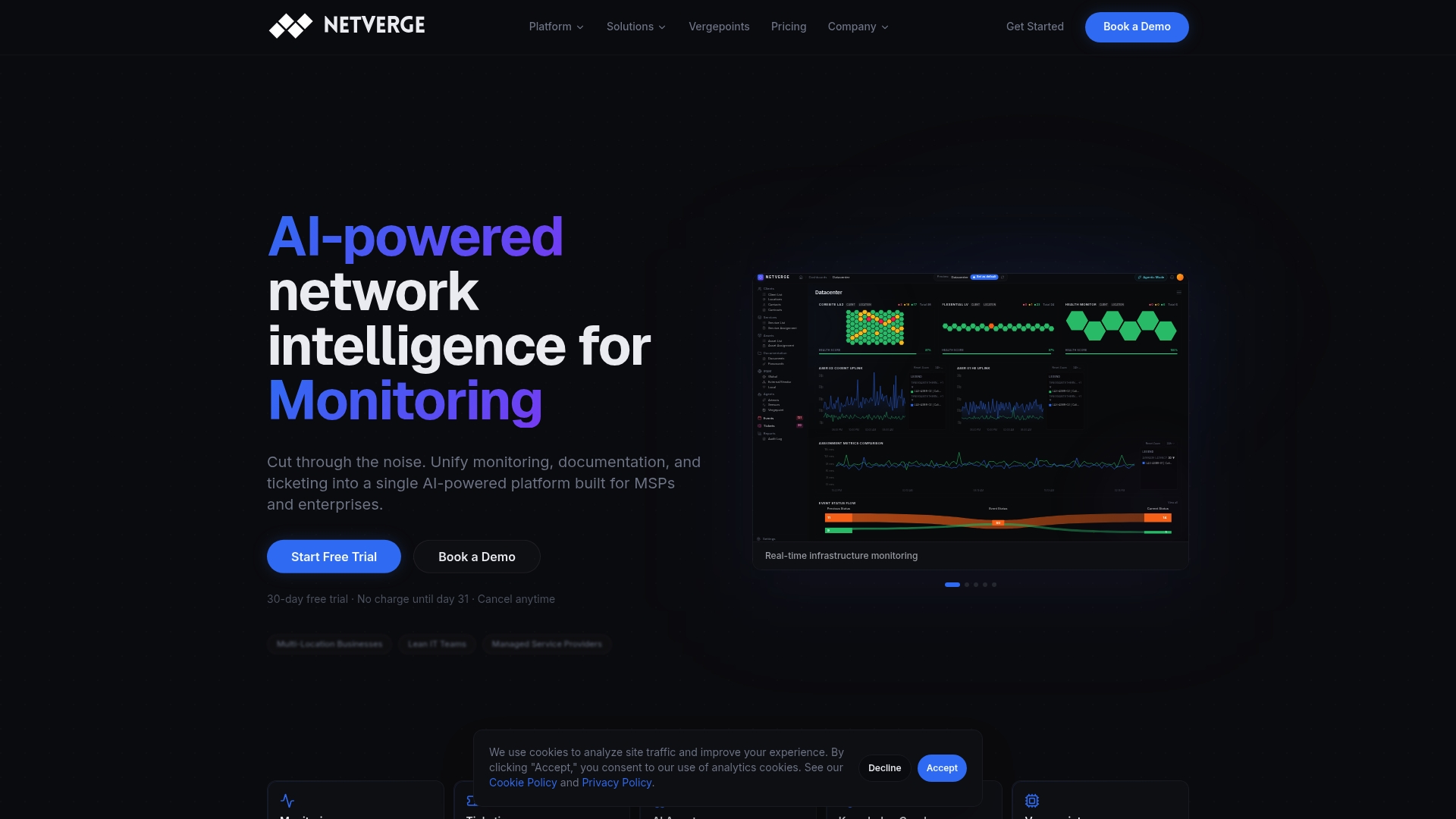
Netverge's AI-powered network monitoring gives event technology teams real-time visibility into the infrastructure supporting their event platforms. Anomaly detection, automated troubleshooting, and intelligent ticket triage reduce response times when something goes wrong during a live event. Vergepoints hardware provides physical network visibility at each venue location, feeding telemetry into a unified dashboard alongside software monitoring data. For organizations managing distributed event infrastructure across multiple sites, Netverge consolidates that visibility into a single interface rather than a collection of disconnected tools. If your enterprise event operations depend on network reliability, Netverge is worth evaluating alongside your event management platform selection.
Key Takeaways
The strongest EventAgent.us alternatives are purpose-built for specific event types, and matching platform to event pillar determines both cost efficiency and CRM data quality.
| Point | Details |
|---|---|
| Match platform to event type | Cvent fits enterprise venue sourcing; Whova fits academic conferences with pricing starting at $2,000 per event; Jotform fits flexible registration needs at a lower cost. |
| Prioritize native CRM integration | API-native platforms push event data to Salesforce or HubSpot in real time, avoiding manual upload errors. |
| — | Onboarding spans 6–12 months; this is only justified when global venue sourcing is the primary requirement. |
| Evaluate trials before committing | Jotform and PromoTix offer self-serve access; Cvent and enterprise platforms require sales engagement first. |
| Netverge for infrastructure reliability | Netverge's AI monitoring supports the network layer that event management platforms depend on at scale. |