
AI network mapping converts plain-English descriptions, config files, and live telemetry into visual, updatable topology maps. Use it for documentation, incident triage, and onboarding, where a fast draft map speeds up your work. Treat every output as a draft, not a record of truth, and verify security-sensitive details against your own systems before you act on them.
TL;DR:
- Proper preparation of configuration snippets, routing tables, inventory data, and telemetry is essential to generate accurate AI network maps.
- Combining active discovery methods like SNMP with passive signals such as flow telemetry improves topological completeness in complex environments.
- Validation requires reconciling maps with device inventories and configuration data, while maintaining version control to track verified changes.
- Governance practices should include provenance tracking, role-based access, and automatic discrepancy detection to mitigate AI hallucination risks.
- Starting small with pilot projects and focusing on continuous evaluation ensures reliable integration of AI mapping into existing workflows.
Table of Contents
- What Is AI Network Mapping and What Can It Produce?
- How Do You Prepare Inputs and Write Prompts for Accurate Maps?
- Which Data Sources Feed Automated Network Mapping?
- How Do You Validate an AI-Generated Network Map?
- What Governance Practices Keep Automated Mapping Trustworthy?
- How Netverge Applies These Mapping Practices
- What Should Your Adoption Path Actually Look Like?
- Ready to Put AI Mapping to Work in Your Environment?
- Sources
- FAQ
What Is AI Network Mapping and What Can It Produce?
AI network mapping is the process of feeding device data, network descriptions, or discovery output into a model that generates a visual topology map without you manually dragging shapes into a diagramming tool. The outputs vary: physical layer diagrams showing racks and cabling, logical diagrams showing VLANs and routing domains, cloud architecture views spanning VPCs and subnets, and flow overlays that trace traffic paths across all three.
The technical shift behind this is retrieval-augmented generation (RAG) paired with knowledge graphs. Instead of a static Visio file that goes stale the day someone swaps a switch, an AI system can parse unstructured text, configuration snippets, and log files, then store that state in a graph structure it can query and update. Research on LLM-based network assistants shows this grounding step matters: without RAG and knowledge graph backing, language models tend to hallucinate connections that don't exist, especially with sparse or ambiguous input. A model without solid grounding will confidently draw a link between two devices that have never exchanged a packet. Treat every AI-generated map as a first draft.

How Do You Prepare Inputs and Write Prompts for Accurate Maps?
The map you get out is only as good as what you feed in. Before you write a single prompt, gather the raw material AI tools actually need to work with:
- Configuration snippets from routers, switches, and firewalls (running-config exports work fine)
- Routing tables and ARP/MAC tables for adjacency data
- Inventory spreadsheets or CSVs listing device names, models, and locations
- Scanned PDFs of old network diagrams or rack elevations
- Infrastructure-as-code files (Terraform, Ansible playbooks) that declare intended state
- Flow telemetry or log exports for traffic-path context
Once you have inputs, structure your prompt around four elements, in order: scope, components, flows, and output format.
- Scope — define the boundary ("map the branch office LAN, excluding guest Wi-Fi").
- Components — list device types and roles ("three core switches, two firewalls, one router").
- Flows — describe traffic paths ("all branch traffic routes through the firewall to the WAN uplink").
- Output format — specify a structured target like
.drawio, SVG, or JSON rather than a plain image, since practitioner workflows show structured formats are far easier to edit and re-import later.
A short prompt example: "Map a three-tier campus network: core, distribution, access. Output as .drawio." A longer version adds device counts, IP ranges, and named links. For large environments, chunk your source documents into device-group batches rather than dumping an entire config archive into one prompt. Overly large inputs cause the model to drop or merge details.
Pro Tip: Keep a running prompt template in your documentation wiki so every engineer on the team feeds the AI tool the same structure. Consistency in prompts produces consistency in maps.
Which Data Sources Feed Automated Network Mapping?
Automated network mapping tools discovery falls into two broad categories, and the strongest maps blend both.
Active discovery reaches out and asks devices directly:
- SNMP polling for interface status, uptime, and basic inventory
- NETCONF/RESTCONF for structured config pulls on modern gear
- Vendor APIs (cloud provider APIs, controller APIs) for programmatic state
Active methods are accurate but intrusive. They generate load, and in some environments they require change-control approval before you point a scanner at production gear.
Passive and multi-modal signals fill the gaps active discovery misses:
- NetFlow or sFlow telemetry for traffic paths between endpoints
- MAC address table parsing for Layer 2 adjacency
- LLDP for neighbor discovery, though it has real limits
That last point deserves emphasis. LLDP alone is not reliable in overlay-heavy, multi-tenant environments, where virtual links obscure physical adjacency. Research on multi-modal data fusion shows that reconstructing a trustworthy physical topology in those conditions requires combining passive flow signatures, ephemeral MAC table snapshots, and PoE telemetry rather than leaning on any single protocol. The tradeoff you're always managing is completeness against risk: broader discovery gives a fuller map but expands your permission footprint and your timing window for disruption.
How Do You Validate an AI-Generated Network Map?
An AI-generated map is a hypothesis about your network, not a certified record. Run it through a validation pass before anyone treats it as documentation of record.
- Reconcile against inventory. Cross-check every device the map shows against your asset inventory. Extra or missing nodes are the first sign of a parsing error.
- Match interfaces and IPs. Confirm interface names and IP assignments in the map line up with what SNMP or CLI output actually reports.
- Check routing adjacencies. Verify that routing neighbors shown in the map match your routing table's actual peer relationships.
- Validate subnets and CIDR blocks. A single transposed digit in a subnet mask can make an AI tool draw two separate networks as one.
- Run automated cross-checks. Compare the AI's parsed output against a second data source, SNMP, CLI, or telemetry, and flag any mismatch automatically rather than relying on a human to spot it.
- Apply topological invariants. Sanity-check things like interface counts per device or expected redundancy paths; a core switch with only one uplink where two should exist is a red flag.
None of this replaces a human approver. Define who signs off on a map before it becomes the reference used for change planning, and log every version so you can roll back to the last verified state if a new map introduces errors nobody caught.
Pro Tip: Keep your last three verified map versions on hand. When an automated update looks off, a quick diff against the prior version usually reveals the exact parsing error faster than re-running discovery from scratch.
What Governance Practices Keep Automated Mapping Trustworthy?
Automated mapping touches infrastructure that keeps a business running, which puts it squarely in the category of AI use cases that deserve formal risk controls, not ad hoc trust. NIST's AI Risk Management Framework treats AI systems as requiring continuous evaluation rather than a one-time accuracy check, and its generative AI profile specifically addresses the hallucination and drift risks that apply directly to AI-generated topology maps. NIST's Cybersecurity Framework offers a complementary lens, showing how AI-assisted analysis can support existing security outcomes when it's monitored and aligned with your existing controls rather than run as a separate, ungoverned process.
In practice, that translates into a short list of controls worth putting in place:
- Provenance tracking on every map (what sources fed it, when it was generated)
- Version history with rollback to any prior verified state
- Role-based access limiting who can approve a map as authoritative
- Audit trails covering every automated change proposal
The policy line worth drawing: let AI propose maps and flag discrepancies freely, but require human verification before any automated config change ships in a sensitive environment.
How Netverge Applies These Mapping Practices
Netverge builds this pattern directly into its platform instead of leaving it as a manual process. Its knowledge graph stores device relationships and state as connected data, the same grounding approach that reduces hallucination risk in the research on LLM-based network assistants cited earlier. Hardware Vergepoints feed real-time telemetry from the network edge, giving the knowledge graph a live, physical-layer signal instead of a snapshot that goes stale within days.
Autonomous AI agents then cross-reference that graph against monitoring data before surfacing a proposed map or diagnosis, which mirrors the reconciliation and cross-check steps described above. For MSPs juggling dozens of client sites, that integration matters more than the mapping feature alone: a map that lives inside the same system as your ticketing and alerting shortens the distance between "something changed" and "here's what changed and why."
What Should Your Adoption Path Actually Look Like?
Start small. Pilot AI mapping on one site or one VLAN, not your whole enterprise, and define success metrics up front: mean time to resolution (MTTR), percentage of infrastructure with current documentation, and how many map errors your validation checks catch versus miss. Wire the pilot into your existing ticketing workflow rather than running it as a side project.
The most common mistake is treating the first AI-generated map as final and skipping the reconciliation pass. Measure ROI against documentation coverage and MTTR, not against how impressive the output image looks, and expand only after a few cycles of continuous evaluation prove the process holds up.
— Jim
Ready to Put AI Mapping to Work in Your Environment?
Netverge is built for exactly this problem: MSPs and multi-location enterprises drowning in disconnected monitoring tools, static diagrams, and documentation that's already out of date by the time anyone opens it. Instead of stitching together a mapping tool, a ticketing system, and a separate monitoring dashboard, Netverge unifies discovery, live telemetry, documentation, and AI-driven automation into one interface.
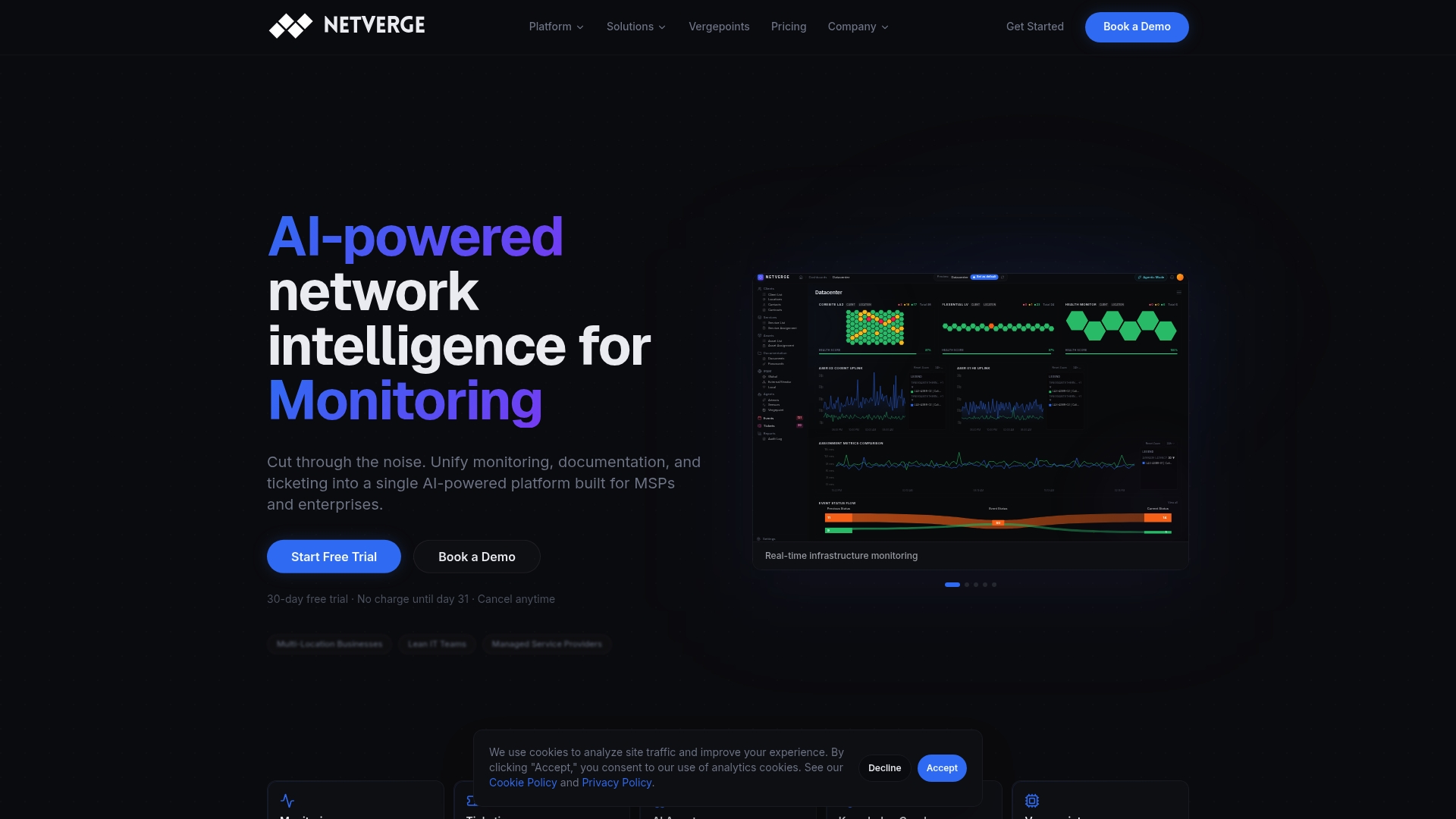
Its knowledge graph keeps your topology grounded in real device relationships, while Hardware Vergepoints add physical-layer visibility that pure software tools can't match on their own. If you're evaluating professional help to get your rollout moving faster, partners like NEXTmsp's AI transformation services can support the operational side of that shift.
If you're ready to see how it fits your environment, the Starter Package runs $299 per month, or you can start a free trial to test mapping and monitoring against your own network first.
Sources
FAQ
Is There an AI Tool for Network Mapping?
Yes, several platforms now generate network diagrams from text descriptions, configuration files, or discovery data instead of requiring manual drawing. Tools range from standalone diagram generators to integrated platforms like Netverge that pair mapping with live monitoring and a knowledge graph for ongoing accuracy.
Which AI Tool Is Best for Creating Network Diagrams?
The right choice depends on whether you need a one-off diagram or a living map that updates with your infrastructure. For MSPs and multi-site enterprises that need maps tied to real-time telemetry and ticketing, an integrated platform like Netverge tends to deliver more operational value than a standalone diagram generator, since isolated mapping tools show lower returns when they aren't connected to monitoring and ticketing workflows.
What Is the Best Free Tool for Network Mapping?
Free options generally rely on basic SNMP or LLDP discovery combined with open diagramming software, which works for small, single-site networks but struggles with overlay-heavy or multi-tenant environments. For anything beyond a small lab or branch office, the manual verification burden on free tools usually outweighs the cost savings.
What Is the Best AI Tool for Networking Overall?
There's no single universal answer since needs vary by network size and complexity, but the strongest tools combine RAG and knowledge graph grounding with real device telemetry rather than relying on text parsing alone. Platforms that integrate mapping with monitoring and automated ticket triage, such as Netverge, cut down the manual reconciliation work that standalone mapping tools leave to your team.
How Do I Know If an AI-Generated Map Is Accurate?
Run the map through reconciliation checks against your device inventory, interface tables, and routing adjacencies before trusting it for change planning. Automated cross-checks against a second data source, like SNMP or CLI output, catch most parsing errors that a visual review alone would miss.